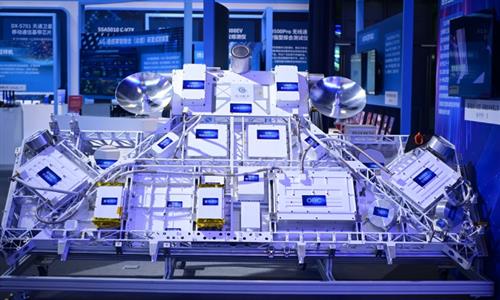
6G Photo: VCG
China's first Pre-6G test network was officially put into operation in Nanjing, the capital city of East China's Jiangsu Province, on Tuesday, according to CCTV News. A Chinese industry analyst said that the move represents another step closer for 6G technology toward real-world applications.
The test network integrates 6G innovative technologies into the existing 5G network and features high bandwidth, long-range coverage, deterministic low latency, and native artificial intelligence (AI) integration, with capabilities reportedly up to 10 times those of 5G, according to CCTV News.
The test network has been conducting systematic verification in areas such as low-altitude inspection, industrial manufacturing, embodied intelligence, and holographic communications. It marks a shift of 6G technology from key technology validation to a new stage of system-level capability verification, laying an important foundation for future 6G standardization and industrial applications, said the report.
There is already 5G-Advanced (5G-A), which is the evolutionary stage of 5G networks, and the emergence of Pre-6G means integrating 6G-related technologies into existing 5G networks to enhance current network capabilities, Ma Jihua, a veteran market analyst, told the Global Times on Tuesday.
Ma said that the significance of this kind of trial lies its ability to test and apply certain 6G standards. It also better address the growing demand for more advanced communication technologies from key sectors such as new materials, new energy, the low-altitude economy, and aerospace during the 15th Five-Year Plan (2026-30) period.
China has already established the world's largest 5G network, with large-scale deployment accelerating in key sectors such as industry, mining, power, and healthcare, according to industry data, which provides a certain foundation for the evolution toward 6G.
Speaking at a press conference on Tuesday, Xie Cun, head of the bureau for information and communications development of the Ministry of Industry and Information Technology, said that as of the end of March, the total number of 5G base stations across China reached 4.958 million. Meanwhile, 5G-A has now covered 330 cities.
The development of 5G has also driven progress in multiple fields, including AI and the industrial internet, gradually giving rise to future demand for 6G, Ma said. On this basis, through the continuous evolution of 5G and Pre-6G, there is potential to establish a certain first-mover advantage in future 6G standard-setting, the expert said.
According to the 15th Five-Year Plan, the government vows to push forward technological research, product development, enterprise cultivation, and ecosystem building in multiple fields, including 6G technology.
As the country enters the next five-year plan starting this year, new applications such as robotics and AI are expected to emerge, creating more opportunities for the development of 6G technologies and providing stronger momentum for the real economy, said Ma.
RELATED ARTICLES