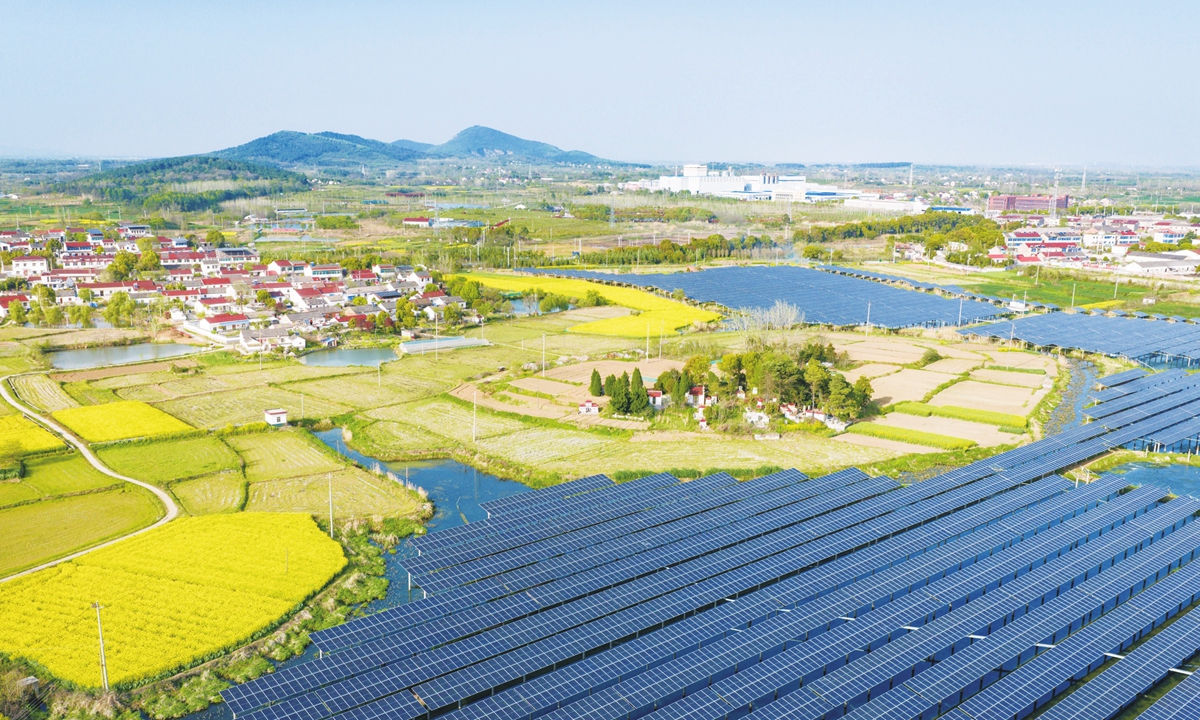
Photovoltaic panels are neatly arranged among the surrounding green scenarios in He county of Ma'anshan city, East China's Anhui Province on April 5, 2026. Photo: VCG
Global renewable energy capacity maintained double-digit growth in 2025 despite headwinds such as supply chain constraints, with China continuing to drive global renewable deployment, according to the International Energy Agency's (IEA) latest annual assessment.
The findings underscore a broader shift in the global energy landscape. As the share of new energy continues to rise, analysts say China is emerging as a key force behind changes in the global energy structure.
At the COP28 climate summit in Dubai in 2023, governments agreed to work toward tripling global renewable energy capacity by 2030, a target that has since become a key benchmark for measuring the pace of the global energy transition.
The IEA said annual global renewable capacity additions reached a record 800 GW in 2025, with solar accounting for 75 percent of the increase, showing that renewable deployment has continued to accelerate despite policy uncertainty and grid-related constraints.
According to the IEA's Global Energy Review 2026, released on Monday, global renewable capacity additions rose 16 percent in 2025 despite supply chain strains, grid delays, financial pressures and policy shifts, marking a 23rd consecutive year of record expansion.
Solar PV and natural gas led the growth. Solar PV alone met more than one-quarter of global primary energy demand growth, marking the first time on record that a modern renewable source accounted for the largest share of global energy demand growth, according to the report.
Natural gas followed, meeting around 17 percent of global demand growth. In all, low-emissions sources - including solar, wind, nuclear, hydropower and other renewables - together contributed nearly 60 percent of the increase in global energy demand.
Within this broader trend, China remained central. As in 2024, the country accounted for the largest share of global energy demand growth in 2025, although its growth rate slowed to 1.7 percent, reflecting the rapid expansion of renewables and gains in energy efficiency.
At the same time, strong growth in renewable power generation in China helped curb coal consumption, with a knock-on effect of improving primary energy intensity, the IEA noted.
Zhou Mi, a senior research fellow at the Chinese Academy of International Trade and Economic Cooperation, told the Global Times on Tuesday that the global energy system is accelerating its shift from fossil fuels to renewables — a transition that has entered a substantive phase. This is reflected in the rising share of renewables in new power generation, a trend that is beginning to reshape the existing energy mix.
Once renewables surpass conventional sources, they will trigger broader structural changes in both the energy system and industrial landscape, Zhou said. He added that China plays a particularly important role in this process, reducing its reliance on fossil fuels while scaling up renewables and helping drive changes in the global energy mix.
The IEA report also showed that renewable capacity expansion in China continued to accelerate in 2025, reaching a record level with nearly 500 gigawatts (GW) of new installations, accounting for more than 60 percent of global growth.
Meanwhile, global coal-fired power generation declined in 2025 for the first time since 2019. China led this trend, with coal power generation falling by about 1.5 percent, the report said.
Developments in other low-carbon sources further reinforced the shift. Global nuclear capacity stood at 420 GW at the end of 2025, while nuclear generation rose by around 1.2 percent to a record high. Of the 10 construction starts worldwide in 2025, nine were in China, and the country's total installed capacity is expected to reach around 100 GW by 2030, according to the IEA.
In parallel, growth in global energy-related carbon dioxide emissions slowed further in 2025, increasing by about 0.4 percent. Emissions in China declined by around 0.5 percent, reflecting reductions in both industrial processes and electricity generation.
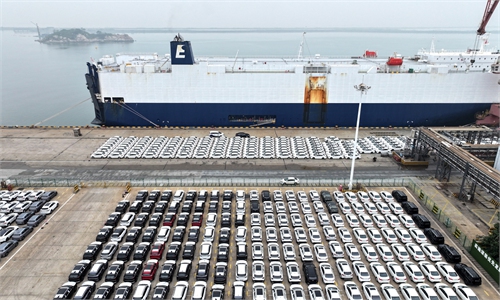
This was mainly driven by rapid growth in renewables and nuclear energy, which reduced coal use in power generation, while strong growth in electric vehicles helped curb oil demand. A relatively limited increase in cooling degree days also tempered the rise in electricity demand, according to the IEA report.
Zhou said that as resource constraints tighten and environmental pressures mount, China's rapid scaling-up of renewables offers a practical and replicable path for other countries, urging stronger international cooperation and long-term, multi-stakeholder frameworks to sustain the global energy transition.
RELATED ARTICLES