SPORT / BASKETBALL
Chinese basketball legend Wang Zhizhi inducted into FIBA Hall of Fame
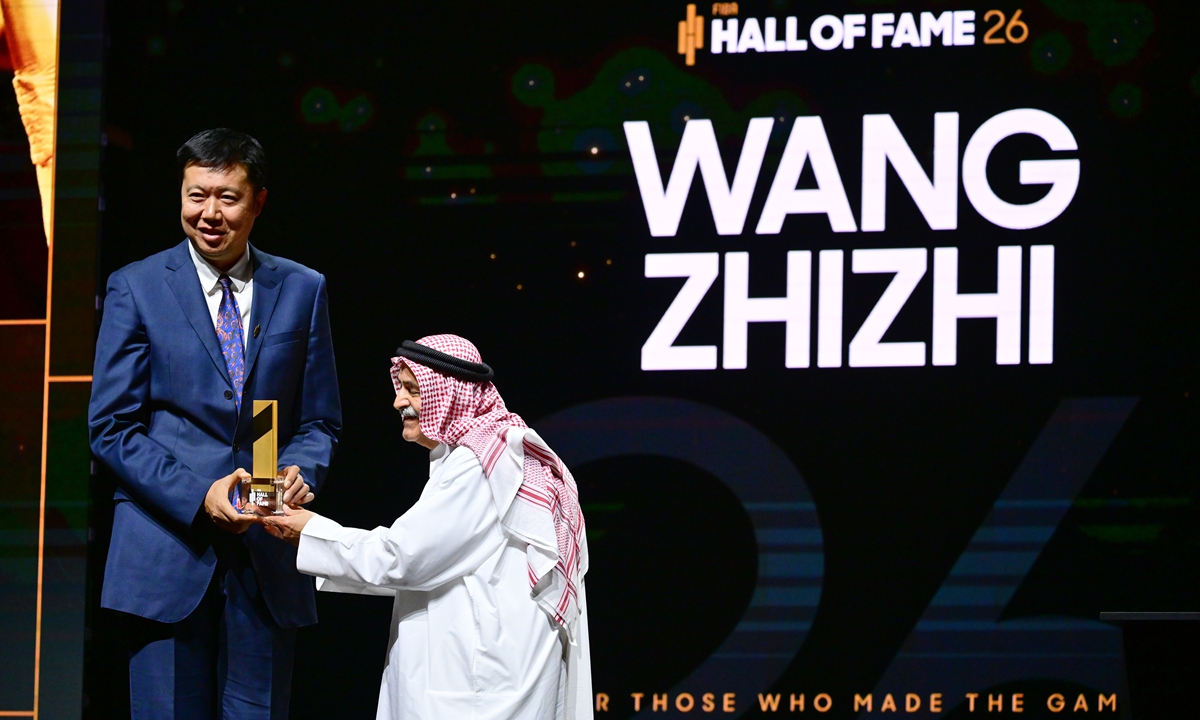
Chinese basketball legend Wang Zhizhi (left) receives an award from FIBA President Sheikh Saud Ali al Thani during the induction ceremony into the FIBA Hall of Fame on April 21, 2026, in Berlin, Germany. Photo: VCG
Chinese basketball legend Wang Zhizhi has been officially inducted into the FIBA Hall of Fame as part of the Class of 2026, marking another milestone for Chinese basketball and highlighting the legacy of one of the country's most influential players.
The induction ceremony took place in Berlin on April 21, where Wang was formally honored for his contributions to the sport both in China and internationally.
"I deeply understand that without the nurturing of my country, I would not have achieved what I have today. Every time I wore the national team jersey and fought on the court, the sense of mission to win glory for the nation inspired me to keep moving forward," Wang said at the ceremony.
"This honor belongs to Chinese basketball and to everyone who has contributed to its development. Let us continue to dedicate our efforts to the growth of Chinese basketball, and I hope that more young Chinese players will shine on the world stage in the future."
Wang becomes the fifth Chinese basketball figure to enter the FIBA Hall of Fame, following pioneers including Mu Zuoyun, Zheng Haixia, Yao Ming and Miao Lijie.
The Chinese Basketball Association (CBA) has sent a congratulatory message following the announcement in December 2025, praising Wang's career as a reflection of the dedication and perseverance of an entire generation of Chinese basketball players.
In its congratulatory letter, the CBA said Wang's induction "is not only an affirmation of his professional career, but also a recognition of the dedication and perseverance of a generation of Chinese basketball players."
The association expressed hope that younger athletes would follow the example set by earlier stars and continue to advance the development of the sport in China.
Born in Beijing, Wang emerged as one of the most talented players of his generation. He joined the Chinese national team in 1994 and went on to become a central figure in the squad during a period when China consistently ranked among the top teams in Asia.
He represented China at four Olympic Games and helped the national team reach the quarterfinals at the 1996 Summer Olympics and the 2008 Summer Olympics, two of the best results in the team's history.
At the continental level, Wang was a key contributor to China's dominance in Asia. During his national-team career, China won four FIBA Asia Championship and three Asian Games titles, with Wang playing a major role as one of the team's most reliable scorers and interior presences.
Wang also holds a special place in the history of Chinese basketball for his pioneering role abroad. In 2001, he became the first Chinese player to compete in the National Basketball Association, opening the door for stars such as Yao Ming to follow. During his time in the league, he played for teams including the Dallas Mavericks, Los Angeles Clippers and Miami Heat.
Before and after his NBA stint, Wang built a decorated domestic career in China. Playing for the Bayi Rockets, he helped the club win seven league titles and established himself as one of the most dominant players in the CBA league. He also earned regular-season and finals MVP honors during his time in the domestic competition.
After retiring from professional play, Wang remained involved in the sport, including serving as head coach of the Bayi men's team and continuing to contribute to the development of younger talent in China.
RELATED ARTICLES