PLA Navy’s new film marks anniversary, urges ‘Xiaowan’ (Taiwan) to return to motherland
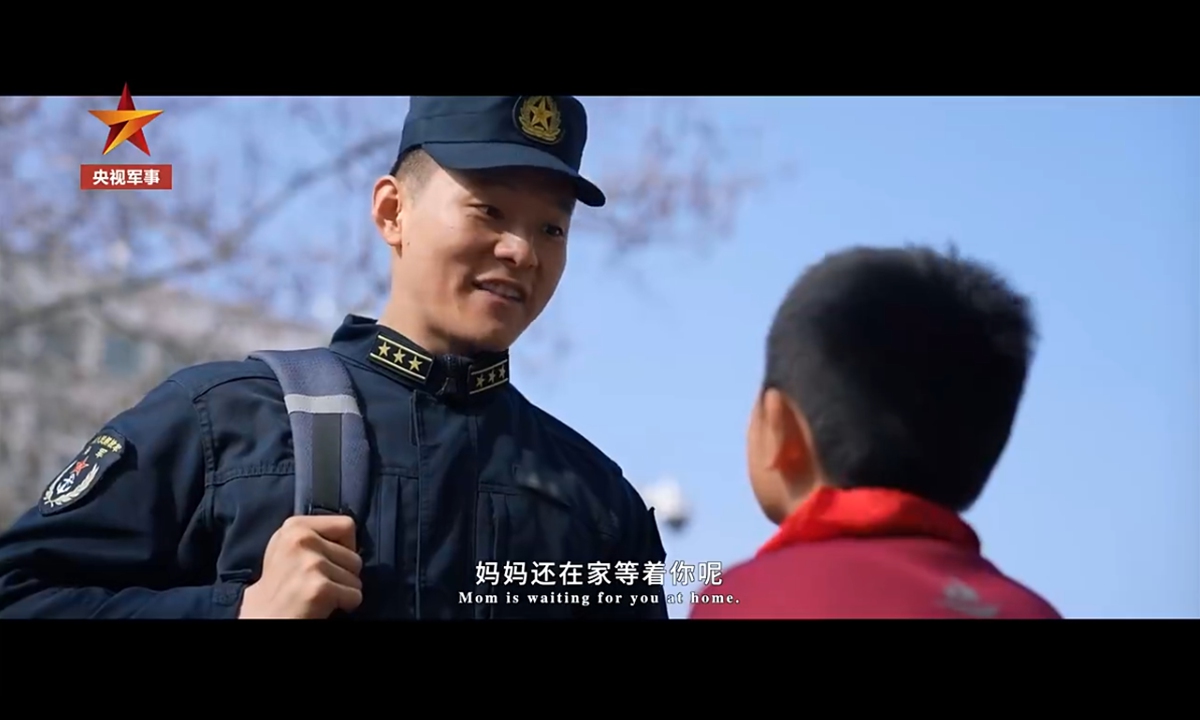
Chinese People's Liberation Army (PLA) Navy releases a promotional film titled Sailing Toward the Ocean to mark the 77th anniversary of its founding on April 22, 2026. Photo: Screenshot from Sailing Toward the Ocean
Marking the 77th anniversary of its founding on Wednesday, the Chinese People's Liberation Army (PLA) Navy released a promotional film titled Sailing Toward the Ocean, highlighting its leapfrog development from a modest origin to a modern force under the leadership of the Communist Party of China. The film features four generations of naval personnel and concludes with a symbolic "Easter egg" alluding to the eventual reunification of Taiwan island with the motherland.
The film opens with scenes of modern naval warfare, while a compass serves as the "soul" running throughout the storyline. It traces a clear chain of mentorship across generations of servicemen: Liao Ning, a former crew member of the Changjiang gunboat, mentors submarine captain Shan Dong, who in turn passes the compass to Fu Jian, deputy navigation officer of the Anshan destroyer.
The compass, a recurring motif in the film, symbolizes unwavering faith and direction. "This compass is the light in my heart. Even in the deep ocean, it shows me the way," Shan says following a successful anti-ship missile launch in the western Pacific. Echoing the sentiment, Liao adds, "I have never lost my way — when there is light in your heart, your course will not stray."
The transmission of the compass symbolizes the inheritance of faith and spirit across generations. "The 'compass' and 'light' in the film demonstrate that generations of naval personnel have remained steadfast in following the Party's leadership and commands, ensuring they never lose direction on long voyages, while upholding the fundamental purpose of serving the people, resolutely safeguarding national sovereignty and security," military affairs expert Zhang Junshe told the Global Times on Wednesday.
Zhang noted that while the Changjiang was only a few-hundred-ton gunboat, the film features coordinated operations involving submarines, the Anshan, the aircraft carrier Shandong, surface combatants, marines, coastal defense forces, and naval aviation. "The PLA Navy has grown from a modest force centered on a small gunboat into a modern navy encompassing five major service arms. Under the Party's leadership, it has achieved leapfrog development from nothing to something, from small to large, and from weak to strong," he said.
A detail in the film has drawn attention from viewers. The four protagonists are named Liao Ning, Shan Dong, Fu Jian, and a new recruit, He Jian. Observant netizens noted that the names are homophones for Liaoning, Shandong, and Fujian — coinciding with the Navy's aircraft carriers. Some suggested that the name of the new recruit may hint at further expansion of China's carrier fleet.
The "Easter egg" in PLA Navy promotional films has become something of a tradition, and the ending of this latest release is rich with symbolism. The scene shifts to Tongyi Road Primary School in Weihai, where submarine captain Shan Dong picks up his son, nicknamed Xiaowan, after school. The setting — "Tongyi (Unity) Road" — is self-explanatory. The boy's nickname, Xiaowan, is widely seen as a reference to Taiwan island.
The seemingly ordinary dialogue also carries deeper meaning. "Dad, I don't want to go home yet. I want to play outside a little longer," Xiaowan says, to which Shan Dong replies, "Don't be naughty — your mom is still waiting for you at home."
Many netizens interpreted the exchange as an allegory alluding to "Lai Ching-te" (a pun on "being willful") and "returning home." It conveys a simple yet firm message: No matter how long the "child" stays out, it will eventually return home, where the motherland awaits. This narrative echoes the PLA Navy's robust drills in the western Pacific — suggesting that strong military capability underpins the assurance of a safe return.
Zhang Junshe said the film's details — from the line "your mom is waiting at home" to the father's affectionate gesture of tapping the child's nose — reflect that the mainland views Taiwan as part of a shared family and expresses goodwill.
"Achieving complete national reunification is an inevitable requirement for the great rejuvenation of the Chinese nation. The Lai Ching-te authorities and 'Taiwan independence' separatist forces must not persist in their mistaken course or drift further down the path of splitting the country," Zhang said.
Zhang added that the mainland's goodwill and restraint are not without limits, and that all moves by "Taiwan independence" forces remain under control. "We urge relevant forces to return from their misguided path and come to their senses. The motherland's door is always open, and it looks forward to the early reunion of compatriots on both sides of the Taiwan Straits," he said.
RELATED ARTICLES