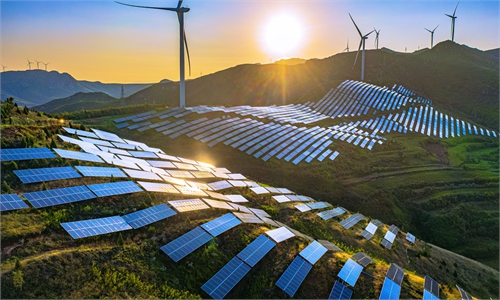
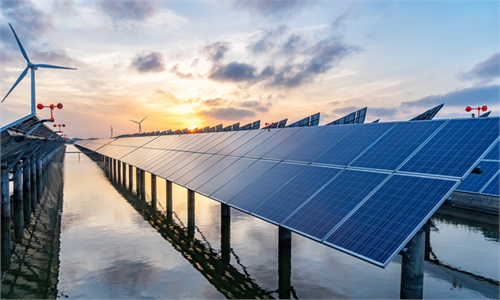
The sheep beneath the photovoltaic panels hint at what else a solar park can yield
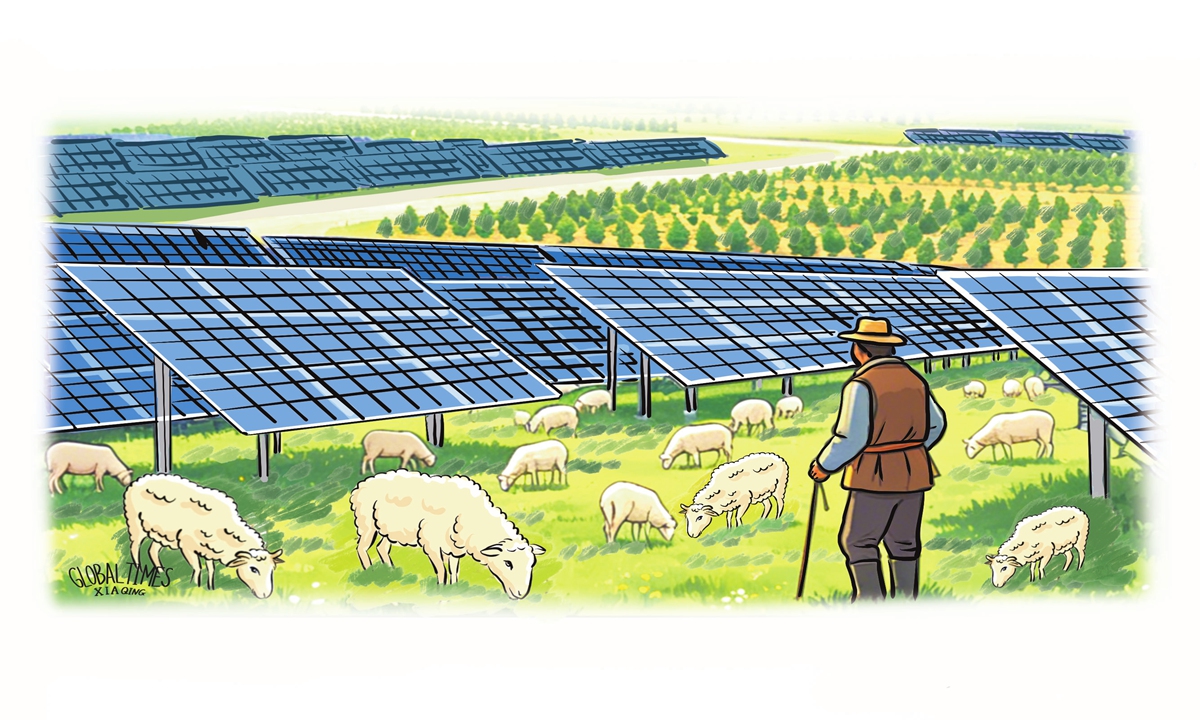
Illustration: Xia Qing/GT
In Northwest China's Qinghai Province, two pursuits that rarely intersect in the popular imagination - photovoltaic (PV) panels and sheep herding - have settled into a practical coexistence. Across what is reported to be the world's largest solar park by installed capacity, sheep graze beneath the panels, keeping the grass short enough that it never rises to block the light. The sheep, for their part, gain a generous stretch of pasture, while the herders who tend them secure a durable source of income. That loop of mutual benefit is one local example of a broader effort to align solar expansion with desert control - one that, in turn, enlarges the economic logic of the renewables build-out itself.According to a CCTV documentary, the site began as barren ground. Every few weeks, workers wash the panels to clear off dust and the water leaves the soil slightly damp. With the dense panel arrays in place, wind speeds have dropped by half, and soil evaporation is down by roughly 30 percent. Within a few years, vegetation cover has topped 80 percent. To keep the grass from shading the panels, sheep were brought in, turning a maintenance problem into a grazing opportunity.
This model fully leverages the complementary resource advantages of PV systems and desert control, achieving environmental protection and economic growth objectives simultaneously: generating solar power, curbing desertification, and enabling livestock farming. In a September 2025 report, the Xinhua News Agency dubbed this model the "photovoltaic + desert control" model. Through this model, some regions in China are turning deserts into oases and transforming sunlight into a new engine for green development.
Behind this model lies scientific wisdom. Deserts, with their vast expanses and abundant sunshine, provide the land and solar resources needed for PV power generation. While absorbing sunlight to generate electricity, the panels also shade the plants growing beneath them, reducing water evaporation and improving the growing environment. Water used to clean the PV panels can also be used to irrigate vegetation, enabling water recycling. Moreover, livestock and poultry manure are returned to the fields to improve sandy soil, aiding desert control efforts.
China's renewable capacity is expanding, and solar is part of that build-out. The build-out adds momentum to the energy transition and to economic growth more broadly. As PV capacity expands, another question worth watching is whether, and how, that expansion can foster ancillary industries and deliver ecological and economic benefits. In parts of China, local efforts are already yielding results.
Deep in the Kubuqi Desert, in Hanggin Banner, North China's Inner Mongolia Autonomous Region, a PV and desert control project has an installed capacity of 2,000 megawatts. At the project, local farmers and herders, under the guidance of desert control experts, raise chickens beneath the PV panels and grow plants such as tomatoes, potatoes, and woad root, generating economic returns. Additionally, according to the Xinhua News Agency, the Kubuqi photovoltaic desert control project can generate approximately 4.1 billion kilowatt-hours of electricity annually, saving about 1.23 million tons of standard coal and reducing carbon dioxide emissions by roughly 3.19 million tons each year.
The approach marries renewable expansion to ecological and economic gain. Variations of it are now taking shape elsewhere in China, each tailored to local conditions.
In Northwest China's Xinjiang Uygur Autonomous Region, there are also some successful practices of this "photovoltaic + desert control" model. According to a Xinhua report in September 2025, an area 15 kilometers east of Lop County, on the southern edge of the Taklamakan Desert in Xinjiang - once plagued by desert - has become an example of integrated development featuring PV systems, greenery, and livestock farming. Beneath the PV panels, cash crops are being experimentally cultivated, while chickens and sheep are raised, generating economic returns.
Beyond China, solar power is also part of the renewables build-out. The question of how to pair it with other activities - and generate additional ecological and economic benefits in the process - is not confined to one country. On that front, the efforts unfolding in China offer a valuable reference.
The build-out of renewable energy leaves room for cooperation between China and other economies. Some of the techniques and experience China has built up in scaling solar power could find use elsewhere, contributing to the growth of renewable capacity in those markets.
The author is a reporter with the Global Times. bizopinion@globaltimes.com.cn
RELATED ARTICLES