China will take measures to safeguard firms’ rights, interests, if they face discriminatory treatment under EU’s revised Cybersecurity Act: MOFCOM
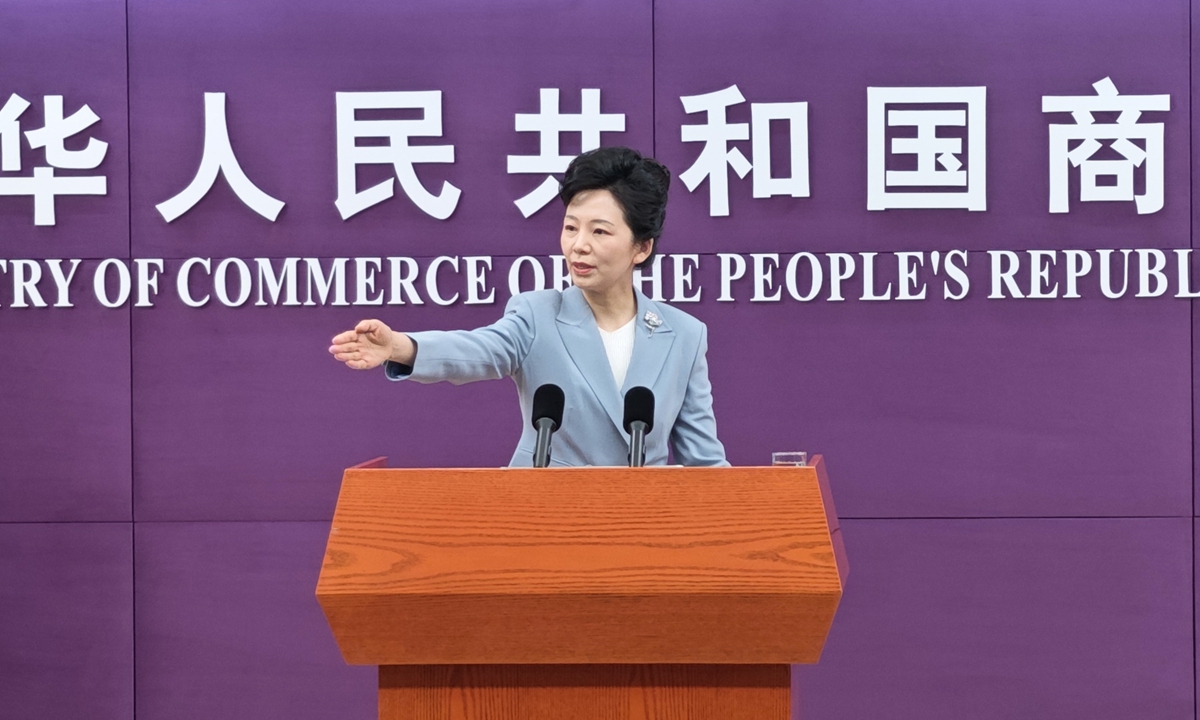
China's Ministry of Commerce spokesperson He Yongqian Photo: Yin Yeping/GT
If Chinese enterprises face discriminatory treatment as a result of the EU's revision of the EU Cybersecurity Act, China will take countermeasures in accordance with the Foreign Trade Law and regulations on industrial and supply chain security to safeguard the legitimate rights and interests of its enterprises, a spokesperson for the Ministry of Commerce (MOFCOM) said on Thursday.
The remarks were made in response to a question about whether the MOFCOM could provide further details on the specific countermeasures China is considering if the EU revises its Cybersecurity Act and adopts discriminatory treatment against Chinese companies.
MOFCOM spokesperson He Yongqian said at a regular press conference that on April 17 the MOFCOM had officially submitted comments to the EC regarding the proposal for revision of the EU Cybersecurity Act, outlining its grave concerns and official position.
"We hope that the EU side will attach great importance to and carefully consider the comments and amendment suggestions submitted by China," He Yongqian said.
The Chinese side believes that cooperation and dialogue represent the correct approach to resolving China-EU issues, and is willing to properly manage differences through consultations with the EU to jointly maintain the stability and smooth flow of global industrial and supply chains, the spokesperson said.
On January 20, the EU released a draft amendment to the Cybersecurity Act, mandating that member states exclude so-called "high-risk suppliers" from 18 critical sectors, including energy, transport, healthcare, and information and communications technology services management.
In the comments submitted to the European side, China stated that the draft contains multiple issues, according to the spokesperson.
First, it is suspected of violating core World Trade Organization (WTO) principles such as most-favored-nation treatment and national treatment. It is also inconsistent with several WTO agreements, including the General Agreement on Tariffs and Trade 1994, the General Agreement on Trade in Services, the Agreement on Subsidies and Countervailing Measures, and the Agreement on Technical Barriers to Trade, as well as the EU's own commitments on services trade liberalization.
Second, the MOFCOM noted that it is believed to go beyond the legal mandate of the EU and encroach on the exclusive authority of member states in managing national security affairs.
Third, it is expected to cause substantive damage to China-EU economic and trade relations, severely disrupt global industrial and supply chains, and ultimately hinder the EU's own digital and green transformation process.
China suggested that the European side delete provisions in the draft concerning "countries of cybersecurity concern" and "non-technical risks," and remove or substantially revise the criteria for identifying "high-risk suppliers" as well as the related restrictive measures, said the spokesperson.
Chinese experts have reiterated that the regulation lacks clear technical definitions, and its use of "high-risk" designations constitutes pure political manipulation.
Cybersecurity is a global common concern, and China has always attached great importance to cybersecurity, Jian Junbo, director for the Center for China-Europe Relations at Fudan University's Institute of International Studies, told the Global Times on Thursday.
This essentially politicizes cybersecurity issues as a purely political maneuver, rather than being grounded in objective technical assessments, Jian said. "It runs counter to WTO rules and the principles of fair market competition, which is the core reason for our doubts."
Jian called on the EU to view cybersecurity from a pragmatic perspective. He urged resolving differences through proper channels such as joint technical investigations, professional research and multilateral political consultations, and opposed disrupting market cooperation on unwarranted grounds.
RELATED ARTICLES