Facing legal principles, ‘Taiwan independence’ has no ‘international space’ at all: Global Times editorial
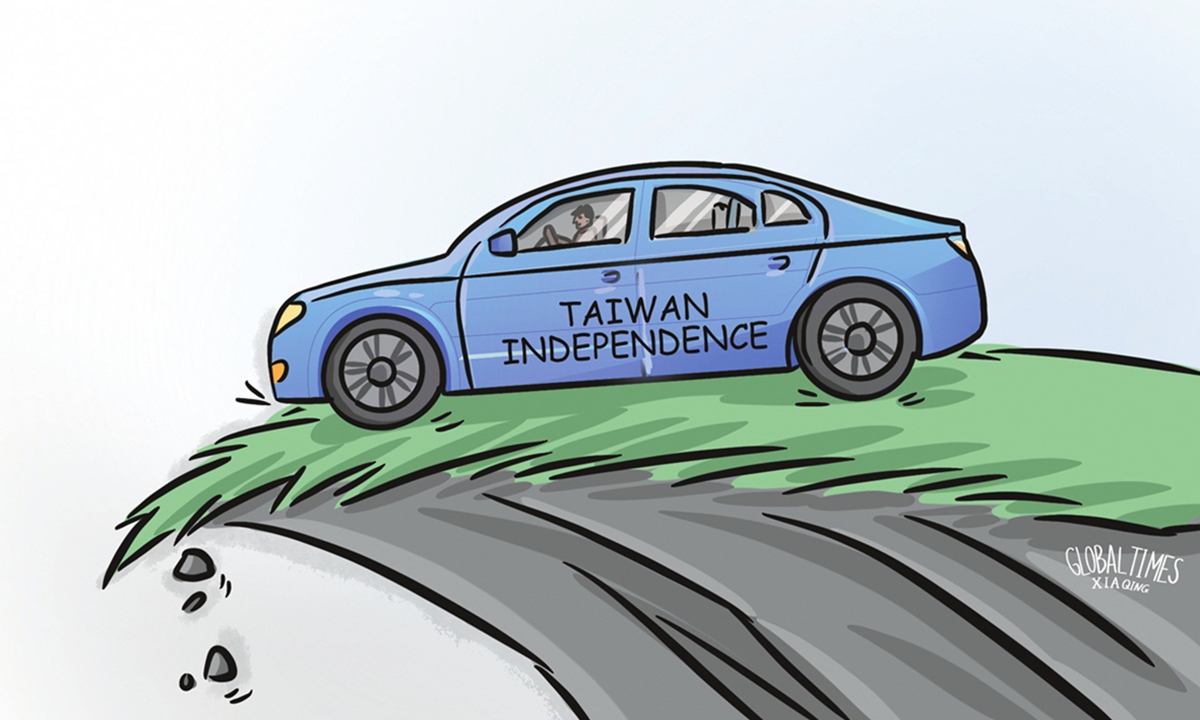
Illustration: Xia Qing/GT
Recently, the three sovereign countries of Seychelles, Mauritius, and Madagascar, acting in accordance with the one-China principle, lawfully denied flyover permission to the charter flight of Taiwan regional leader Lai Ching-te. His political farce of planned provocative visit to the African country of Eswatini, which has not yet started, has been forced to end in an embarrassing flop. Facts have once again proven that the one-China principle is a basic norm of international relations and a broad consensus of the international community. The separatist schemes of "Taiwan independence" forces are nothing more than a mantis trying to stop a chariot - they are doomed to fail.
The latest setback met by Lai is by no means an isolated case, but rather the most recent example of how the "Taiwan independence" separatist forces are becoming ever more isolated internationally and finding themselves increasingly unable to move forward. Multiple events in recent years have long confirmed this trend. In 2025, the South African government relocated Taiwan's so-called "representative office" in Pretoria to Johannesburg and renamed it the "Taipei Commercial Office." In the same year, Lai, who had planned to visit Taiwan's so-called "diplomatic allies" in Central and South America, was forced to cancel the trip after reports emerged that the US government had refused to allow him to "transit" through New York. In 2026, the Lithuanian prime minister has also admitted that its previous decision to allow Taiwan regional authorities to establish a so-called "representative office" was a mistake and has begun to correct it. Recently, Brazil's "representative in Taiwan" reiterated that Taiwan is part of China during an interview with local media. These cases all unequivocally signal the complete failure of "Taiwan independence" attempts to expand its so-called "international space."
After the visit plan collapsed, the DPP authorities and their external backers, as usual, quickly resorted to their standard "blame-shifting" tactic, accusing the Chinese mainland of "economic coercion" and "pressure." At the same time, individual countries, acting out of geopolitical self-interest, have seized the opportunity to play the "Taiwan card," interfere in China's internal affairs, and indulge and support "Taiwan independence" separatist forces. For example, the US State Department expressed "concern" over the matter. The US' finger-pointing at China's legitimate actions to safeguard national sovereignty and territorial integrity, as well as its criticism of relevant countries for upholding the one-China principle, is a blatant attempt to confuse right and wrong and turn black into white.
In fact, all 53 African countries except Eswatini have established diplomatic relations with China. Together with the African Union, they adopted the Beijing Declaration at the 2024 Summit of the Forum on China-Africa Cooperation and have on multiple occasions reaffirmed their firm adherence to the one-China principle. The ratio of 53 to 1 speaks volumes about Africa's overwhelming position on the Taiwan question. The actions of Seychelles, Mauritius, and Madagascar fully demonstrate their commitment to justice and their adherence to their promises.
Portraying African sovereign states' lawful exercise of their airspace management rights and their defense of diplomatic principles as "being coerced" is not only disrespectful to the countries concerned, but also blatantly tramples on international law and the basic norms of international relations.
There is no such position as "President of the Republic of China" in today's world. Anyone claiming that title is acting against the tide of history and will only bring embarrassment upon themselves. The DPP's tactic of shifting blame has long become stale rhetoric. It deceives neither the international community nor the people on the island. Taiwan's economy is highly dependent on the mainland, and its security and public well-being are tied to cross-Straits peace and development.
A recent poll released by the Taiwan Democracy Foundation shows that 50.7 percent of respondents support the view that Taiwan must proactively face reunification as a way to safeguard its security and future. Increasingly, Taiwan compatriots are recognizing that the so-called "resist mainland, protect Taiwan" approach is in fact a path that harms Taiwan.
At present, the one-China principle has become a universal consensus of the international community. The communiqués establishing diplomatic relations between China and its 183 diplomatic partners, together with a series of documents possessing international legal force - including the Cairo Declaration, the Potsdam Proclamation, the Japanese Instrument of Surrender, and UN General Assembly Resolution 2758 - have laid a solid historical and legal foundation for the fact that Taiwan is an inalienable part of China's territory.
The DPP authorities' so-called "protests" and "accusations" are merely desperate cries which show that they have run out of tricks, reinforcing their role as "destroyer of cross-Straits peace," a "creator of Taiwan Straits crises," and a "troublemaker." These actions cannot shake the international community's basic pattern of upholding the one-China principle, let alone halt the unstoppable historical trend toward China's eventual and inevitable reunification.
Encountering setbacks in Africa is a lesson the international community has delivered to "Taiwan independence" separatist forces. The reasonable and lawful actions taken by the three African countries have added another "solid brick" to the international community's collective effort of building a "wall" against "Taiwan independence."
This demonstrates that every reckless move by "Taiwan independence" forces will only invite stronger resistance and deeper isolation. The Chinese government has the firm will, full confidence, and sufficient capability to safeguard national sovereignty and territorial integrity. We urge relevant countries to adhere to the one-China principle, handle Taiwan-related questions prudently and properly, and refrain from providing any support or facilitation for any form of separatist activities.
RELATED ARTICLES