ARTS / CULTURE & LEISURE
A person with disabilities brings warmth to others by sharing reading
Spreading love and power
Editor's Note:
Chinese President Xi Jinping has said, "reading can inspire the mind, help people form lofty ideals, and foster a strong sense of integrity."
The fragrance of books carries us the farthest. Reading is not only a vital ladder for personal growth and self-improvement, but also a force that nurtures the cultural atmosphere of society and the spiritual character of a nation.
Recently, People's Daily reporters approached several book lovers. Some have transformed their lives through reading, while others use books to light up the dreams of children in rural areas. Let us explore their stories of enriching the soul with the scent of books and illuminating life through reading.
In 1988, Wu Siyu, born in Nanchang, East China's Jiangxi Province, was left with lifelong cerebral palsy due to premature birth, suffering from severe visual and physical impairments. From the very beginning, fate seemed to have closed a door on her.
"My hands are constantly cramped and curled, like chicken claws. I can't walk independently, and my vision is very blurry," Wu said with a smile, without a trace of resentment.
"The hardest part of my childhood was rehabilitation therapy. Doctors would force my spastic legs apart and then bind them tightly with bandages for 40 minutes - it was excruciating," Wu said, glancing at her mother Zhou Pinglan. "Whenever the pain became unbearable, my mom would sit by my bedside and read to me."
Zhou's eyes grew moist as she gently held her daughter's hand. "Seeing her in such pain, there was nothing I could do but try to distract her. I read her magazines and essays, and little by little, she would calm down."
"Books felt like magic," Wu said, her eyes lighting up with childlike sincerity. "Once the words reached my ears, the pain seemed to ease. Back then, I felt that reading was my painkiller."
At the age of seven, Wu entered school. Her deformed hands could barely hold a pen, and even the simplest writing felt like an impossible task.
"Every day, my mom would pry open my fingers one by one, help me grip the pen, and then hold my hand tightly as she guided me stroke by stroke," Wu said, raising her right hand and gesturing gently. "It took me half a year just to learn how to write the number '2.'"
"No matter how hard it was, I couldn't let my child grow up without education or books," Zhou said firmly. "Books can give her strength and help her become confident."
In primary school, when her math teacher saw her struggling with her studies, the teacher quietly handed her a copy of How the Steel Was Tempered, a novel detailing the troubled life of soldier named Pavel Korchagin.
"The teacher didn't say a word, but that book changed me," Wu recalled. "Even Pavel Korchagin, who became blind and completely paralyzed, never bowed to fate. Compared to that, what are my difficulties?"
With her family's support, the care of her teachers, and the nourishment of books, Wu overcame challenges that most people could hardly imagine and completed her education. In 2007, she was admitted to Jiangxi Engineering Vocational College to study Chinese language and literature, and in 2011, she was admitted to the Open University of China to pursue a bachelor's degree in education management. There is no complaint or despair in her, only an optimistic and resilient outlook on life.
Sharing the warmth of reading
After graduating from college, Wu set out to find a job but faced rejection after rejection. Struggling to come to terms with the setbacks, she turned once again to How the Steel Was Tempered in search of answers. "This time, I truly understood the protagonist's inner tenacity and perseverance," she said.
Later, she pulled herself together and opened a small sports lottery shop near her home. "Running this shop gave me something to do," she said. Wu managed the little store with great enthusiasm.
Gradually, it became more than just a shop. Nearby sanitation workers would drop in to rest and chat during breaks, turning it into a caring rest stop. Neighbors in a hurry would leave their children there for a while, and the shop would become a temporary daycare. When no one was home to receive deliveries, it also served as a parcel drop-off point for the neighborhood.
As the saying goes, "When you give others a rose, the fragrance lingers in your own hands." "While passing on luck, joy, and a sense of security, the warmth of love also nourishes me," Wu said. Having received so much help herself, she is determined to give back by taking part in public welfare. She joined a reading club for people with disabilities in Nanchang and the disabled persons art troupe in Donghu district, where she reads aloud and shares reflections with those who have limited mobility.
When she learned that the Spiritual Wealth Club (a Chinese knowledge-sharing platform) supports people with disabilities in reading, her eyes lit up. "Such a wonderful opportunity. I want to help more people get close to books and experience their beauty!"
Invited to share her story on stage as a "Reading Star," Wu offered words that were simple yet powerful: "Reading helps us step out of isolation and overcome feelings of inferiority, allowing us to see a broader world. As long as we start reading, there is hope in life."
Wu insisted on sharing classical Chinese literature, revolutionary-era family letters, and inspirational essays every day in WeChat groups, opening a window to knowledge for people with disabilities who cannot read with ease. She also took part in a charity program, lending her voice to children in mountainous areas and to visually impaired children. Moving between schools, communities, and libraries, she shares her story, encouraging more people to face challenges with courage and develop a love for reading.
Inspired by her efforts, a strong reading culture has taken root in the community. More and more people with disabilities are stepping out of their homes and embracing reading, while an increasing number of residents are moved to take part in volunteer work, supporting people with disabilities and reading alongside them.
"Immersed in the fragrance of books, the heart finds a place to rest," Wu said, gazing out the window as the spring sunlight fell on her face, warm and radiant. "I want to share the warmth of reading with more people who need it."
Illuminating others
Wu, who has a deep love for recitation, once learned by chance that the city was hosting a recitation competition. "At the time, I was a complete beginner. I didn't even understand terms like pauses or emphasis," she said with a playful blink. "I just thought, why not give it a try?"
Over four months, from the preliminary rounds to the semifinals and then the final, she made her way through each stage. "When the awards were announced, I was completely stunned," she said, clutching her chest, her voice filled with disbelief and excitement. "I won second place and I was the only individual contestant with a disability in the final!"
She still remembers the judge's comment to this day: "You may not have professional techniques, but your expression carries sincerity and strength." The words moved her to tears. "It was recitation that gave me strength, and reading that gave me confidence," Wu said.
To support her passion, her family built her a simple "recording studio" in the living room, made by piecing together a wardrobe and storage cabinets, using curtains as a door, and lining the space with quilts for soundproofing. The entire space measured just 1.6 square meters.
Day after day, in that tiny space, Wu practiced her pronunciation and breath control over and over again, reading until her voice turned hoarse without ever stopping.
Later, staff from the China Disabled Persons' Federation came to visit her. "They encouraged me, saying, 'use this setup for now, we'll help you build a professional one!'" Wu recalled, mimicking their tone, her eyes sparkling.
A few days later, professional equipment, including a microphone, audio interface, and soundproofing materials, was delivered to her home. "This recording studio is the warmth brought to me by the federation, which is like family," she said earnestly, her voice full of gratitude. "It's not big, but it's the most precious gift I've ever received."
From then on, her voice traveled far beyond Nanchang and across the country. She became a lead recitation host for a poetry group in Northwest China's Shaanxi Province, recording The Song of Everlasting Sorrow, a poem by Tang Dynasty (618-907) poet Bai Juyi, in segments to help people with disabilities with memorization. Her warm voice has also been featured on Jiangxi News Radio's program and in many audio-reading video channels.
"I feel very fortunate. I am a flower nurtured with love," Wu said, word by word, with sincerity and gravity. "I have little else to offer in return to society, so I can only carry this warmth forward through recitation, letting every word become a light that illuminates others."
The article was first published in Chinese on Page 6 of the People's Daily on April 24.
Chinese President Xi Jinping has said, "reading can inspire the mind, help people form lofty ideals, and foster a strong sense of integrity."
The fragrance of books carries us the farthest. Reading is not only a vital ladder for personal growth and self-improvement, but also a force that nurtures the cultural atmosphere of society and the spiritual character of a nation.
Recently, People's Daily reporters approached several book lovers. Some have transformed their lives through reading, while others use books to light up the dreams of children in rural areas. Let us explore their stories of enriching the soul with the scent of books and illuminating life through reading.
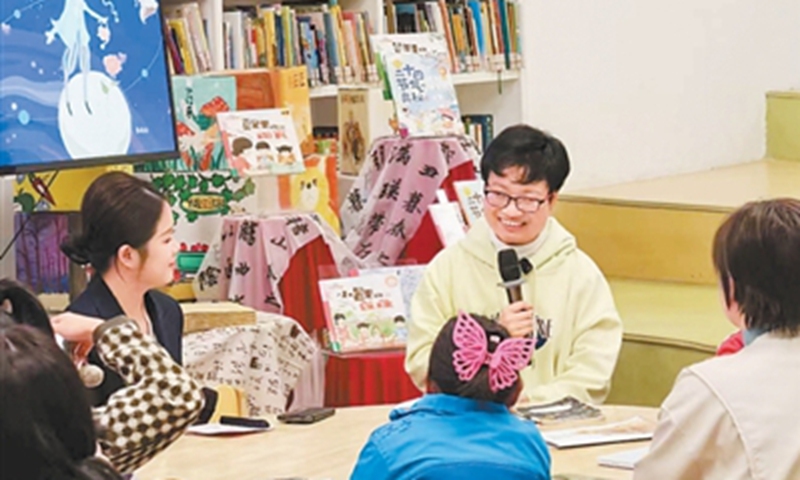
Wu Siyu shares her ideas at a reading event. Photo: Courtesy of Wu Siyu
In 1988, Wu Siyu, born in Nanchang, East China's Jiangxi Province, was left with lifelong cerebral palsy due to premature birth, suffering from severe visual and physical impairments. From the very beginning, fate seemed to have closed a door on her.
"My hands are constantly cramped and curled, like chicken claws. I can't walk independently, and my vision is very blurry," Wu said with a smile, without a trace of resentment.
"The hardest part of my childhood was rehabilitation therapy. Doctors would force my spastic legs apart and then bind them tightly with bandages for 40 minutes - it was excruciating," Wu said, glancing at her mother Zhou Pinglan. "Whenever the pain became unbearable, my mom would sit by my bedside and read to me."
Zhou's eyes grew moist as she gently held her daughter's hand. "Seeing her in such pain, there was nothing I could do but try to distract her. I read her magazines and essays, and little by little, she would calm down."
"Books felt like magic," Wu said, her eyes lighting up with childlike sincerity. "Once the words reached my ears, the pain seemed to ease. Back then, I felt that reading was my painkiller."
At the age of seven, Wu entered school. Her deformed hands could barely hold a pen, and even the simplest writing felt like an impossible task.
"Every day, my mom would pry open my fingers one by one, help me grip the pen, and then hold my hand tightly as she guided me stroke by stroke," Wu said, raising her right hand and gesturing gently. "It took me half a year just to learn how to write the number '2.'"
"No matter how hard it was, I couldn't let my child grow up without education or books," Zhou said firmly. "Books can give her strength and help her become confident."
In primary school, when her math teacher saw her struggling with her studies, the teacher quietly handed her a copy of How the Steel Was Tempered, a novel detailing the troubled life of soldier named Pavel Korchagin.
"The teacher didn't say a word, but that book changed me," Wu recalled. "Even Pavel Korchagin, who became blind and completely paralyzed, never bowed to fate. Compared to that, what are my difficulties?"
With her family's support, the care of her teachers, and the nourishment of books, Wu overcame challenges that most people could hardly imagine and completed her education. In 2007, she was admitted to Jiangxi Engineering Vocational College to study Chinese language and literature, and in 2011, she was admitted to the Open University of China to pursue a bachelor's degree in education management. There is no complaint or despair in her, only an optimistic and resilient outlook on life.
Sharing the warmth of reading
After graduating from college, Wu set out to find a job but faced rejection after rejection. Struggling to come to terms with the setbacks, she turned once again to How the Steel Was Tempered in search of answers. "This time, I truly understood the protagonist's inner tenacity and perseverance," she said.
Later, she pulled herself together and opened a small sports lottery shop near her home. "Running this shop gave me something to do," she said. Wu managed the little store with great enthusiasm.
Gradually, it became more than just a shop. Nearby sanitation workers would drop in to rest and chat during breaks, turning it into a caring rest stop. Neighbors in a hurry would leave their children there for a while, and the shop would become a temporary daycare. When no one was home to receive deliveries, it also served as a parcel drop-off point for the neighborhood.
As the saying goes, "When you give others a rose, the fragrance lingers in your own hands." "While passing on luck, joy, and a sense of security, the warmth of love also nourishes me," Wu said. Having received so much help herself, she is determined to give back by taking part in public welfare. She joined a reading club for people with disabilities in Nanchang and the disabled persons art troupe in Donghu district, where she reads aloud and shares reflections with those who have limited mobility.
When she learned that the Spiritual Wealth Club (a Chinese knowledge-sharing platform) supports people with disabilities in reading, her eyes lit up. "Such a wonderful opportunity. I want to help more people get close to books and experience their beauty!"
Invited to share her story on stage as a "Reading Star," Wu offered words that were simple yet powerful: "Reading helps us step out of isolation and overcome feelings of inferiority, allowing us to see a broader world. As long as we start reading, there is hope in life."
Wu insisted on sharing classical Chinese literature, revolutionary-era family letters, and inspirational essays every day in WeChat groups, opening a window to knowledge for people with disabilities who cannot read with ease. She also took part in a charity program, lending her voice to children in mountainous areas and to visually impaired children. Moving between schools, communities, and libraries, she shares her story, encouraging more people to face challenges with courage and develop a love for reading.
Inspired by her efforts, a strong reading culture has taken root in the community. More and more people with disabilities are stepping out of their homes and embracing reading, while an increasing number of residents are moved to take part in volunteer work, supporting people with disabilities and reading alongside them.
"Immersed in the fragrance of books, the heart finds a place to rest," Wu said, gazing out the window as the spring sunlight fell on her face, warm and radiant. "I want to share the warmth of reading with more people who need it."
Illuminating others
Wu, who has a deep love for recitation, once learned by chance that the city was hosting a recitation competition. "At the time, I was a complete beginner. I didn't even understand terms like pauses or emphasis," she said with a playful blink. "I just thought, why not give it a try?"
Over four months, from the preliminary rounds to the semifinals and then the final, she made her way through each stage. "When the awards were announced, I was completely stunned," she said, clutching her chest, her voice filled with disbelief and excitement. "I won second place and I was the only individual contestant with a disability in the final!"
She still remembers the judge's comment to this day: "You may not have professional techniques, but your expression carries sincerity and strength." The words moved her to tears. "It was recitation that gave me strength, and reading that gave me confidence," Wu said.
To support her passion, her family built her a simple "recording studio" in the living room, made by piecing together a wardrobe and storage cabinets, using curtains as a door, and lining the space with quilts for soundproofing. The entire space measured just 1.6 square meters.
Day after day, in that tiny space, Wu practiced her pronunciation and breath control over and over again, reading until her voice turned hoarse without ever stopping.
Later, staff from the China Disabled Persons' Federation came to visit her. "They encouraged me, saying, 'use this setup for now, we'll help you build a professional one!'" Wu recalled, mimicking their tone, her eyes sparkling.
A few days later, professional equipment, including a microphone, audio interface, and soundproofing materials, was delivered to her home. "This recording studio is the warmth brought to me by the federation, which is like family," she said earnestly, her voice full of gratitude. "It's not big, but it's the most precious gift I've ever received."
From then on, her voice traveled far beyond Nanchang and across the country. She became a lead recitation host for a poetry group in Northwest China's Shaanxi Province, recording The Song of Everlasting Sorrow, a poem by Tang Dynasty (618-907) poet Bai Juyi, in segments to help people with disabilities with memorization. Her warm voice has also been featured on Jiangxi News Radio's program and in many audio-reading video channels.
"I feel very fortunate. I am a flower nurtured with love," Wu said, word by word, with sincerity and gravity. "I have little else to offer in return to society, so I can only carry this warmth forward through recitation, letting every word become a light that illuminates others."
The article was first published in Chinese on Page 6 of the People's Daily on April 24.
RELATED ARTICLES