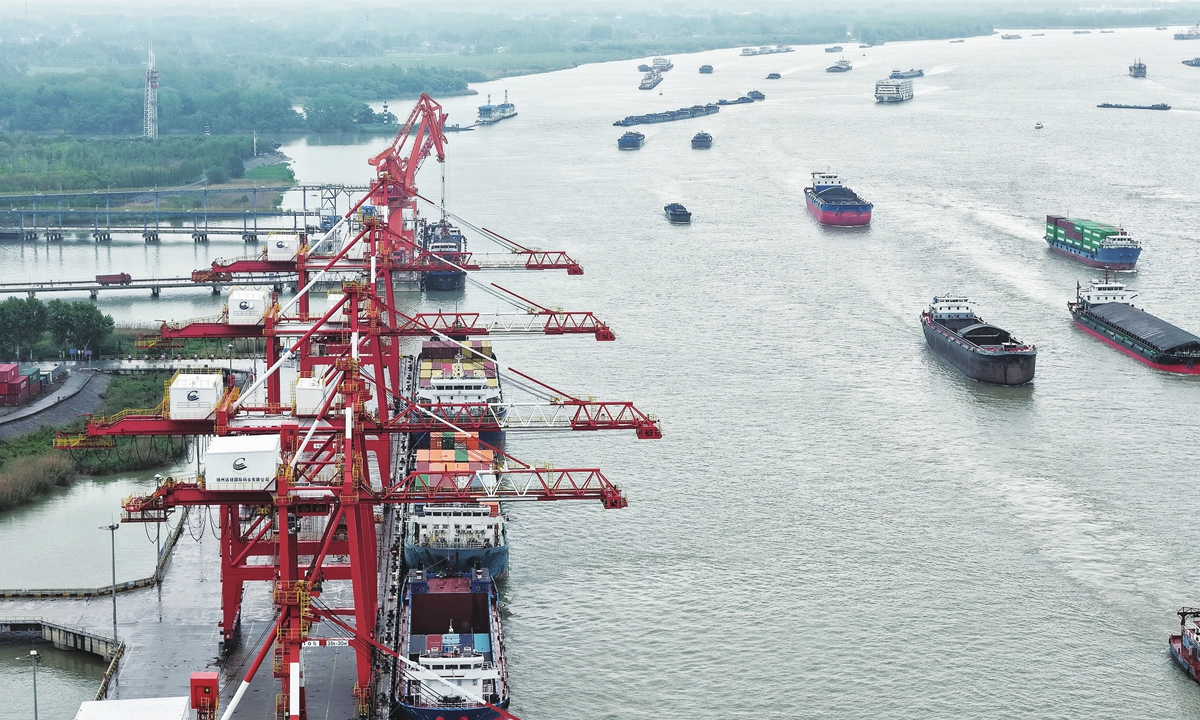
View of cargo ships at a container terminal of Yangzhou Port, East China's Jiangsu Province on April 23, 2026 Photo: VCG
China's gross domestic product (GDP) grew 5 percent year-on-year in the first quarter of 2026, 0.5 percentage points faster than in the fourth quarter of 2025, in a performance that was strong and somewhat better than expected. The country continues to grow clearly above the world average, underscoring both its resilience and its importance in the world economy.
Of course, data from a single quarter are never sufficient to draw definitive conclusions about long-term trends or structural transformation. Nevertheless, the latest figures confirm that China has entered the first year of the 15th Five-Year Plan (2026-30) with solid momentum.

Paulo Nogueira Batista Photo: Courtesy of Paulo Nogueira Batista
It is also important to recognize that some of the major external shocks currently unfolding have not yet been fully felt. The geopolitical tensions in the Middle East, the near-total closure of the Hormuz Strait and the resulting rise in oil and gas prices - the fourth major global oil shock since the 1970s - have not yet produced their full effects on the world economy. If the conflict goes on for a long period, a sharp slowdown in the world economy is quite possible and will inevitably affect major trading nations, including China.
However, China appears relatively well-positioned to navigate such external challenges. Its dependence on imported oil is lower than that of other major Asian economies. Moreover, the country has built up substantial strategic reserves and is making rapid progress in developing alternative energy sources such as wind and solar power. And, the notable expansion of electric vehicles in recent years will also help the country cushion the blow from the fourth global oil price shock. In a recent visit to Beijing and Shanghai, I was struck by how dominant electric vehicles have become.
China's long-term success hinges on at least two macroeconomic pillars - high levels of aggregate investment and export dynamism. Contrary to what is often said and recommended, especially in the West, China is likely to continue to rely on these two pillars, while at the same time expanding consumption levels and further improving the productivity of investment. With a lower capital-output ratio, the country should be able to sustain long-term economic growth at somewhat lower investment-to-GDP ratios, allowing consumption to grow in real terms and as a share of GDP.
It is also worth noting that China retains significant macroeconomic policy flexibility. Risks such as deflationary pressures, which could arise from exchange rate movements or weak external demand, remain manageable. The authorities have both the tools and the experience to respond effectively, ensuring that growth remains on a stable trajectory. In this context, concerns about abrupt slowdowns appear overstated.
In terms of the internationalization of the renminbi, China does not appear to be pursuing a large-scale push, but rather proceeding in a more measured way. A rapid expansion could entail, among other issues, appreciation pressures that may weigh on export competitiveness and on sectors that compete with imports, with implications for growth. This is an outcome China would not allow, and it remains in a position to manage such pressures.
China's growth carries broader significance at a time of heightened global uncertainty. If it is able to sustain growth in the range of 4 to 5 percent per year, this would help compensate for the slowdown in other parts of the world economy and contribute to more predictable growth conditions.
This is particularly important for developing economies. China is the largest market for many of them. For Latin American countries such as Brazil, China has been the largest trading partner since 2009. If China continues to grow, as we expect, this will benefit Brazilian exporters by providing sustained demand for their products. From a structural point of view, both sides are now working to adjust the nature of their trade relationship, which has largely been based on Brazil's exports of primary products to China and imports of manufactured goods by Brazil, supporting a more balanced and sustainable evolution of the relationship over time.
More broadly, China's engagement with Latin America and the broader Global South has been beneficial to all and has already delivered tangible results, often more closely aligned with local development needs than traditional partnerships with the US and Europe. As one widely cited remark attributed to an African official puts it, "Every time China visits, we get a hospital, a bridge or a road; every time Americans or Europeans visit, we get a lecture."
To further improve cooperation, Chinese investment in the Global South can play a greater role in creating new productive capacity, rather than the acquisition of existing firms. There is scope for deeper cooperation in generating local employment and strengthening productive linkages with local suppliers in the Global South, while also contributing to technology transfer.
In this way, relations with China can bring even greater benefits to partner economies. As countries in the Global South continue to develop, China will also gain in terms of markets and destinations for exports and investment, reinforcing the win-win nature of these relationships.
In Latin America and the Caribbean, a major challenge today lies in external attempts to constrain China's economic engagement in the region. However, attempts to prevail through political pressure and threats will cause significant damage and will not ultimately succeed. In this context, there is a need for closer coordination and stronger cooperation between China and other countries, especially those in the Global South, to advance shared development.
The author is former executive director of the International Monetary Fund and former vice president of the BRICS Bank.
RELATED ARTICLES