IN-DEPTH / IN-DEPTH
China’s 70-year nature reserve system charts sustainable, smart upgraded path toward Beautiful China
Mapping ecological protection
By Published: Apr 24, 2026 09:21 PM

Editor's Note:
"Building an ecological civilization concerns the well-being of the people and the future of the nation."
Chinese President Xi Jinping, also general secretary of the Communist Party of China (CPC) Central Committee and chairman of the Central Military Commission, pointed out: "Respecting, adapting to, and protecting nature is essential for building China into a modern socialist country in all respects."
The building of a Beautiful China is a key component of Xi Jinping Thought on Ecological Civilization. As outlined in the 15th Five-Year Plan (2026-2030) for national economic and social development, securing major breakthroughs in strategic tasks of overall importance to Chinese modernization and making major new progress in the Beautiful China Initiative are set as key objectives for the 2026-2030 period.
The Global Times's column on Xi Jinping Thought on Ecological Civilization is launching a series of articles titled "BeautifulChinaING." From the perspectives of the beauty of nature, the beauty of system and the beauty of lifestyle, the series uses both Chinese and international cases as entry points. Through field reporting and video storytelling, it explores how green development has become a defining feature of Chinese modernization while showcasing China's role as a responsible major country providing global public goods.
Wednesday was Earth Day. In this installment, we turn our focus to the conservation of nature. In 2026, China marks the 70th anniversary of the Dinghu Mountain National Nature Reserve in South China's Guangdong Province, the country's first nature reserve. This installment examines how China's nature conservation system has evolved over the past seven decades, through stories of wildlife protection, protected areas and the people helping shape this process.
Across China's protected areas, from alpine reserves and wetlands to panda forests, signs of returning wildlife are telling a quieter story of ecological change.
Seventy years have passed since the establishment of the country's first nature reserve, the Dinghu Mountain National Nature Reserve, in South China's Guangdong Province in 1956.
China is currently building a protected-area system with national parks as the mainstay, nature reserves as the foundation, and various natural parks as supplements. The country has established more than 2,600 nature reserves of various kinds and at different levels, according to the People's Daily.
Over the decades, China's conservation efforts have expanded far beyond the early tasks such as saving rare species. They have grown into a broader effort to protect entire ecosystems, restore habitats and build a more systematic framework for coexistence between people and nature.
That transformation is not only reflected in policy. It can also be seen in the changing signs of life across the country's landscapes. In alpine regions, snow leopards once considered elusive are appearing more frequently in camera footage. In the wetlands in the western part of China, the return of predators such as wolves points to the gradual repair of ecological relationships across marshes and grasslands. In the Giant Panda National Park, conservation is no longer just about protecting one iconic animal, but about preserving a whole habitat and the species in it while getting more local communities into nature education and ecological stewardship.
These changes suggest that China's conservation story has started a new chapter. The issue today is no longer simply whether a forest, a wetland area or a species can be saved from immediate loss. It is whether protection can become more integrated, more scientific and more sustainable over time.

Story behind a rescue
On a bare rock at an elevation of more than 4,600 meters above sea level, a young snow leopard lay curled up, motionless.
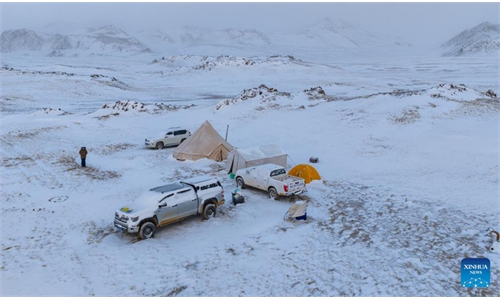
At noon on March 28, in the Lancang River source section of the Sanjiangyuan National Park, in Qinghai Province's Yushu Tibetan Autonomous Prefecture, ecological rangers spotted an unusual figure from a distance during a routine patrol. At first, they simply took a photo. Only after looking closely again and again did they realize that what seemed to be a pale rock was in fact an injured snow leopard cub.
The rangers reported the find immediately, contacting the park administration and local forest police. After arriving at the scene, staff quickly transported the injured cub down the mountain. Following initial treatment in the county seat, it was sent in the early hours of April 1 to the Qinghai Wildlife Rescue and Breeding Center for professional care, according to the center.
As the rescue took place close to the Qingming solar term, a traditional Chinese solar term associated with clarity, brightness, and the revival of life, the approximately 10-month-old male cub was given the name "Ling Xiaoming."
Examinations showed that it had a penetrating wound on the right side of its abdomen, injuries to its tail, and was also suffering from infection, a low-grade fever, parasitic infection and difficulty standing. Rescuers initially believed the injuries may have been caused by a yak attack or trampling, with the wound already leading to an abdominal infection, staff member from the Qinghai center told the Global Times.
After a week of treatment, Ling Xiaoming had recovered some of its vitality. From lying listlessly at first, it had begun to show signs of spirit again, even letting out low growls at the medical staff. Currently, it remains in the treatment and recovery stage and is not yet out of danger, according to the center.
Years ago, such a discovery might have been far less likely. Snow leopards inhabit remote, high-altitude areas rarely reached by people. Even if one was found by chance, that did not necessarily mean it could be reported in time and handled properly.
This time, however, through a relay of efforts, the cub was given a chance to survive.
After news of the rescue was released, many netizens stayed glued to their phone screens, sending messages of support. This also reveals the growing public concern for the fate of wild animals. "We hope Ling Xiaoming can survive, like the snow leopards rescued here before," some of them said.
This capacity is not simply the result of a temporary act of goodwill. It is the product of long-term development in protected-area construction, and of a steadily tightening protection network that made such a rescue possible.
Sanjiangyuan is a major source of China's freshwater, one of the most concentrated regions of plateau biodiversity, a sensitive and important starting area for global climate change, and a vital ecological security barrier for the country.
The CPC Central Committee and the State Council have attached great importance to ecological protection in Sanjiangyuan. On August 19, 2000, the Sanjiangyuan Nature Reserve was officially established. On January 24, 2003, the State Council formally recognized it as a national-level nature reserve, according to the Xinhua News Agency.
In 2021, it became one of China's first five national parks.
In October 2021, China officially established its first batch of national parks, which included Sanjiangyuan. The headwater areas of the three major rivers that had previously belonged to the Sanjiangyuan National Nature Reserve, together with areas such as the Hoh Xil National Nature Reserve, were incorporated as a whole into the Sanjiangyuan National Park for integrated protection, according to Xinhua.
Over the past two decades, conservation in Sanjiangyuan has become broader in scope, stronger in implementation and more closely integrated with local economic and social development.
"Over the years, ecological conservation has been given steadily greater weight at both the national and provincial levels, and Qinghai has long made it a central part of its development strategy," Qi Xinchang, who, as deputy director of the Qinghai Wildlife Rescue and Breeding Center, has been involved in the rescue of Ling Xiaoming as well as several other snow leopards and wild animals in Sanjiangyuan, told the Global Times.
"With such policy guidance in place over the years, there has also been a strong response among the public. Ordinary people have started to care about wildlife, pay attention to it, and take part in wildlife protection through their own actions," he said.
Where it began
If the rescue of Ling Xiaoming shows what China's protected areas can do today, the Dinghu Mountain reserve shows where that story began.
Established on June 30, 1956 in Zhaoqing, Guangdong, the Dinghu Mountain National Nature Reserve was China's first nature reserve. Managed by the South China Botanical Garden under the Chinese Academy of Sciences, it remains the country's only nature reserve directly affiliated with the academy, according to the reserve's official website.
Over the decades, it has grown into more than a protected patch of forest. It has become a long-term platform for conservation, scientific monitoring, public education, community development and international cooperation.
As China's first national nature reserve, this primeval forest - referred to as the "Green Pearl on the Tropic of Cancer Desert Belt" - harbors 2,291 species of higher plants and 277 species of birds, while the groundbreaking scientific achievements made in the reserve have revolutionized global understanding of forest carbon sequestration, according to the reserve's website.
It was also approved by UNESCO in 1980 as one of China's first members of the "Man and the Biosphere" program.
Over time, China's protected-area system expanded. In 1994, China's Regulation on Nature Reserves took effect, giving the country's nature reserve system a clearer legal framework.
In 2021, China established the first batch of national parks, with a protected land area of 230,000 square kilometers. These parks, namely, the Sanjiangyuan National Park, the Giant Panda National Park, the Northeast China Tiger and Leopard National Park, the Hainan Tropical Rainforest National Park and the Wuyishan National Park, are home to nearly 30 percent of the key terrestrial wildlife species found in the country, Xinhua reported.
That shift did not replace nature reserves. It built on them. Official policy defines China's protected-area system as one with national parks as the mainstay, nature reserves as the foundation, and natural parks as supplements, according to the Ministry of Ecology and Environment.
In that sense, the Dinghu Mountain National Nature Reserve was not just the first chapter. It helped lay the institutional groundwork for what came later.
Going smart, sustainable
Across China's protected areas, conservation is increasingly becoming smarter, more connected and more grounded in long-term legal support.
Recently, the Xishuangbanna National Nature Reserve launched a new Asian elephant protection system using AI, big data and cloud computing to help ease human-elephant conflict, according to the National Natural Science Foundation of China.
In Northeast China Tiger and Leopard National Park, staff members use an integrated monitoring system combining ground, aerial and satellite-based technologies to keep real-time watch over vast forest areas.
In the Giant Panda National Park, protection today no longer focuses only on a single iconic species. It also extends to habitat connectivity, community participation and nature education.
Meanwhile, a stronger legal framework is also taking shape. The revised regulations on nature reserves officially came into effect on March 15. According to a report on the English website of China's Ministry of Justice, the revision clarifies the functional positioning of nature reserves, improves the management system, standardizes the procedures for their establishment, and strengthens regulation of human activities and legal accountability for violations within protected areas.
The newly adopted Ecological and Environmental Code is also set to take effect on August 15, according to Xinhua.
For some long-time observers of China's environmental governance, such legal progress provides an important foundation for conservation work to move forward in a more sustained way.
Ma Jun, director of the Institute of Public and Environmental Affairs, told the Global Times that for nature conservation, this means habitat protection, ecological restoration, green and low-carbon development, and related governance rules are being brought together under a more comprehensive legal framework.
"Building an ecological civilization concerns the well-being of the people and the future of the nation."
Chinese President Xi Jinping, also general secretary of the Communist Party of China (CPC) Central Committee and chairman of the Central Military Commission, pointed out: "Respecting, adapting to, and protecting nature is essential for building China into a modern socialist country in all respects."
The building of a Beautiful China is a key component of Xi Jinping Thought on Ecological Civilization. As outlined in the 15th Five-Year Plan (2026-2030) for national economic and social development, securing major breakthroughs in strategic tasks of overall importance to Chinese modernization and making major new progress in the Beautiful China Initiative are set as key objectives for the 2026-2030 period.
The Global Times's column on Xi Jinping Thought on Ecological Civilization is launching a series of articles titled "BeautifulChinaING." From the perspectives of the beauty of nature, the beauty of system and the beauty of lifestyle, the series uses both Chinese and international cases as entry points. Through field reporting and video storytelling, it explores how green development has become a defining feature of Chinese modernization while showcasing China's role as a responsible major country providing global public goods.
Wednesday was Earth Day. In this installment, we turn our focus to the conservation of nature. In 2026, China marks the 70th anniversary of the Dinghu Mountain National Nature Reserve in South China's Guangdong Province, the country's first nature reserve. This installment examines how China's nature conservation system has evolved over the past seven decades, through stories of wildlife protection, protected areas and the people helping shape this process.
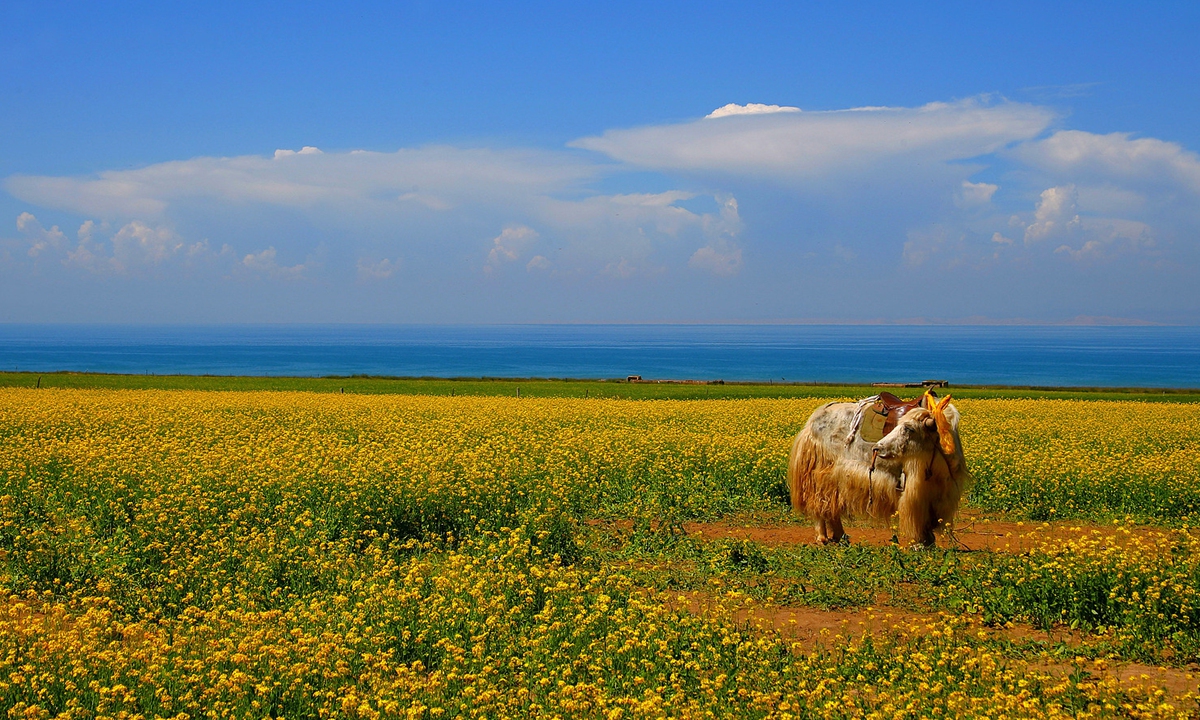
A picturesque view of the Qinghai Lake National Nature Reserve in Qinghai Province Photo: VCG
Across China's protected areas, from alpine reserves and wetlands to panda forests, signs of returning wildlife are telling a quieter story of ecological change.
Seventy years have passed since the establishment of the country's first nature reserve, the Dinghu Mountain National Nature Reserve, in South China's Guangdong Province in 1956.
China is currently building a protected-area system with national parks as the mainstay, nature reserves as the foundation, and various natural parks as supplements. The country has established more than 2,600 nature reserves of various kinds and at different levels, according to the People's Daily.
Over the decades, China's conservation efforts have expanded far beyond the early tasks such as saving rare species. They have grown into a broader effort to protect entire ecosystems, restore habitats and build a more systematic framework for coexistence between people and nature.
That transformation is not only reflected in policy. It can also be seen in the changing signs of life across the country's landscapes. In alpine regions, snow leopards once considered elusive are appearing more frequently in camera footage. In the wetlands in the western part of China, the return of predators such as wolves points to the gradual repair of ecological relationships across marshes and grasslands. In the Giant Panda National Park, conservation is no longer just about protecting one iconic animal, but about preserving a whole habitat and the species in it while getting more local communities into nature education and ecological stewardship.
These changes suggest that China's conservation story has started a new chapter. The issue today is no longer simply whether a forest, a wetland area or a species can be saved from immediate loss. It is whether protection can become more integrated, more scientific and more sustainable over time.
Giant pandas Zi Rui (left) and Ao Ke feed on bamboo at the Dujiangyan base of the China Conservation and Research Center for Giant Panda in Dujiangyan, Southwest China's Sichuan Province in September 2025. Photo: Shan Jie/GT
Story behind a rescue
On a bare rock at an elevation of more than 4,600 meters above sea level, a young snow leopard lay curled up, motionless.
At noon on March 28, in the Lancang River source section of the Sanjiangyuan National Park, in Qinghai Province's Yushu Tibetan Autonomous Prefecture, ecological rangers spotted an unusual figure from a distance during a routine patrol. At first, they simply took a photo. Only after looking closely again and again did they realize that what seemed to be a pale rock was in fact an injured snow leopard cub.
The rangers reported the find immediately, contacting the park administration and local forest police. After arriving at the scene, staff quickly transported the injured cub down the mountain. Following initial treatment in the county seat, it was sent in the early hours of April 1 to the Qinghai Wildlife Rescue and Breeding Center for professional care, according to the center.
As the rescue took place close to the Qingming solar term, a traditional Chinese solar term associated with clarity, brightness, and the revival of life, the approximately 10-month-old male cub was given the name "Ling Xiaoming."
Examinations showed that it had a penetrating wound on the right side of its abdomen, injuries to its tail, and was also suffering from infection, a low-grade fever, parasitic infection and difficulty standing. Rescuers initially believed the injuries may have been caused by a yak attack or trampling, with the wound already leading to an abdominal infection, staff member from the Qinghai center told the Global Times.
After a week of treatment, Ling Xiaoming had recovered some of its vitality. From lying listlessly at first, it had begun to show signs of spirit again, even letting out low growls at the medical staff. Currently, it remains in the treatment and recovery stage and is not yet out of danger, according to the center.
Years ago, such a discovery might have been far less likely. Snow leopards inhabit remote, high-altitude areas rarely reached by people. Even if one was found by chance, that did not necessarily mean it could be reported in time and handled properly.
This time, however, through a relay of efforts, the cub was given a chance to survive.
After news of the rescue was released, many netizens stayed glued to their phone screens, sending messages of support. This also reveals the growing public concern for the fate of wild animals. "We hope Ling Xiaoming can survive, like the snow leopards rescued here before," some of them said.
This capacity is not simply the result of a temporary act of goodwill. It is the product of long-term development in protected-area construction, and of a steadily tightening protection network that made such a rescue possible.
Sanjiangyuan is a major source of China's freshwater, one of the most concentrated regions of plateau biodiversity, a sensitive and important starting area for global climate change, and a vital ecological security barrier for the country.
The CPC Central Committee and the State Council have attached great importance to ecological protection in Sanjiangyuan. On August 19, 2000, the Sanjiangyuan Nature Reserve was officially established. On January 24, 2003, the State Council formally recognized it as a national-level nature reserve, according to the Xinhua News Agency.
In 2021, it became one of China's first five national parks.
In October 2021, China officially established its first batch of national parks, which included Sanjiangyuan. The headwater areas of the three major rivers that had previously belonged to the Sanjiangyuan National Nature Reserve, together with areas such as the Hoh Xil National Nature Reserve, were incorporated as a whole into the Sanjiangyuan National Park for integrated protection, according to Xinhua.
Over the past two decades, conservation in Sanjiangyuan has become broader in scope, stronger in implementation and more closely integrated with local economic and social development.
"Over the years, ecological conservation has been given steadily greater weight at both the national and provincial levels, and Qinghai has long made it a central part of its development strategy," Qi Xinchang, who, as deputy director of the Qinghai Wildlife Rescue and Breeding Center, has been involved in the rescue of Ling Xiaoming as well as several other snow leopards and wild animals in Sanjiangyuan, told the Global Times.
"With such policy guidance in place over the years, there has also been a strong response among the public. Ordinary people have started to care about wildlife, pay attention to it, and take part in wildlife protection through their own actions," he said.
Giant pandas Zi Rui (left) and Ao Ke feed on bamboo at the Dujiangyan base of the China Conservation and Research Center for Giant Panda in Dujiangyan, Southwest China's Sichuan Province in September 2025. Photo: Shan Jie/GT
Where it began
If the rescue of Ling Xiaoming shows what China's protected areas can do today, the Dinghu Mountain reserve shows where that story began.
Established on June 30, 1956 in Zhaoqing, Guangdong, the Dinghu Mountain National Nature Reserve was China's first nature reserve. Managed by the South China Botanical Garden under the Chinese Academy of Sciences, it remains the country's only nature reserve directly affiliated with the academy, according to the reserve's official website.
Over the decades, it has grown into more than a protected patch of forest. It has become a long-term platform for conservation, scientific monitoring, public education, community development and international cooperation.
As China's first national nature reserve, this primeval forest - referred to as the "Green Pearl on the Tropic of Cancer Desert Belt" - harbors 2,291 species of higher plants and 277 species of birds, while the groundbreaking scientific achievements made in the reserve have revolutionized global understanding of forest carbon sequestration, according to the reserve's website.
It was also approved by UNESCO in 1980 as one of China's first members of the "Man and the Biosphere" program.
Over time, China's protected-area system expanded. In 1994, China's Regulation on Nature Reserves took effect, giving the country's nature reserve system a clearer legal framework.
In 2021, China established the first batch of national parks, with a protected land area of 230,000 square kilometers. These parks, namely, the Sanjiangyuan National Park, the Giant Panda National Park, the Northeast China Tiger and Leopard National Park, the Hainan Tropical Rainforest National Park and the Wuyishan National Park, are home to nearly 30 percent of the key terrestrial wildlife species found in the country, Xinhua reported.
That shift did not replace nature reserves. It built on them. Official policy defines China's protected-area system as one with national parks as the mainstay, nature reserves as the foundation, and natural parks as supplements, according to the Ministry of Ecology and Environment.
In that sense, the Dinghu Mountain National Nature Reserve was not just the first chapter. It helped lay the institutional groundwork for what came later.
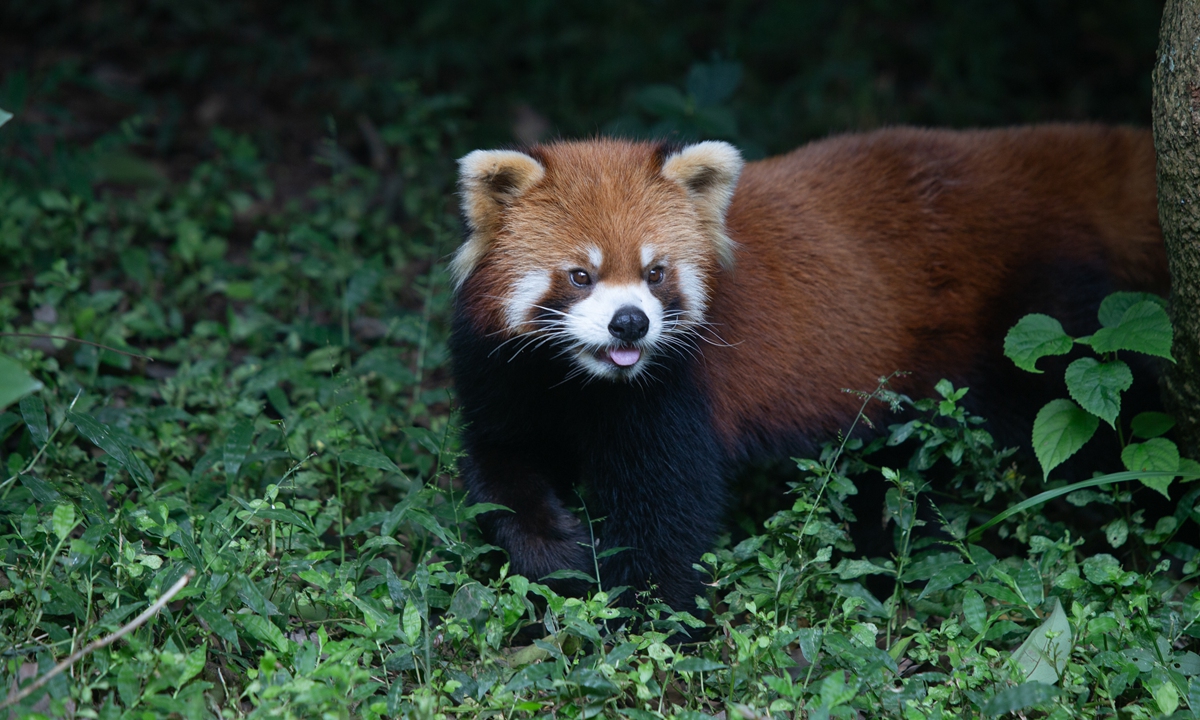
A red panda is seen at the panda base in Chengdu, Southwest China's Sichuan Province, in September 2025. Photo: Shan Jie/GT
Going smart, sustainable
Across China's protected areas, conservation is increasingly becoming smarter, more connected and more grounded in long-term legal support.
Recently, the Xishuangbanna National Nature Reserve launched a new Asian elephant protection system using AI, big data and cloud computing to help ease human-elephant conflict, according to the National Natural Science Foundation of China.
In Northeast China Tiger and Leopard National Park, staff members use an integrated monitoring system combining ground, aerial and satellite-based technologies to keep real-time watch over vast forest areas.
In the Giant Panda National Park, protection today no longer focuses only on a single iconic species. It also extends to habitat connectivity, community participation and nature education.
Meanwhile, a stronger legal framework is also taking shape. The revised regulations on nature reserves officially came into effect on March 15. According to a report on the English website of China's Ministry of Justice, the revision clarifies the functional positioning of nature reserves, improves the management system, standardizes the procedures for their establishment, and strengthens regulation of human activities and legal accountability for violations within protected areas.
The newly adopted Ecological and Environmental Code is also set to take effect on August 15, according to Xinhua.
For some long-time observers of China's environmental governance, such legal progress provides an important foundation for conservation work to move forward in a more sustained way.
Ma Jun, director of the Institute of Public and Environmental Affairs, told the Global Times that for nature conservation, this means habitat protection, ecological restoration, green and low-carbon development, and related governance rules are being brought together under a more comprehensive legal framework.
RELATED ARTICLES