Japan considering revising SDF Act to green light surplus defense equipment export, a move 'pushing Tokyo toward remilitarization': Chinese expert

Latest news
Japanese government is considering revising the Self-Defense Forces (SDF) Act to allow, under special exceptions, the transfer of surplus defense equipment overseas, including weapons with lethal and destructive capabilities, either free of charge or at low cost, Yomiuri Shimbun reported on Sunday.According to Yomiuri Shimbun, the Japanese government plans to explicitly state the necessity of such measures in the revised National Security Strategy and two other security documents within the year, with the aim to pass related legal amendments during the regular Diet session next year.
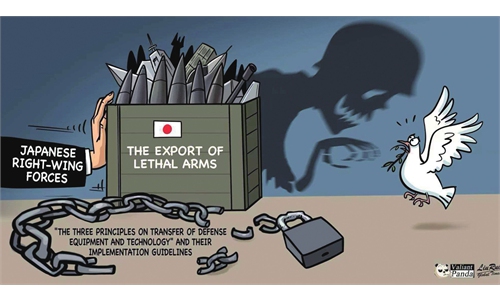
This move follows the revision of the Three Principles on Transfer of Defense Equipment and Technology and aims to advance the implementation of the new framework, as supporting legal measures are needed to put the updated principles into practice. The move once again reveals Japan's push toward rapid "remilitarization" and efforts to free itself from the constraints of the pacifist constitution, Xiang Haoyu, a distinguished Research Fellow at the China Institute of International Studies, told the Global Times on Sunday.
The SDF Act contains detailed and operational provisions, some of which may conflict with the revised principles, so related legal clauses need to be amended to enable practical implementation and green light specific export decisions, Xiang said.
According to Japanese law, defense equipment, even when used, is treated as state property and cannot be provided free of charge or at low cost. Article 116-3 of the SDF Act allows items no longer needed to be transferred to governments in developing countries at below market value, but only non-lethal equipment such as helmets is allowed. Weapons and ammunition, including destroyer escorts, are not allowed, according to the Yomiuri Shimbun.
On April 21, the Japanese government revised the implementation guidelines for the Three Principles on Transfer of Defense Equipment and Technology, which sets the rules for exports of defense equipment, allowing, in principle, the export of weapons with lethal and destructive capabilities. The Philippines and Indonesia are among the 17 countries eligible for such exports, according to Japanese media reports.
Following the further easing of the principles, Southeast Asia could become a key region for exporting weapons with lethal capabilities as the policy is under the banner of maritime security, particularly by supporting coastal states in the South China Sea in strengthening their near sea defense and securing interests. Under this banner, Japan could further expand its role in equipping and assisting these countries, Xiang said.
Japan's Defense Minister Shinjiro Koizumi is reportedly scheduled to visit the Philippines and Indonesia in May to hold talks on the export of second-hand defense equipment, per Yomiuri Shimbun.
According to Yomiuri Shimbun, the Philippines is considering acquiring the "Abukuma" class destroyer escort, which entered service more than 30 years ago. If realized, the export of used destroyer escorts would be the first such case. Indonesia is also said to be interested in acquiring used "Oyashio" class submarine.
According to the Philippine Star, Japan is participating in this year's Balikatan 2026 joint military exercise, held from April 20 to May 8, which will feature live-fire operations in northern Luzon facing the Taiwan Straits, as well as activities in waters linked to the South China Sea, with 1,400 personnel deployed.
Before taking part in Balikatan, Japan also sent about 420 members of the Japan Ground Self-Defense Force to participate in the phase one of US-Philippine combat drill "Salaknib" which was scheduled from April 6 to April 17, according to media reports.
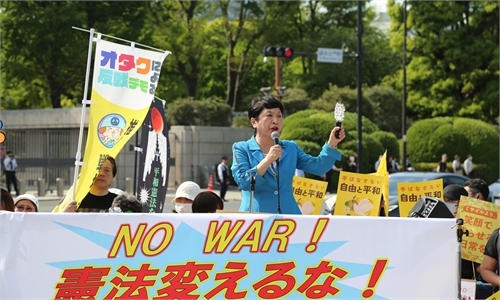
Domestic concerns in Japan have continued to grow following the revision of the implementation guidelines.
Tokyo News said in a report on April 22 that the government, which has fully lifted its ban on arms exports, is poised to accelerate the export of weapons with lethal and destructive capabilities. This move comes as an extension of a series of major shifts in Japan's postwar restrained security policy over the past decade, including allowing the exercise of collective self-defense and the deployment of long-range missiles capable of striking enemy bases. It could heighten concerns among neighboring countries and risk triggering a security dilemma that could lead to an arms race.
There are also concerns that decisions to green-light arms exports could be made at the government's discretion, increasing the risk that Japanese weapons may be used in conflicts, the Asahi Shimbun reported on April 21.
Opposition parties in Japan had called for prior notification to the Diet before any arms exports. However, according to the Asahi Shimbun, the government claimed that once such decisions are made by the National Security Council, it will notify the Diet afterward instead.
Mainichi said in an editorial article on April 22 that under the new system, it is difficult to expect effective oversight by the Diet. A mechanism for prior review needs to be established.
The greatest concern is the lack of a mechanism to restrain the expansion of arms exports, the Mainichi said.
Further expansion of arms exports is likely to go hand in hand with efforts to accelerate constitutional revision. Whether involving new or second-hand equipment, such exports may reflect motives beyond purely defensive needs, Xiang said, noting that if they are perceived as targeting China or intervening in regional flashpoints, they could intensify regional tensions, fuel an arms race, and ultimately undermine regional peace and stability.
RELATED ARTICLES