Chinese expert urges India not to forget history or seek balance by consenting to Japan scrapping its lethal weapons exports policy after Delhi reportedly welcomes Tokyo’s move
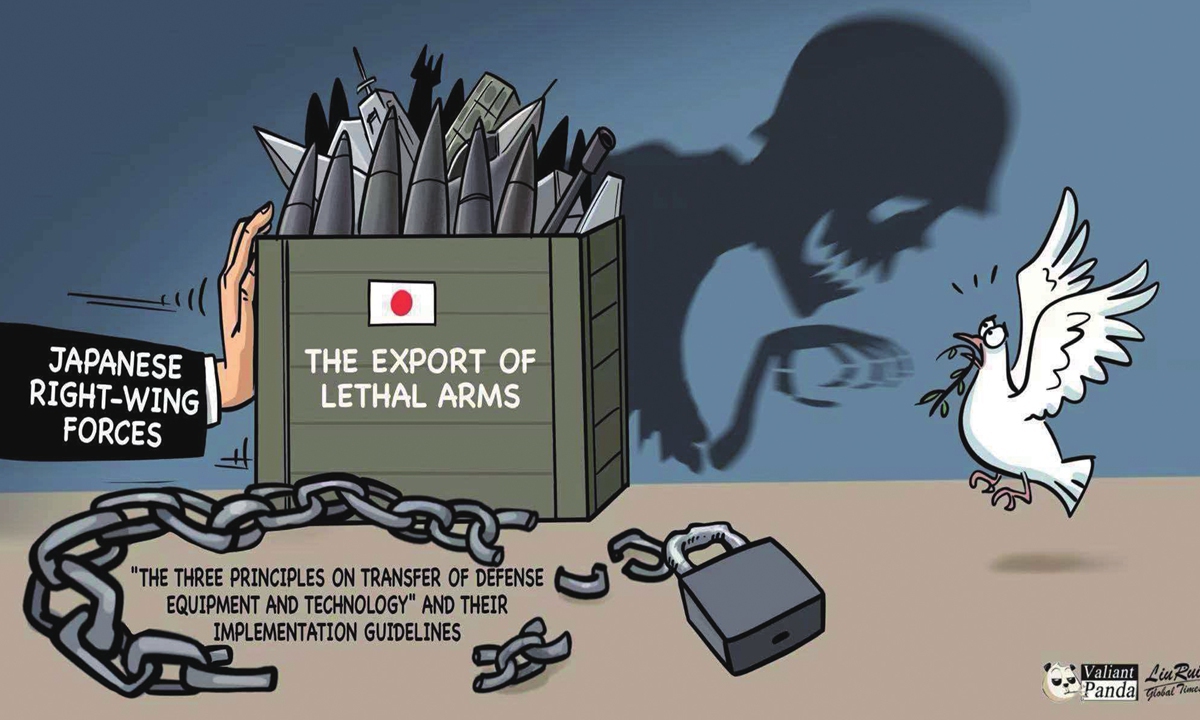
Illustration: Liu Rui/GT
After Japan scrapped a ban on lethal weapons export in a move seen by observers as a dangerous breach of its postwar "pacifist constitution" and security framework, India nevertheless welcomed the shift. A Chinese expert said Tokyo's move effectively breaks the postwar order, threatens regional stability, and risks undermining Asia-Pacific prosperity, while urging India not to forget history or seek strategic balancing by loosening constraints on Japan.India on Thursday welcomed Japan's decision to scrap a ban on lethal weapons exports, and its Ministry of External Affairs (MEA) claimed that defense and security cooperation forms an "important pillar" of the India-Japan Special Strategic and Global Partnership, local media Business Standard reported.
A spokesperson for India's MEA claimed that "as part of the Joint Declaration on Security Cooperation between India and Japan, both sides have committed to increase practical cooperation in the interest of their national security and continued economic dynamism," according to the report.
"India hopes to use the statement to deepen ties with Japan in service of its 'Indo-Pacific' strategy, and even attempt to use Japanese strength to balance China's influence in the Asia-Pacific and pursue strategic containment," Qian Feng, director of the Research Department at Tsinghua University's National Strategy Institute, told the Global Times on Friday.
However, neither India nor Japan appears to realize that the Asia-Pacific was able to maintain stability after the Cold War and become a prosperous part of an unsettled world because countries in the region chose mutual cooperation over military confrontation and shared the opportunities brought by peace and development, Qian said.
He added that Japan is ignoring today's geopolitical realities in the Asia-Pacific by seeking to revise its pacifist framework, opening lethal weapons exports, recklessly provoking confrontation with China, and even attempting to return to the old road of militarism. Such actions damage regional geopolitical stability and will inevitably arouse vigilance and opposition from countries, including China, that suffered from Japanese aggression, Qian said.
Although India was also invaded by Japan during World War II, it has chosen at this moment to support Japan's mistaken move. India should not forget history and should clearly see Japan's true intentions, Qian added.
Earlier this week, Sanae Takaichi, described by The Economist as "Japan's hawkish new prime minister," announced another historic policy shift by loosening long-standing restrictions on arms exports and significantly expanding the scope for overseas sales of lethal equipment. The magazine said Japan's "pacifist shibboleths" are "falling one by one."
It noted that a decades-long taboo against spending more than 1 percent of GDP on defense was abandoned in 2022, with spending set to reach nearly 2 percent this year. After long refraining from possessing weapons capable of striking enemy territory, Japan deployed its first long-range "counter-strike" missiles last month.
For nearly eight decades, Japan's self-imposed ban on lethal weapons exports has served as a cornerstone of its postwar pacifist image. The Takaichi cabinet frames the current shift as necessary to ensure Japan's security and contribute to regional and global stability. Critics, however, see it as a step toward dismantling the postwar order, according to The Diplomat.
Japanese media also voiced concerns over the shift. Tokyo Shimbun wrote in an editorial that the government revised the Three Principles on Transfer of Defense Equipment and related operational guidelines, and fully lifted the ban on exports of weapons with killing capability. "This major shift in security policy, which had strictly restricted arms exports in order to avoid fueling international conflicts, can only be judged as a rash act that damages the pacifism of the Constitution," it says.
The paper added that "Restrictions on arms exports, together with the exclusively defense-oriented policy and the Three Non-Nuclear Principles, have formed the core of postwar Japanese pacifism."
"This time, the government approved exports of finished lethal weapons. Without careful deliberation in the Diet or national public debate, this deeply undermines the ideals of pacifism and is profoundly worrying," warned the editorial.
Asahi Shimbun also ran an editorial titled Major shift in weapons export policy: Concern that the ideals of a peaceful nation are being left behind, stating that "Self-restraint on arms exports, which had somehow been maintained as one pillar of Japan as a peaceful nation, is now being substantially loosened."
It also warned that "Export destinations are limited to countries that are parties to defense equipment transfer agreements, but these include countries that have military tensions with neighboring states. The fear of fueling conflict cannot be dispelled." It said that although post-facto notification to the Diet was requested, the Diet has no means to stop exports and cannot perform a sufficient checking function.
With Japan opening lethal weapons exports, it is in effect abandoning a foundational principle of the postwar "pacifist constitution", Qian said. Japan enjoyed decades of peace, economic prosperity and social stability under that framework. Now that it is abandoning this principle and even revisiting the path of militarism, India should carefully consider the true consequences of such acts made by Japan's Takaichi government, Qian added.
RELATED ARTICLES