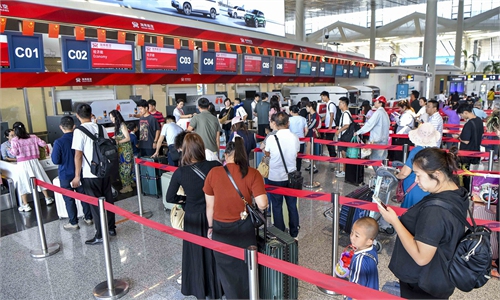
Outbound travel bookings for May Day holidays remain strong
Demand has ‘vast potential’ despite disruptions in global market: expert
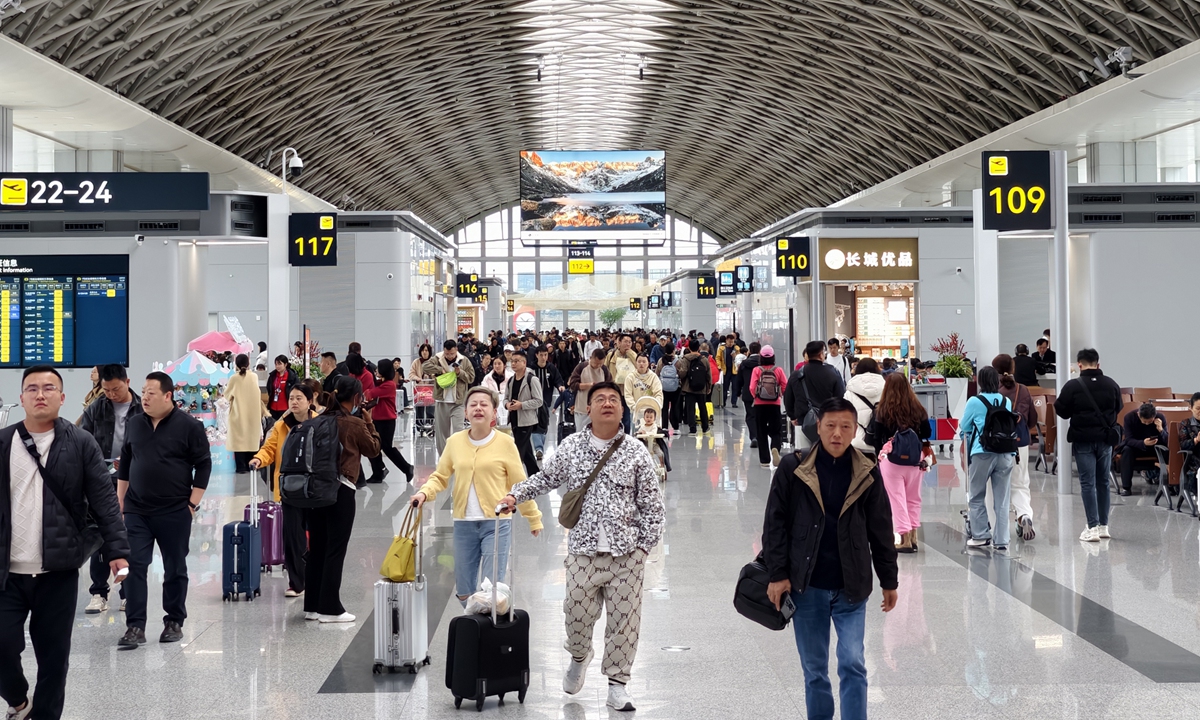
Passengers at Chengdu Shuangliu International Airport in Chengdu, Southwest China's Sichuan Province, on March 14, 2026 Photo: VCG
As the May Day holidays draw near, many Chinese travelers are making plans for outbound trips, with various countries and regions, including South Korea, Thailand and Russia, expected to see large numbers of Chinese tourists, according to data from Chinese travel platforms on Sunday.
Despite certain disruptions in international travel from geopolitical tensions in the Middle East, China's outbound travel market remains resilient with vast potential, as more diversified demand is creating opportunities for many destinations, according to industry insiders and experts.
During the May Day holidays, which run from May 1 to May 5, the top 10 outbound destinations for Chinese travelers include South Korea, Egypt, Russia, Italy, the UK and Switzerland, data sent by travel service provider Tongcheng to the Global Times on Sunday showed.
Bookings for short-haul destinations such as Seoul and Jeju Island in South Korea have surged by more than 150 percent compared with previous periods, according to Tongcheng.
Xu Fang, a marketing manager at an international travel agency based in Harbin, Northeast China's Heilongjiang Province, told the Global Times on Sunday that her company, which focuses on outbound travel to border cities in Russia, including Vladivostok, has not been negatively affected by recent developments.
"On the contrary, due to geographical proximity and convenient travel arrangements, our orders have increased by about 30 percent compared with last year," she said.
Geopolitical tensions in the Middle East and rising jet fuel prices have posed some challenges for international travel. Reuters reported that jet fuel prices have surged sharply in recent weeks, in some cases more than doubling since late February, significantly increasing airlines' operating costs. As a result, carriers worldwide have raised fares, cut capacity and canceled less profitable routes, per Reuters.
During the May Day holidays, the average tax-inclusive airfare for domestic routes has exceeded 1,000 yuan ($137), up nearly 14 percent year-on-year and about 25 percent higher than in 2019, the China News Service (CNS) reported on Sunday.
Wang Sen, a marketing manager at domestic travel agency UTour, told the Global Times on Sunday that compared with last year, outbound travel during the May Day holidays is being, to a certain degree, affected by geopolitical developments and changes in flight routes and fares.
However, overall, despite certain impacts, China's outbound travel demand remains solid, Yang Yong, deputy director of the College of Economics and Management at East China Normal University, told the Global Times on Sunday.
Yang noted that more diversified preferences are creating opportunities for emerging destinations. "Nearby regions with shorter distances, more controllable risks and more convenient visa policies are still considered relatively safe destinations, which helps attract outbound travelers," Yang noted.
CNS, citing VariFlight data, also reported that South Korea and Thailand rank among the top destinations by scheduled flights, while Southeast Asian countries such as Malaysia, Vietnam and Singapore have maintained steady growth. Scheduled flights serving Malaysia are up by 28.5 percent year-on-year, according to the report.
Yang said that travel demand is entering an era of personalization. "As people gain more travel experience, they are increasingly seeking distinctive, niche destinations rather than traditional sightseeing routes," he said, adding that this trend is evident in both domestic and outbound tourism markets and is likely to continue.
Meanwhile, despite short-term adjustments, demand for long-haul travel will likely remain strong, according to Wang.
Recent data also points to a continued rebound in cross-border travel. In the first quarter of 2026, China recorded about 185 million inbound and outbound trips, up 13.5 percent year-on-year, reflecting a steady recovery in international mobility, according to a recent report.
Industry observers said the sustained increase in cross-border flows underscores the resilience of outbound demand despite external uncertainties.
At the same time, industry forecasts suggest further expansion. Estimates show Chinese travelers could take between 165 million and 175 million outbound trips in 2026, supported by improved flight connectivity and policy facilitation, according to market research cited by Tourism Review.
"Europe still sees the highest levels of inquiries and confirmed bookings, as the period from Qingming Festival to the National Day holidays has traditionally been the peak season for travel to the Northern Hemisphere," Wang said, adding that demand is gradually shifting toward longer holiday periods such as summer and the National Day holidays.
RELATED ARTICLES