ARTS / CULTURE & LEISURE
1st China-Greece archaeological collaboration project launched
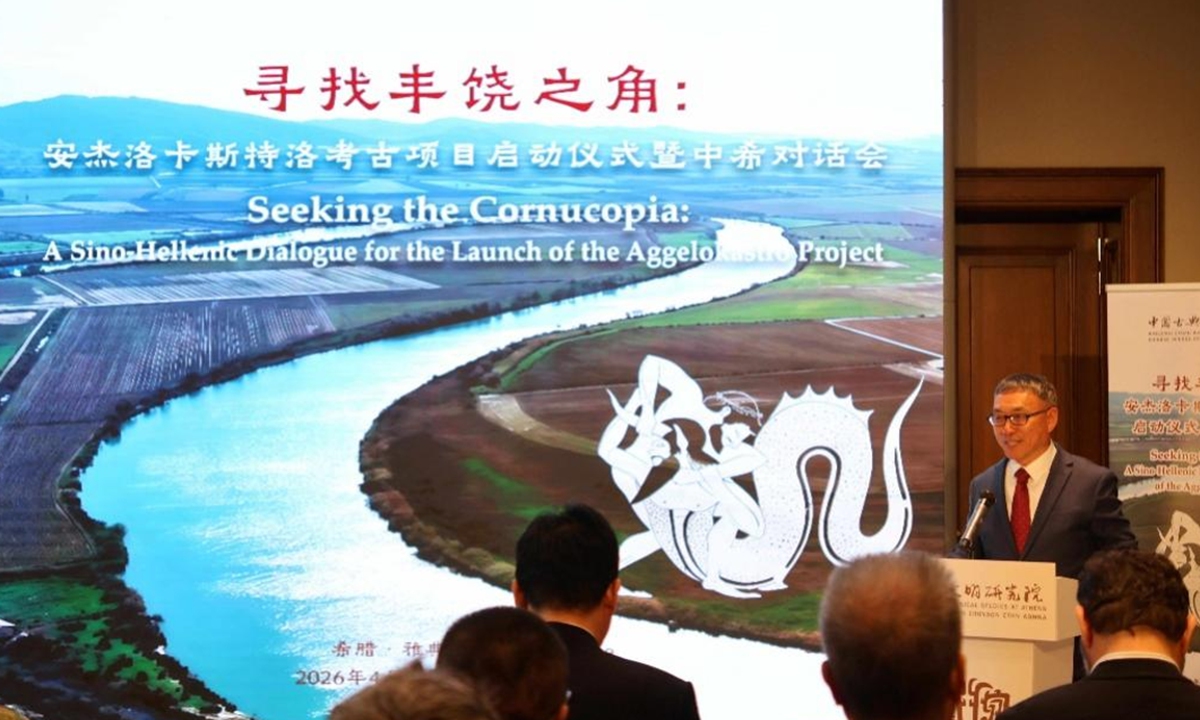
People attend a forum held for the launch of the Aggelokastro project inAthens, Greece, on April 24, 2026. Photo: CMG
A joint Chinese-Greek archaeological project has been officially launched on Friday in Athens, marking the first collaborative excavation between the two countries.The Aggelokastro project, located in western Greece, also marks the first time that Chinese archaeologists, together with scholars from non-Western countries, have taken leading roles in an excavation within a core region of the Western civilization. The project is being jointly carried out by Greece's Ministry of Culture, the Ephorate of Antiquities of Aetolia-Acarnania and Lefkada, and the Chinese School of Classical Studies at Athens (CSCSA).
The excavation will focus on approximately five hectares of land at the Aggelokastro site, located in the ancient region of Aetolia. According to the Homeric epics, this region was home to significant city-states between roughly 1600BC and 1200BC and is believed to have contributed forces to the Trojan War.
Li Xinwei, director of the CSCSA, told the Global Times that during the Hellenistic period, roughly corresponding to China's late Warring States Period (475BC-221BC) through the Han Dynasty (206BC-AD220), the region formed the Aetolian League, which facilitated extensive cultural exchanges across Eurasia.
Earlier small-scale excavations uncovered significant architectural remains, while recent surveys have revealed a well-organized urban layout and possible traces of an ancient theater, suggesting the site was likely an important small city-state at the time, according to Li.
"The site's location near a river suggests it may have served as a key transportation hub," Li said. "We hope to uncover clues about early long-distance trade networks."
The project has been approved by the Greek Ministry of Culture, and geophysical surveys and excavation preparations have been completed. Formal excavation work is expected to begin after the May Day holidays, he added.
Over the past year, researchers from the CSCSA conducted extensive field visits across Greece, surveying more than 50 archaeological sites. Aggelokastro was ultimately selected as the first excavation site with the support of Greek authorities and scholars.
Constantina Benissi, head of the Department for the Supervision of Greek and Foreign Scientific Institutions and the Coordination of International Cooperation and Organizations at the Greek Ministry of Culture, said at the launch ceremony that the project is an important part of systematic cooperation between the ministry and the CSCSA, adding that it has been approved as part of a five-year joint archaeological program, according to the Xinhua News Agency.
She said the Greek side hopes interdisciplinary approaches and modern technologies will be adopted to help reveal the site's characteristics and produce fruitful results.
The initiative represents the first fieldwork project undertaken by the CSCSA since its establishment in November 2024.
The CSCSA is the first institution of its kind established in Greece by an Asian country. Its mission is to promote in-depth studies by Chinese scholars of Greek civilization and other world civilizations, and to strengthen academic exchanges, collaboration and talent development among Chinese, Greek, European and global research institutions in the fields of archaeology and civilization studies.
According to Li, one of the key missions of the CSCSA, a classical studies institution based in Athens, is to conduct archaeological research in Greece. The Chinese side will participate in the project with a spirit of learning, cooperation and sharing, aiming to advance comparative studies of Eastern and Western civilizations.
Aetolia is the birthplace of the myth of the "cornucopia," and this joint project is expected to live up to that symbolism, yielding rich discoveries and deepening understanding of ancient Greek civilization," noted Li.
RELATED ARTICLES