ARTS / CULTURE & LEISURE
Display facilities bring back original looks of hall ruins in Yuanmingyuan
By Published: Apr 26, 2026 10:27 PM

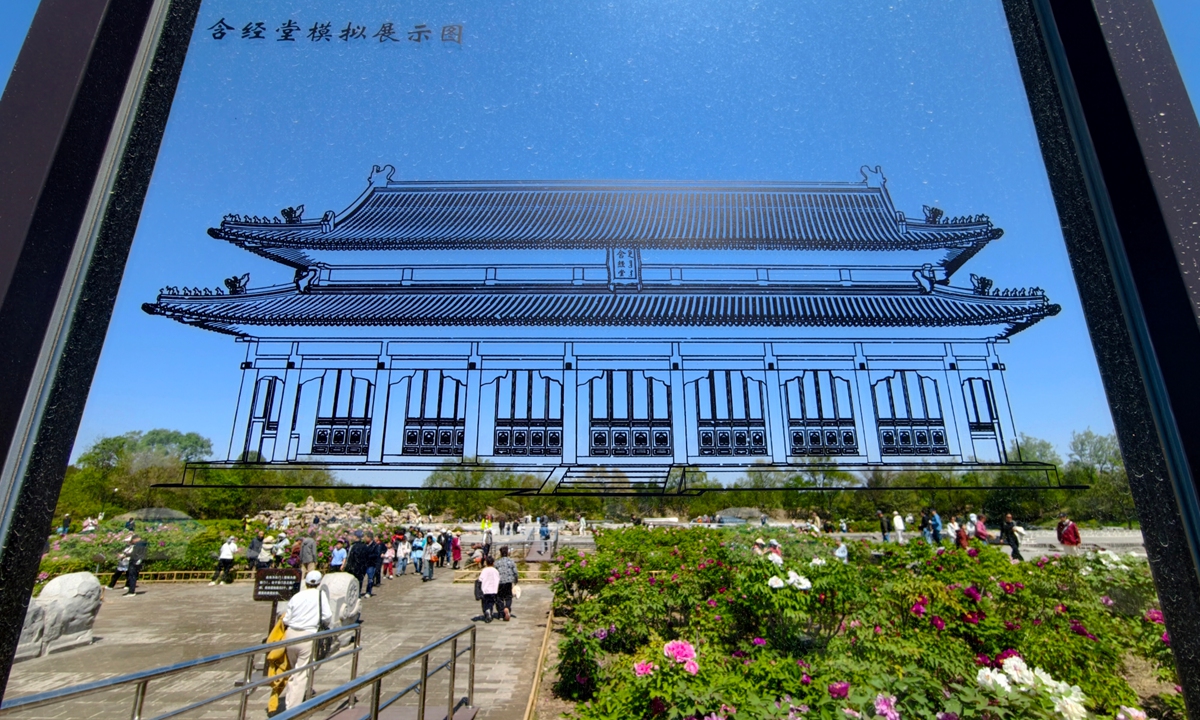
Han Jing Hall ruins in the Old Summer Palace, or Yuanmingyuan Photo: VCG
Recently, over 100 varieties of peonies have come into full bloom at the Old Summer Palace, or Yuanmingyuan, in Beijing. The Han Jing Hall ruins, the area with the highest concentration of peonies, have just reopened to the public after renovation and upgrades. One of the key changes is the installation of four perspective display boards at the site. These visual boards help visitors understand the original structure of the Han Jing Hall by providing clear illustrations, according to CCTV News.The Han Jing Hall, one of the ruins in the core building complex in Yuanmingyuan, is known as the primary area for peony planting at the park. The site began a project to upgrade its conservation and display facilities in April 2025. Now that the renovation is finished, the area is open to the public again.
New additions include age-friendly facilities, protective nets for the ancient stage, and, most noticeably, perspective display boards. The visuals of these boards restore the layout of the Han Jing Hall's original buildings, letting visitors "see" how it once looked while standing amid the ruins. This directly solves the common problem at large historical sites where visitors can only see ruined walls but cannot imagine the original structure, the report said.
"We hope that by creating such landscapes, visitors who enter the historical ruins can truly feel the collision of history with the present. This is our way to bring history and culture to life," said Yu Na, director of the publicity department of the Yuanmingyuan Administration Office, in an interview with CCTV News.
At present, a smart online tour guide system, designed to go along with the upgrades at the Han Jing Hall, is being tested and will be officially launched soon, according to the administration office.
This type of upgrade helps to make up for the loss of the garden buildings in Yuanmingyuan, leaving visitors with a more vivid impression. At the same time, these efforts led to deeper research into Yuanmingyuan's culture and heritage, Liu Zheng, a member of the Chinese Society of Cultural Relics, told the Global Times.
To help visitors get closer to historical sites, Yuanmingyuan has also tried many other digital approaches. For instance, by harnessing multiple cutting-edge digital technologies, researchers have vividly recreated the magnificent appearance of 40 scenic spots at the park as they existed around the ninth year of the Qianlong Emperor's reign (1744) during the Qing Dynasty (1644-1911). Portions of this digitized achievement have already been incorporated into several virtual reality cultural tourism projects at the park.
The project integrates a wealth of historical sources, most importantly 40 scenic illustrations of the palace painted by court artists Tang Dai and Shen Yuan, which were lost during the looting and burning of the palace by Anglo-French allied forces in 1860. This resulted in a comprehensive panoramic image of all 40 scenic spots. The digital restoration achieves accurate representation of architecture, vegetation, and water systems. Real-time rendering and dynamic interaction using high-precision 3D digital models bring the garden's splendor to life under different times of day and varying weather conditions, according to the Yuanmingyuan Administration Office.
Liu added that such measures not only reveal the profound significance of Yuanmingyuan itself, but are even more important as examples and inspiration for protecting and researching other major heritage sites.
RELATED ARTICLES