ARTS / CULTURE & LEISURE
2 billion views later, ‘Me-ism’ home trend not only a lifestyle, but also pursuit of young souls
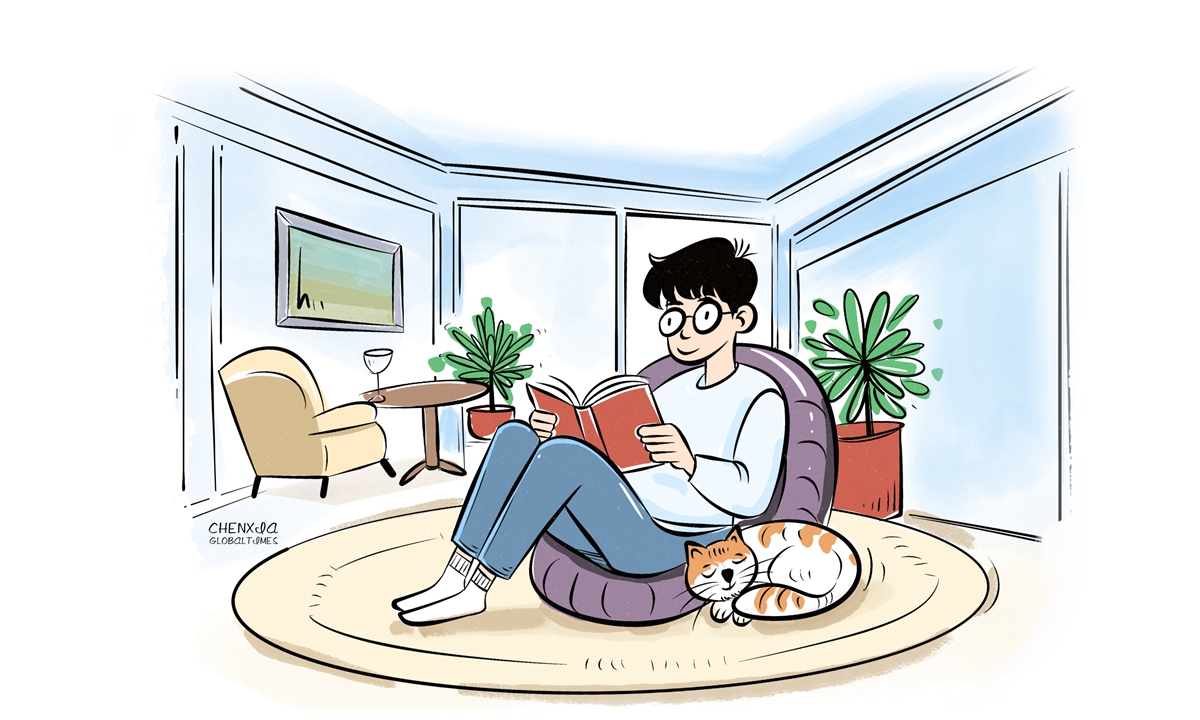
Illustration: Chen Xia/GT
Amassing over 2 billion views, the "Me-ism" trend has taken Chinese lifestyle platform Xiaohongshu, or RedNote, by storm. "Me-ism," originally called "shiwo zhuyi" in Chinese, means that people are no longer blindly chasing fads but instead placing greater value on self-expression. Today, this trend is even more closely tied to youth culture - especially interior design.So how does "Me-ism" relate to home design? The answer, in fact, reveals itself through observation of daily life. In the past few years, particularly since the second half of 2020, interior design styles such as "Wabi-Sabi," "mid-century modern interior" and the "buttercream-style" have become praised aesthetic trends among young Chinese homeowners. In 2022, the "buttercream style" was a craze like no other, with related design demand surging by over 7,100 percent year-on-year.
Just as its name implies, the "buttercream-style" interior design brings warmth, comfort, and a sense of healing to a home through oat tones, milky beige, and soft curved lines.
Yet, it is clear that once it became a viral trend, the style gradually moved away from being the personalized expression of "a cozy home" but turned into a cookie-cutter viral template replicated across renovation showrooms and social media feeds. It was exactly this template-like, one-size-fits-all approach that gave rise to the beginnings of "Me-ism."
In other words, the very root of "Me-ism" is not that a particular style is flawed. It is that people have grown tired of what that style represents - being defined, being categorized, and being just like everyone else.
How do people reject being defined? The answer can be seen in the various sub-categories that have emerged within the "Me-ism" trend. These include "pet-adaptive design," "laziness-adaptive design," and even "spiritual-freedom-adaptive design," among others.
In a personalized pet-adaptive home, every door might feature a small pet door, paired with wall-mounted cat shelves that together form an "indoor maze" designed specifically for the resident cat. Meanwhile, a laziness-adaptive design goes far beyond simply equipping a home with smart devices. It's about eliminating the small discomforts of daily life by rethinking spatial flow and adjusting furniture heights. For example, if someone hates bending down, they might raise the height of their countertops or cabinets - small changes that make everyday life noticeably easier.
As for a spiritual-freedom-adaptive home, it is actually nothing less than an outward expression of people's inner needs. Take Cheng Youxin, the owner of a 60-square-meter home from Chengdu, Sichuan Province, as an example. She told the Global Times she loves traditional Chinese gardens, so she didn't "hesitate to sacrifice her second bedroom," opening it up to the balcony and living room to create a small, enclosed "indoor courtyard" for herself.
Behind these examples lies a clear shift: People no longer view living culture as an act of consumption aimed at proving themselves to others. Instead, they see it as a creative act of self-expression.
There was a time when a home filled with expensive furniture and lavish finishes was, in the eyes of parents, friends, and relatives, a symbol of "doing well." But today, a truly "Me-ist" home might strike those same people as "impractical," or even "odd." Yet it is precisely this kind of home that allows its owner to find peace within.
Hence, the "me" in the "Me-ism" trend is not about selfishness; it is about self-awareness and expression. The notion of "Home" has been gradually redefined as well. It is no longer just about square footage and location, but more about whether it supports the homeowner's personal growth.
Although the "Me-ism" home décor trend is currently flourishing, its popularity should not constitute a judgment against other styles. Nor should we expect this trend to last forever.
More accurately, if we observe the evolution of home decor styles through a socio-cultural lens, we may find that what it truly reflects is how people in different eras, shaped by the contexts of their own times, have variously understood and aspired to a "good life."
Looking back to the 1950s and 1960s, the Chinese home décor philosophy of that era valued practicality and durability above all else. The most striking "decoration" did not come from furniture or furnishings, but from crocheted television covers and brightly patterned bedding - modest things, yet they still revealed people's desire for living aesthetics.
Later, China's reform and opening-up policy opened the door to greater exchanges and brought about an economic boom. Luxurious hardwood furniture began to enter households, while intricate ceilings adorned with European decorative motifs became a prevailing trend. Fast forward to today, home decor has shifted toward individual self-expression.
This evolution reveals a profound transformation in social culture - from seeking validation externally to nurturing a sense of inner fulfillment. Therefore, rather than viewing home design as a discourse on changing aesthetics, it actually serves as an epitome of changing social mindsets.
The reason why the current "Me-ism" trend has sparked discussion on the internet is also inseparable from society's growing embrace of people's diverse expressions and individual choices.
On the one hand, young people are more willing to share their "unconventional" homes. On the other hand, the online environment and the public's open attitude have created a safe space for such expression. This is therefore a two-way journey - a meeting point between individual self-narration and society's embrace of diverse values.
The author is a reporter with the Global Times. life@globaltimes.com.cn
RELATED ARTICLES