ARTS / CULTURE & LEISURE
Chinese literature has the power to connect with the world: China Writers Association official
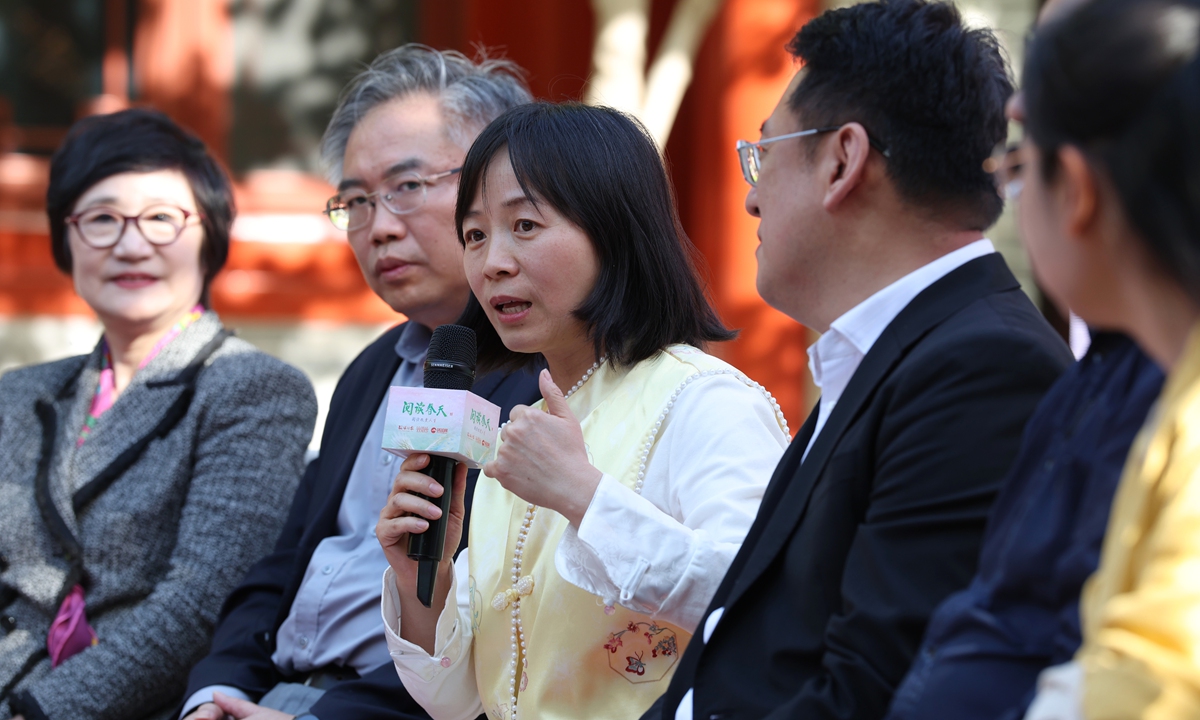
Jiang Haoshu (center) speaks during the Spring Reading event in Beijing on April 20, 2026. Photo: Cui Meng/GT
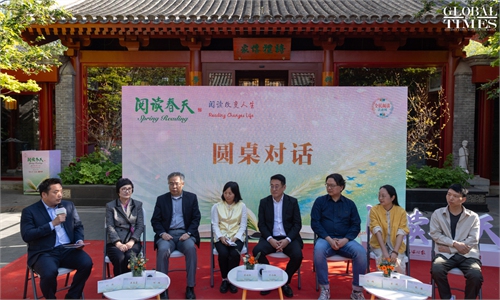
Spring breeze flips the pages, and reading changes life. The Global Times "Spring Reading" event was recently held at the Guangcheng Academy in Beijing. With literature as the medium and making friends through reading, the event has built a bridge for exchanging insights on reading and promoting the National Reading Initiative.
During the event, Jiang Haoshu, deputy director of the international department of the China Writers Association (CWA), shared her interpretations of the significance of reading for personal growth and social development.
Jiang told the Global Times that reading helped her venture out into the wider world.
"For the generation of women born in the 1970s, reading Sanmao's works is a deeply ingrained shared memory. It was through reading that those of us growing up in small, lower-tier cities or towns came to realize that the world is far broader than the tiny corner we inhabit. This spirit of exploration and boldness laid the foundation for my decision to leave my hometown and head for a big city, ultimately changing the course of my life," she noted.
Sanmao is a female writer from China's Taiwan region who lived during the latter half of the 20th century.
"In middle school, I secretly read Sanmao's books. My mother used to say, 'you can't live on reading novels.'On my very first day at CWA, I called her and said, 'today, I'm standing at the CWA, proof that I can really live on reading novels.' From a literature lover who once had to read in secret to a literary professional, reading helped me fulfill a lifelong dream," Jiang said.
During her time working in the international department of the CWA, Jiang said they were committed to promoting Chinese literature to the world.
It is encouraging to see that Chinese literature has a large and devoted readership overseas. Works by authors such as Liu Cixin are widely popular, and online literature has even reshaped the life paths of some international readers. In regions where mobile connectivity remains limited, print reading still enjoys a broad market. Increasingly, readers around the world are coming to understand China through its literature, she said.
Chinese literature has the power to connect with the world, and reading Chinese works enables the world to better understand China, Jiang said.
Although the medium of reading may change, the power of words and language will not disappear. Words engage the left hemisphere and the prefrontal cortex, balancing the more sensory-driven nature of audiovisual content and fostering well-rounded human development. Words come first, and from them, endless possibilities unfold. I hope more people will read, create, and write their own stories, she added.
RELATED ARTICLES