ARTS / BOOKS
Screenwriter Yu Baimei: ‘Reading is humanity’s last weapon in the AI age’
Seeking vs selecting
By Published: Apr 27, 2026 05:39 PM

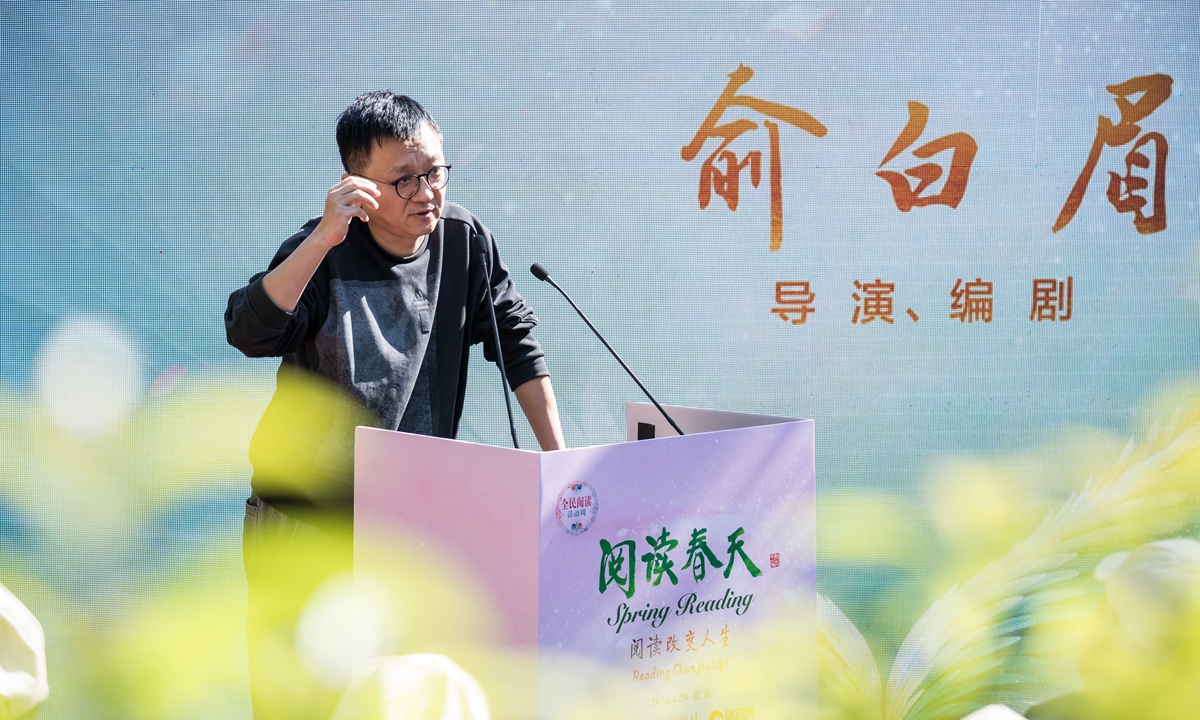
Chinese director and screenwriter Yu Baimei Photo: Chen Tao/GT
Chinese director and screenwriter Yu Baimei has built a distinguished career combining humor, emotion and social insight. A graduate of Xidian University with a degree in computer science, he later turned to filmmaking, directing hits like The Breakup Guru, Devil and Looking Up. His latest work, the martial arts film Blades of the Guardians, that has hit Chinese cinemas this Spring Festival, has drawn widespread attention. In an exclusive interview with the Global Times, Yu reflects on how reading has shaped his journey and why reading, especially deep reading, is so vital in the age of artificial intelligence (AI).A lifelong love
Yu is a nostalgic man who has lived in the same home for over 20 years. Indeed, the greatest challenge during a recent home renovation was not moving furniture, but his extensive book collection.
"Buying books is my only hobby," he told the Global Times.
Reading took root in Yu's childhood in a small town in Northwest China's Shaanxi Province.
"When all other kids went to watch the annual Shehuo folk performance, I would stay behind to read Water Margin," he recalled. That book, worn thin from repeated reading, was his first. On his way to and from school, he would regale his desk-mate with adapted stories from Journey to the West, which he called "the start of his journey as a storyteller."
In junior high, Yu immersed himself in martial arts novels, particularly renowned Chinese wuxia novelist Jin Yong's works, which has become a foundation that later inspired his direction of Blades of the Guardians.
"Although I have never written a martial arts novel, I finally got the chance to shoot my first martial arts film Blades of the Guardians the year before last," he said.
"All this work experience comes from those martial arts novels that were confiscated by my teachers when I was in junior high school," he added jokingly.
In high school, he formed a small reading club and spent his pocket money on second‑hand bookstores in Xi'an, the capital city of Shaanxi Province.
Yu revealed that author Liang Shiqiu's works had the biggest impact on his writing, helping him transition from a computer science student to a professional screenwriter.
"Liang's collected works taught me the most important writing secrets. He influenced me more than any other author," he said.
He also recalled that in high school, he longed for a set of The Complete Works of Lu Xun, but his family's financial constraints made it impossible. It was only later, after he became a screenwriter and started earning money, that he finally bought a deluxe edition, which he has treasured ever since.
Over the years, reading has remained an essential tool for Yu's creative work. His home library spans a wide range of subjects, and for Yu they are a treasure trove of creative material.
"As a screenwriter for so many years, seeking inspiration from books across different disciplines is what I do naturally," Yu said, adding that reading is not just a hobby: books profoundly shaped his mind, helping him use AI more efficiently.
Deep reading
As a judge for the AIGC section of this year's Beijing International Film Festival, Yu has delved deep into AI over the past two years. He acknowledged that AI has reduced his reliance on books for creative research, but it has also reinforced his belief that "reading is humanity's last weapon in the AI age."
Yu sees AI as a tool for creative equality, allowing ordinary people to visualize their stories without professional skills.
"In the past, only 600 professional screenwriters' stories were seen annually," he said. "AI lets people like my father, a farmer-turned-worker in Xi'an, tell his own story." Yet he insists reading is more important than ever.
With a background in AI, Yu offers a sober perspective: AI is essentially a mathematical probability problem.
"In theory, given enough data, AI could write A Dream of Red Mansions, but the probability is so low we'd never see it," he explained. The key difference between humans and AI lies in "selection," AI excels at generating possibilities, but only humans can select what serves human beings' emotional and biological needs.
Yu uses AI to assist in scriptwriting, including the lyrics for Blades of the Guardians, but every choice he makes stems from decades of reading.
"In the age of AI, books that merely deliver information matter less, while books that express and develop ideas are becoming invaluable," he said, emphasizing the importance of deep reading.
"Deep reading is like a pair of running shoes before an 'AI avalanche.' You might not outrun the avalanche, but you can outrun those people around you," he said.
RELATED ARTICLES