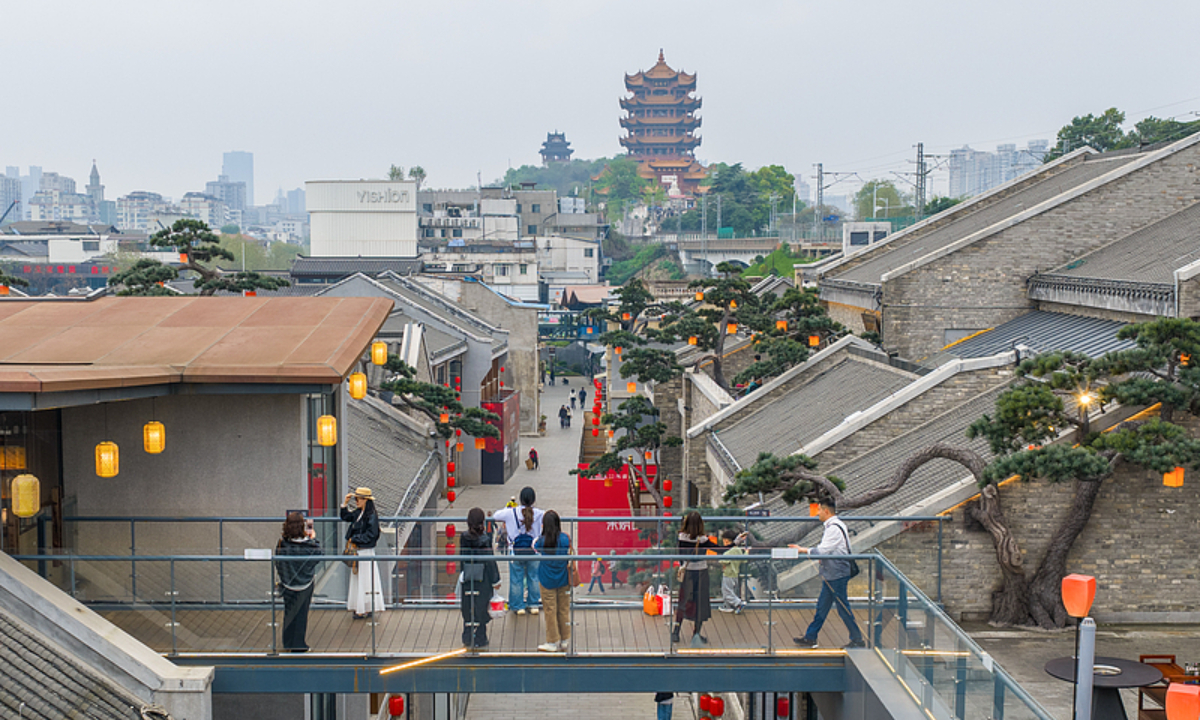
Tourists take pictures with Wuhan’s iconic Yellow Crane Tower on April 6, 2026. Photo: VCG
As the May Day holiday draws near, 28-year-old photographer Zhao Xingchen is overwhelmed with work, busily juggling a surge of bookings and constantly replying to inquiries. A Global Times reporter learned that her WeChat Moments are filled with photo albums of Wuhan’s iconic Yellow Crane Tower, which she took for her clients. Working as a travel photography consultant, she accompanies tourists on their trips, captures professional photos, and introduces local scenic spots and authentic delicacies.
This more flexible form of employment has exploded in popularity as China’s cultural and tourism consumption surges, and Zhao’s example is a vivid microcosm of the broader new occupation boom sweeping the country. In recent years, an increasing number of new occupations have entered the public view, bringing more employment opportunities and diverse career choices.
“The May Day holiday is always busy, and the slots from April 29 to May 5 are almost fully booked, with only a few left. The earliest booking for my service for May Day holiday this year was made on April 8,” Zhao said.
Zhao told the Global Times on Monday. On peak days, she serves up to five groups of clients.
For Zhao, the biggest reward is turning her two passions—photography and her college major in tourism management—into a sustainable career. Ninety percent of her clients are out-of-town visitors who want both a local guide and a professional photographer to document their trips.
She has worked full-time as a travel photography consultant for two years. “Competition is much fiercer this year than last, as more people from all walks of life have joined the industry, offering clients more options,” she said. “Even so, my order volume remains steady, and I earn an above-average income in Wuhan.”
Zhao’s experience is far from unique. Beyond travel photography consultants, a wave of new occupations has entered the public eye, catering to evolving consumer demands for quality, healthy and personalized experiences.
Other notable roles include AI trainers, who feed training data to AI algorithms; long-term care workers, who integrate daily care, medical support, health management and long-term care insurance expertise; indoor environment managers, who improve air quality in newly renovated homes; and sleep health managers, who help people address non-clinical sleep issues, according to Xinhua News Agency.
Rising consumer demand has created acute talent shortages in many of these fields. North China’s Tianjin has classified delivery staff and carbon emission managers as "extremely scarce occupations," while Hangzhou and Ningbo in East China’s Zhejiang Province have listed infant development guides, health caregivers and all-media operators on their scarce occupations lists, according to Xinhua.
Zhang Yi, CEO of iiMedia Research Institute, told the Global Times on Monday that the frequent emergence of new occupations reflects the surging vitality of economic and social development.
From new technological trends such as artificial intelligence, to new consumption formats such as the companion economy and immersive experiences, the acceleration of economic transformation has driven more diverse talent demand, accelerated job turnover, and opened new employment pathways, Zhang said.
RELATED ARTICLES