China's 17-year-old state-owned asset law of enterprise set for first major overhaul
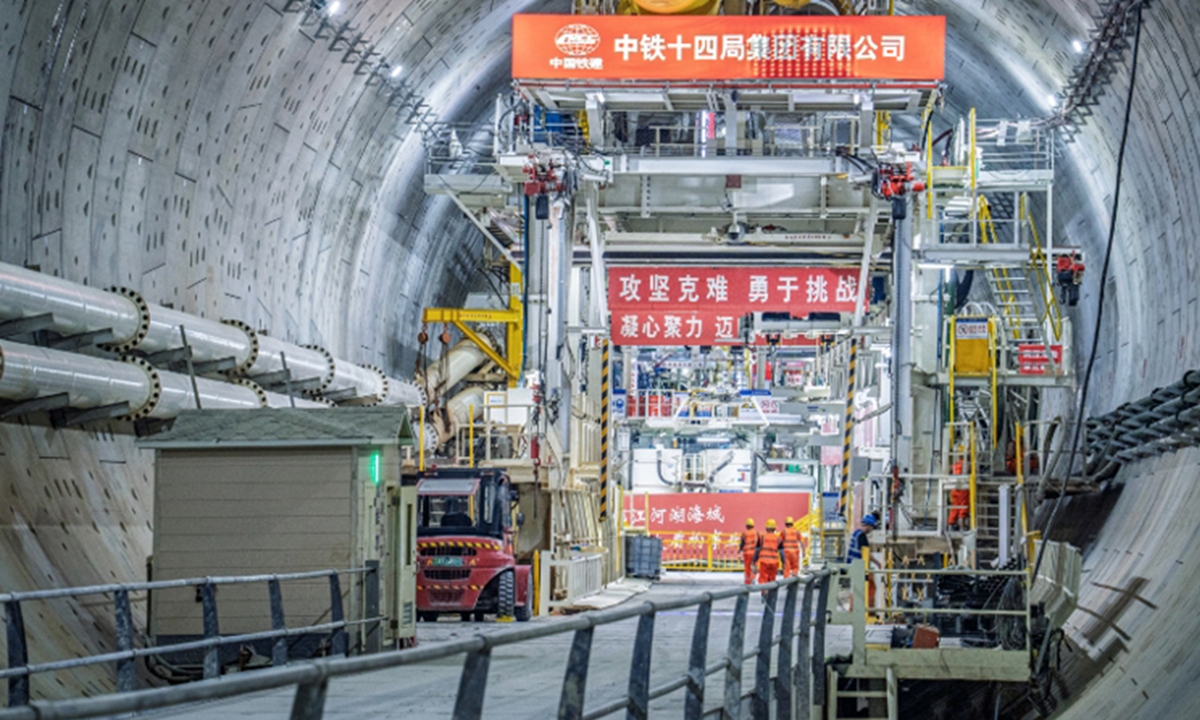
The Huanggang Road Yellow River Tunnel, which is the world's largest-diameter underwater shield tunnel, serves as a key transportation link in Jinan, East China's Shandong Province. Photo: Courtesy of China Railway 14th Bureau Group
China's Law on State-Owned Assets of Enterprises, which has been in effect for nearly 17 years, is undergoing its first major revision. A draft version was submitted to a standing committee session of China's top legislature for its first reading on Monday, according to the Xinhua News Agency.
The revision followed a problem-oriented approach, balanced development and security, and upheld the principle of seeking progress while maintaining stability, according to Xinhua.
The draft made comprehensive changes to the existing law, revising 71 articles and adding 32 new ones, resulting in a total of 109 articles across nine chapters, according to Xinhua.
Key revisions include improving the modern enterprise system with Chinese characteristics, refining the supervision and management system for state-owned assets, clarifying the principle of classified management, and strengthening the management system for state-owned capital gains, Xinhua reported.
Enacted on May 1, 2009, the Law on State-Owned Assets of Enterprises has served as the foundational legal framework for the supervision and management of state-owned assets in China, according to information posted on the website of the National People's Congress.
Over the past 17 years, the law has provided strong legal support for the reform and development of state-owned enterprises (SOEs), according to Xinhua.
In the context of the complex and profound changes in China's development environment during the 15th Five-Year Plan (2026-30) period, revising and improving this law is of great significance. It aims to provide stronger legal guidance and guarantees for the reform and development of state-owned assets and SOEs, and to strengthen the rule of law in state-owned asset supervision and management, thereby ensuring the sustained and healthy development of the state-owned economy.
China will continue to deepen the reform of SOEs, officials said at a press conference in January. Efforts will be made in aspects such as the optimization and restructuring of the state-owned economy's layout, promoting the deep integration of sci-tech and industrial innovation, and continuously improving the supervision system and mechanism for state-owned asset management.
This year's Government Work Report also gave instructions on work related to SOEs. "We will formulate and implement plans for further deepening SOE and state-capital reform to refine the layout of the state-owned sector and adjust its structure," read the report.
Global Times
RELATED ARTICLES