Iran reportedly proposes three-phase peace framework as Iranian FM visits Russia
Progress on talks remains uncertain given divided demands between Washington, Tehran: Chinese expert
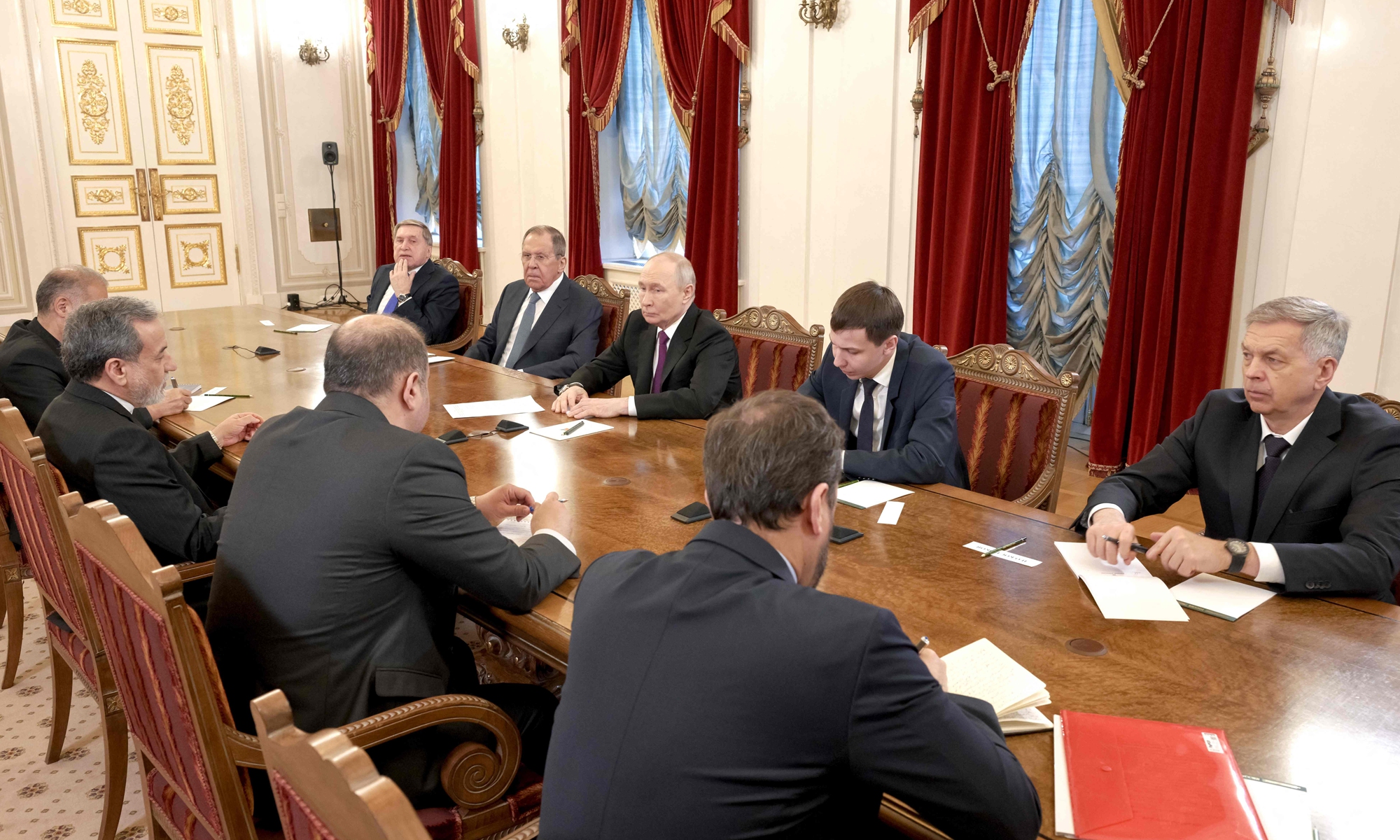
In this pool photograph distributed by the Russian state agency Sputnik, Russia's President Vladimir Putin and Iranian Foreign Minister Abbas Araghchi hold talks at the Boris Yeltsin Presidential Library in Saint Petersburg on April 27, 2026. Photo: VCG
Amid the latest diplomatic efforts regarding the deadlock in US-Iran peace talks, Tehran has outlined a three-phase negotiation approach covering ceasefire guarantees, maritime coordination in the Strait of Hormuz, and later discussions on its nuclear program, as Iran's foreign minister arrived in Russia on Monday and met with Russian President Vladimir Putin, after stops in Pakistan and Oman over the weekend.
Russian President Vladimir Putin held talks with Iran's foreign minister Abbas Araghchi in St. Petersburg in which Putin emphasized that Russia will do everything that corresponds to the interests of Iran and other countries of the region, so that peace in the Middle East comes as soon as possible, according to Russian media RIA Novosti.
Putin also stated that he had received a letter from Iran's Supreme Leader Mojtaba Khamenei, RIA Novosti said.
Chinese experts said that the proposal and flurry of diplomatic visits showed Tehran's willingness to promote the peace talks, and that the latest framework could pave the way for a possible resumption of negotiations. However, given the deep divides over core demands between the US and Iran, prospects for future peace talks remain uncertain.
Iran has informed mediators of a proposed three-phase framework for negotiations and says talks could resume if the US agrees to the plan, Lebanese media outlet Al Mayadeen's correspondent in Tehran reported on Monday.
The proposal, as described by the correspondent, outlines an initial phase focused on ending US-Israeli aggression and securing guarantees that fighting will not resume against Iran and Lebanon. During this stage, Iran would not discuss any other issues, the report said.
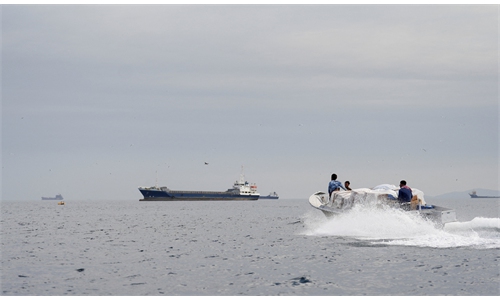
If agreement is reached on the first phase, discussions would move to a second stage centered on the management of the Strait of Hormuz. The plan reportedly envisions coordination with Oman to establish a new legal framework governing the strategic waterway, per the Lebanese media outlet.
The third phase would address Iran's nuclear program, which Tehran would only be prepared to discuss after agreements are reached on the first two phases, according to the report.
Sun Degang, director of the Center for Middle Eastern Studies at Fudan University, told the Global Times on Monday that the three-stage plan showed that Iran is breaking down the very complex conflict into manageable parts. From Iran's perspective, the most urgent priority is to achieve a ceasefire that applies not only to Iran but also to regions including Lebanon. After the ceasefire, the next issues to be addressed are the Strait of Hormuz blockade and the nuclear issue.
"In the current stalemate between the US and Iran, Iran's proactive initiative in putting forward this plan demonstrated its willingness to actively engage in peace talks," Sun said.
Zhu Yongbiao, a Middle East affairs expert with Lanzhou University, told the Global Times on Monday that the phased proposal carries certain realistic implications and could potentially lay a foundation for the possible resumption of relevant negotiations.
Tehran's proposal came as Iran's Foreign Minister Abbas Araghchi landed in Russia on Monday ahead of a meeting with Russian President Vladimir Putin to discuss the conflict with the US, CNN reported.
In comments to local reporters after arriving in Russia, Araghchi said the US' excessive demands have caused peace negotiations to fail in Islamabad, per BBC. Touching down in St Petersburg, Araghchi says he will consult with Russia about the war in the Middle East, the report said.
The stop at Russia came after Araghchi's visits with key mediators in Pakistan and Oman on the weekend. Araghchi arrived in Islamabad on Sunday for a second visit within around 24 hours, returning from a brief stop in Oman as diplomatic activity over the region's fragile ceasefire intensified, the Xinhua News Agency reported, citing Iran's Mehr news agency.
The fact that Iran keeps making visits to third-party countries further shows its readiness for peace talks and its acceptance of mediation from these nations, Sun said, adding that it also indicates that Iran is not isolated within the international community regarding the current situation in the Middle East.
While Iran is stepping up its diplomatic efforts, over in the US, President Donald Trump on Sunday defended his decision to cancel his envoys' planned trip to Pakistan, saying Iranian authorities "can call" if they want to talk, while reiterating the war could "come to an end very soon," CNN said in a report.
"If they want to talk, they can come to us, or they can call us," the US president said in an interview on Fox News' "The Sunday Briefing", according to Reuters.
After nearly two months of maneuvering, neither the US nor Iran has any genuine appetite for prolonged conflict, Sun said. "Nevertheless, deep divides persist over their core demands, with each side waiting for the other to blink first in the stalemate. Against this backdrop, the prospects of the peace talks remain clouded by uncertainty," the expert said.
RELATED ARTICLES