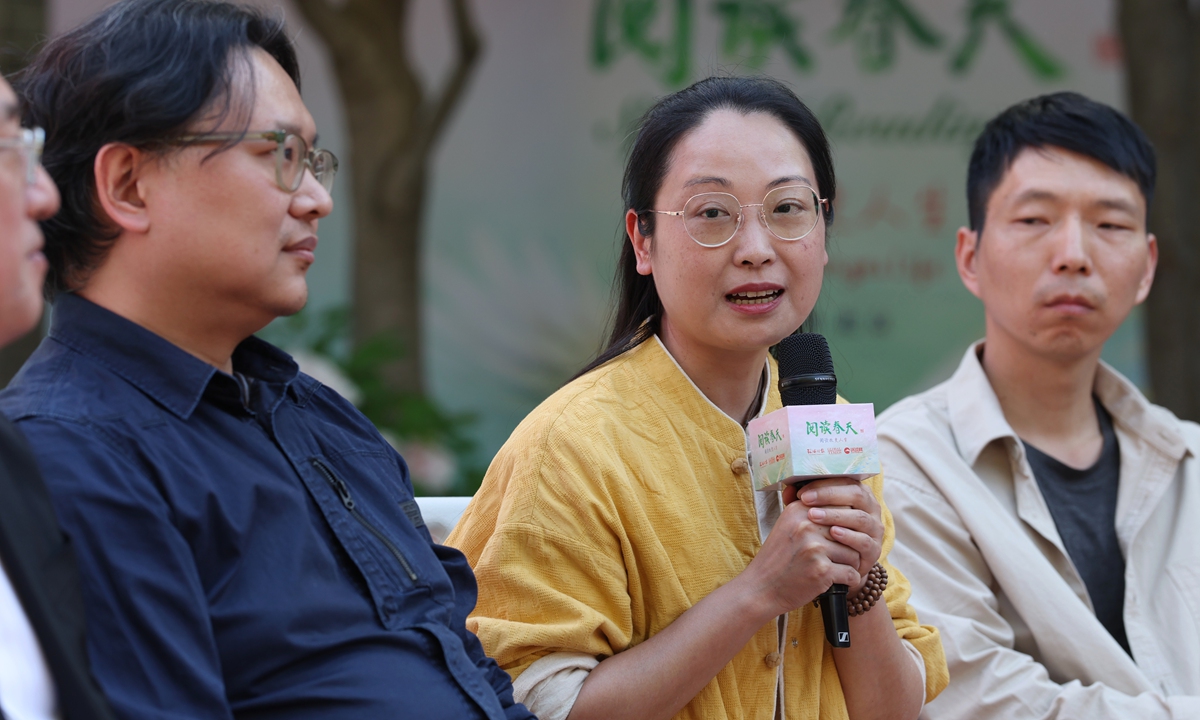
Huang Ying, the co-founder of Qingtian Academy in East China's Jiangxi Province Photo: Cui Meng/ GT
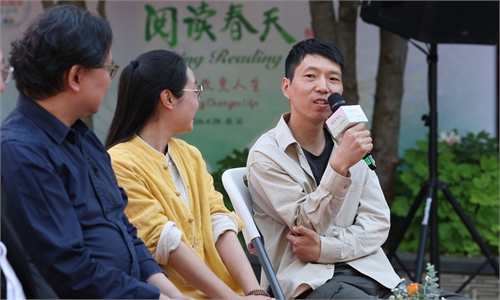
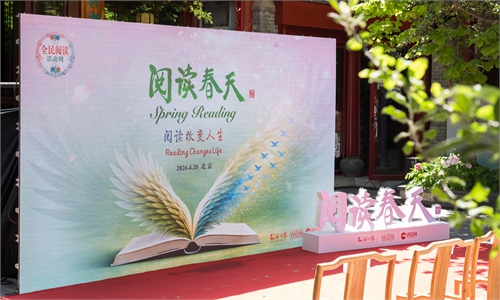
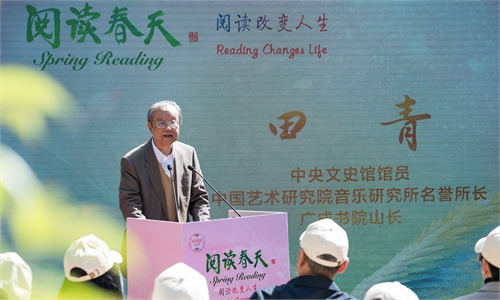
The spring breeze flips the pages, and reading changes lives. The Global Times "Spring Reading" event was recently held at the Guangcheng Academy in Beijing. With literature as the medium and making friends through reading the theme, the event built a bridge for exchanging insights on reading and promoting the National Reading Initiative.
During the event's panel discussion, Huang Ying, co-founder of the Qingtian Academy in East China's Jiangxi Province, shared how an academy rooted in the countryside can inspire a love for reading within the local rural community.
Though set among fields and villages, the academy is, in fact, a place with a long history and rich cultural heritage. Established during the Yuan Dynasty (1279-1368) in honor of the renowned Southern Song (1127-1279) thinker Lu Jiuyuan, the academy offers not only an atmosphere of reading and reflection but also access to around 1,000 ancient texts — something rarely found in cities.
For Huang, enriching the local rural community with such deep cultural heritage requires a rural academy to think clearly about three fundamental problems: Who their readers are, what they should read, and how they should engage with reading.
She noted that in the village where the academy is located, the population is mostly elderly people, women, and children — some of the elderly cannot even read. "With such a demographic reality," she said at the event, "asking them all to sit quietly and read a book is simply impractical."
To cope with this dynamic, Huang said the academy has tried to make "the culture within books visible." For example, among the academy's collection of books and ancient texts, many contain records of Jinxi county, the home county of Lu Jiuyuan and where the academy is located. Instead of asking people to read historical materials about their roots, Huang and her team designed a route titled "Reading Jinxi" that guides participants on a journey through fields and forests to trace Lu Jiuyuan's footsteps.
In addition to the "Reading Jinxi" route, the academy also organizes hands-on cultural activities during which children explore poems and couplets preserved in ancient texts, appreciating them and even trying their hand at writing them. "We've never thought of reading as simply reading a book," Huang remarked. "Reading can be a cultural experience beyond books."
Expressing gratitude for the invitation to the Global Times' reading event, Huang also shared her own journey as a rural cultural worker. She admitted that for the first 30 years of her life, she had never truly set foot in the countryside. "The only idea I had of the rural life came from TV or from my tomb-sweeping experience during the Qingming Festival," she said.
Yet after becoming connected to the Qingtian Academy, she never wanted to leave. When she was asked why she chose to take root in the village, her answer was simple: "I just want to plant a seed in the hearts of the people here."
"Through reading and cultural experiences, I hope to make them proud of their rural heritage, and above all, to inspire the village children with a passion and yearning for knowledge and culture," Huang remarked.