ARTS / CULTURE & LEISURE
Reading preserves human dignity in an AI world
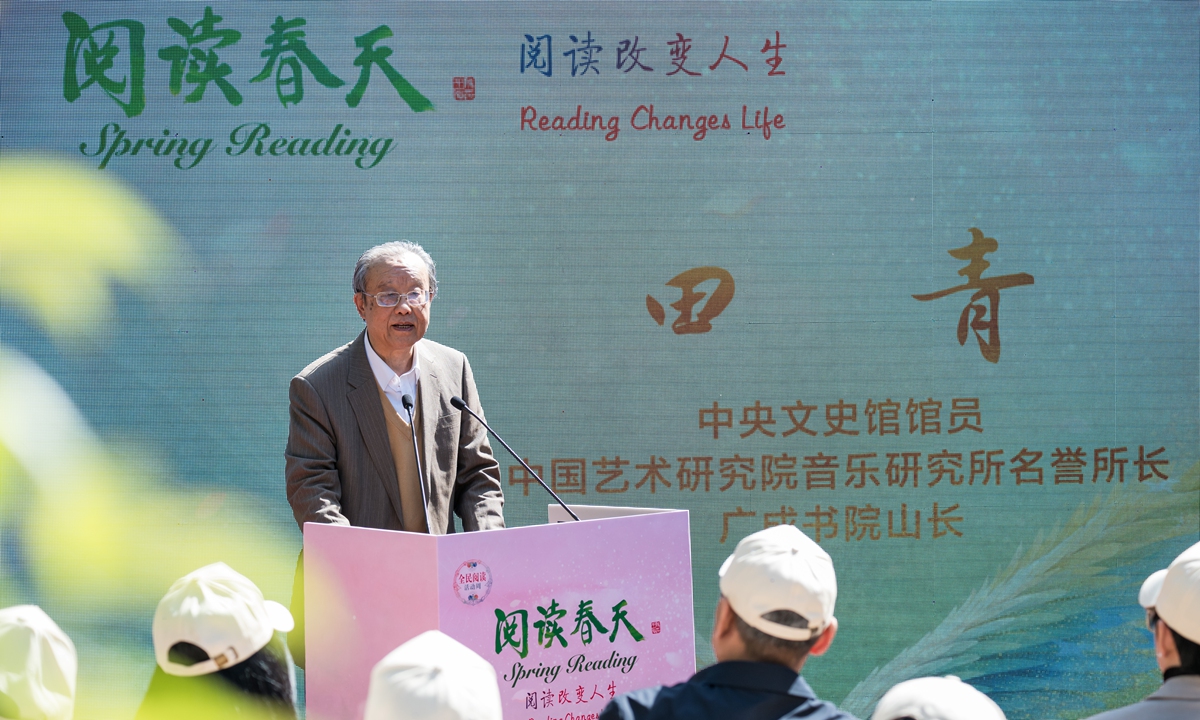
Tian Qing Photo: Chen Tao/GT
Editor's Note:
Spring breeze flips the pages, and reading changes life. On Monday, the first day of China's first National Reading Week, the Global Times "Spring Reading" event was held at the Guangcheng Academy in Beijing. Taking literature as its theme and making friends through reading, the event built a bridge for exchanging insights on reading and promoting a book-loving society.
During the event, Tian Qing, director of the Guangcheng Academy, a member of the China Central Institute for Culture and History, and honorary director of the Institute of Music Research at the Chinese National Academy of Arts, shared his views about the power of reading and the role reading plays in the era of Artificial Intelligence (AI).
This article is based on Tian's speech at the event.
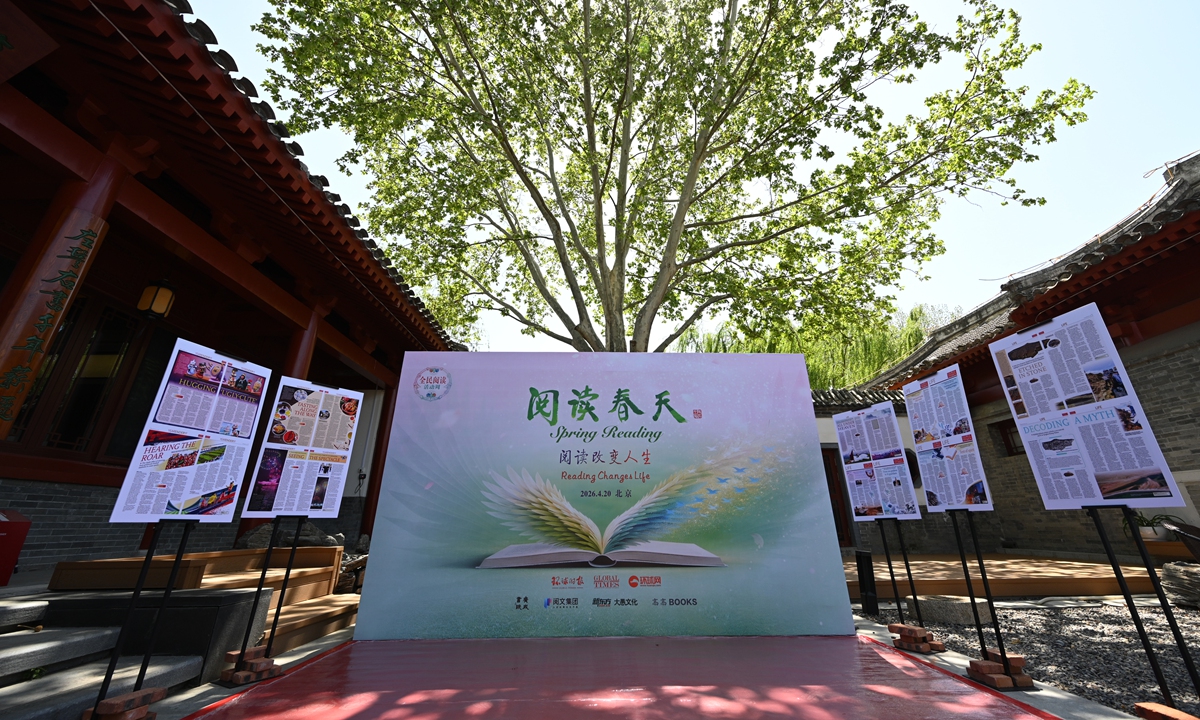
A scene of the Global Times "Spring Reading" event at the Guangcheng Academy in Beijing on April 20, 2026 Photo: Chen Tao/GT
The establishment of the Guangcheng Academy aims to carry forward China's outstanding traditional culture. Since its founding in October last year, the academy has focused on three main initiatives.First, it organizes high-level academic lectures about once a month. Second, it promotes China's intangible cultural heritage through exhibitions and shows. Third, it hosts reading salons, with sessions planned once a week. Through reading, it hopes to ensure that traditional culture is truly passed down.
When discussing the impact of AI on society, someone noted that the changes brought by AI extend beyond individual destinies, reshaping the very structure of the era and society itself. The poetic theme of "Spring Reading," while inspiring, also evokes a question about the future - Amid the rapid advancement of AI, how can humanity achieve sustainable development and avoid being replaced by technology?
As a music professional, I think that AI's capabilities in creative fields are striking. Whether in compositional techniques or vocal performance, AI-generated works have reached, and in some cases, surpassed professional standards in pitch accuracy, timbre control, and even emotional expression. Such "flawless" performance is both admirable and deeply disheartening.
Similar trends are evident in other artistic fields such as painting, where AI's prowess in abstract creation has led many artists to conclude that it is increasingly beyond human reach.
When humans feel they are being outmatched even in creative abilities, what path forward remains? I think that reading may be one of the key answers.
Although AI possesses powerful capabilities in information processing and memory, and can even simulate emotional expression, reading, as a long-established human intellectual practice, has long transcended the mere acquisition of knowledge. It is fundamentally tied to the continuity of human culture and the preservation of human subjectivity.
Today, reading is no longer just about acquiring knowledge; it is about carrying forward one of humanity's most remarkable traditions. As AI reshapes this era and the world, and as people debate how humanity can continue to develop without being replaced, I believe that reading represents one of the last bastions of human dignity in the age of AI.
Although AI's capabilities may surpass those of humans by orders of magnitude, the key lies in how we define and use these capabilities. Do we use them for purely utilitarian ends or do we return to the intrinsic value of human development itself? As technology continues to advance, and may even pose challenges to human existence, we must, while embracing progress, also reflect on how to coexist with it.
The "knowledge" delivered by short videos in just a few seconds is not truly absorbed; it is merely received briefly and quickly forgotten. This mode of consumption makes it difficult to cultivate the capacity for deep thinking.
At present, many creators, in an effort to cater to shrinking attention spans, feel compelled to compress their content into 30 seconds or even less. In such an environment, the space for deep reading and reflection is steadily being squeezed.
As the saying goes, "closing the book invites deep thought": Only by truly engaging with a book can one enter a state of contemplation and carry on a spiritual dialogue with the author, even with minds from the past, an experience that endless scrolling on a cell phone simply cannot provide.
This dependence is not limited to younger generations; some writers have also admitted to spending several hours a day browsing short videos or social media. If this trend continues, it will have a long-term impact on humanity's capacity for thought. Therefore, rebuilding the habit of reading is no longer merely a cultural issue, but one that concerns the future direction of human development.
At the same time, the unique value of intangible cultural heritage lies in its irreplaceability. Compared with visual and auditory experiences that AI can simulate, the connection between people and intangible cultural heritage is formed through touch and bodily participation, an embodied experience that technology finds difficult to replicate.
In conclusion, I want to quote a Qing Dynasty (1644-1911) couplet: "All gentlemen read; even immortals doze," underscoring the importance of reading in shaping one's moral character and personal cultivation.
In today's rapidly advancing era of AI, the value of reading should be re-examined. It is hoped that initiatives such as "Spring Reading" can serve as an opportunity to jointly promote the inheritance and revitalization of traditional culture. This is not only about continuing Chinese civilization, but also about seeking a path forward for the future of humanity as a whole.
RELATED ARTICLES