Foreign business representatives, diplomatic envoys eye on deeper ties with China on AI
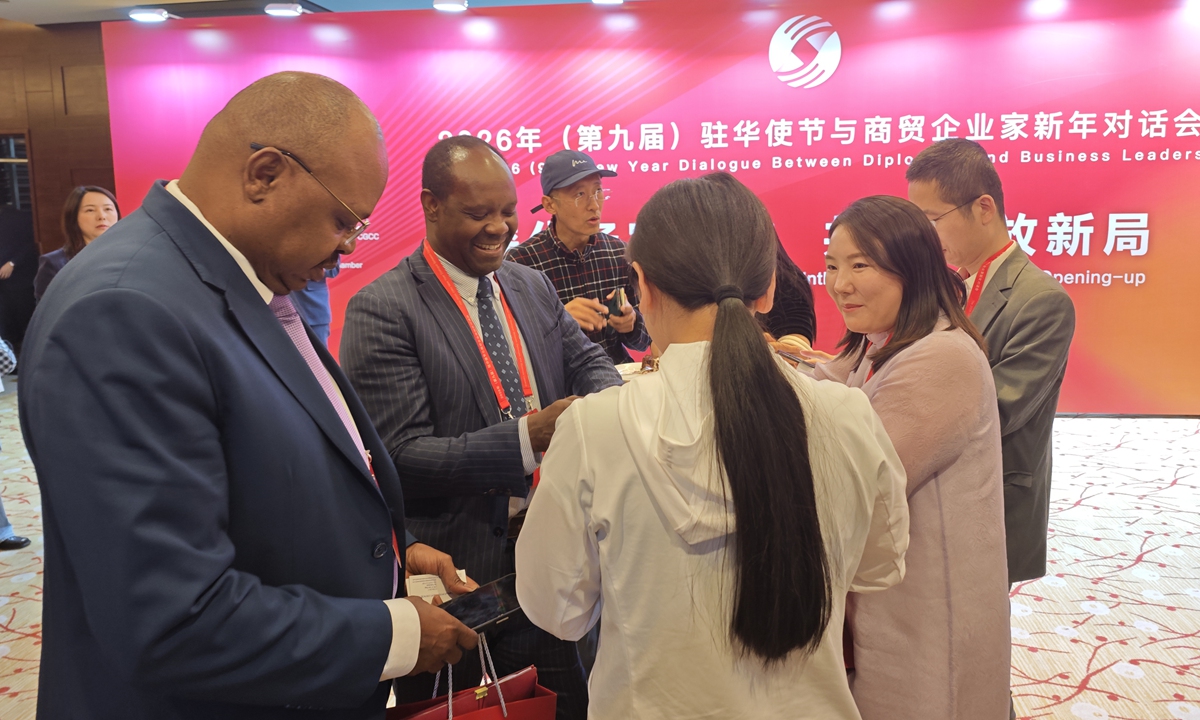
Chinese and foreign participants talk at the forum in Beijing on April 28, 2026. Photo: Yin Yeping/GT
Multiple foreign envoys and business representatives have voiced expectations for expanding cooperation with Chinese high-tech companies in artificial intelligence (AI), where China's competitive edge can help boost traditional sectors such as agriculture and education in their countries.
The remarks were made at the 2026 New Year Dialogue between Diplomats and Business Leaders held in Beijing on Tuesday. The event, which marked its ninth edition this year, attracted hundreds of participants, including government officials and business leaders from various countries.
This year's dialogue, themed "Deepening Practical Cooperation and Jointly Creating New Opportunities for Openness," focused on the practical use of digital technologies such as AI in trade matchmaking, investment decisions, and cross-border cooperation, and promotes linking policy exchanges with project implementation, the Global Times learned from the event organizer.
Speaking at Tuesday's event, Md Ziaur Rahman, commercial counselor, Embassy of Bangladesh in Beijing, told the Global Times that this was his first time to participate in this event centering on AI technology cooperation.
"AI is now a top priority around the world. It is being used across sectors—commerce, sports, tourism, education, and beyond. It can't be ignored... China is one of the leading countries in AI innovations, so it goes without saying China is also at the forefront of AI," Rahman said.
The Bangladesh envoy said that he sometimes use tools like DeepSeek, "which is very useful, especially for preparing reports and gathering data."
"Countries around the world are trying to make use of Chinese technology, and that is very important. The depth of China's technological development is very impressive, and this creates a great opportunity for countries like Bangladesh," Rahman said.
Specific sectors where Chinese AI technology may take root in agriculture in African countries such as Malawi were noted by Fredrick Malire, commercial counselor of the Embassy of Malawi in Beijing.
"AI is a very important tool used across many sectors today... In Malawi, we mainly depend on agriculture, but agricultural practices are not yet very modern," he said, expressing the need to modernize them with AI, "so we can increase production, feed our population, and even expand exports."
And, Malire gave an example that modern tools such as AI can support surveillance of maize fields and other crops, helping detect pest attacks or diseases early so that timely measures can be taken.
African countries are ready to work with Chinese companies to help address these challenges, including those Malawi faces, the African envoy said.
Andriamanalinarivo Zoelinoro, director of Madagascar-China Friendship Strategic Cooperation Association, told the Global Times that she found the event an interesting occasion to discover more opportunities and open doors in different areas regarding technology.
"In education in particular, AI and other advanced technologies could help improve access to educational resources, especially for people in rural and remote areas... We have many people living in rural communities, so this is a real need, and there is definitely potential for cooperation with Chinese companies in this area," said Zoelinoro.
China has become an increasingly important player in global AI industry. In 2025, China became the world's largest holder of AI-related patents, accounting for as much as 60 percent of the global total, the Science and Technology Daily reported, citing data from the World Intellectual Property Organization.
The remarks by foreign representatives on expanding cooperation with China are not surprising, as they reflect broad international recognition of China's AI innovations and application capabilities, Ma Jihua, a veteran industry analyst, told the Global Times on Tuesday.
"With the rapid development of AI, applications are increasingly focused on real-world use. China has accumulated extensive experience, with AI widely applied in industry, agriculture, education, and research, delivering significant results," Ma said, noting that the technologies are highly replicable and scalable.
For many developing countries, adopting such technologies can help realize the inclusive benefits of AI, narrow the digital divide, and support leapfrogging development, the expert added.
RELATED ARTICLES