ARTS / CULTURE & LEISURE
Farmer-writer lets village stories blossom through verses and art
Rural poetry
By Published: Apr 28, 2026 10:03 PM
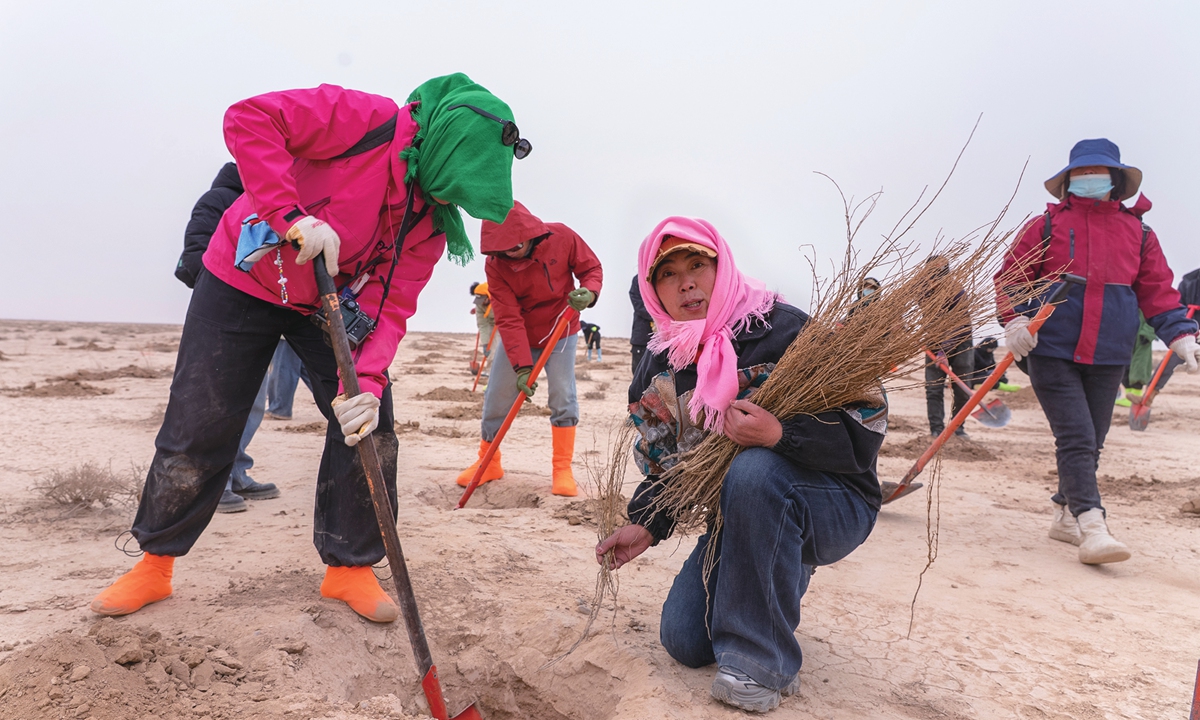
Pei Aimin (right) and local villagers plant trees in a desert in Northwest China's Gansu Province. Photos: Courtesy of Pei Aimin
Whenever readers open one of Pei Aimin's published collections of prose poetry or illustrated books, they can almost smell the scent of earth from the fields and hear the gentle sounds of growing plants swaying in the wind.
For around 30 years, Pei, a farmer-writer in Minqin county, Northwest China's Gansu Province, has tilled the land with her own two hands and cultivated her words on the page. She weaves the fragrance of wheat, the bleating of sheep, and the wrinkles of the village elders into her writing and drawings, bringing the warmth and life of China's northwestern countryside into the hearts of countless readers.
"I always feel like I am standing on the same field as the people in the Shijing, or Book of Songs," Pei told the Global Times. She loves reading this ancient collection of Chinese poems. Though she cannot always fully understand every verse, she pictures ancient farmers working under the same sky as she pulls weeds, and thinks of those spring scenes described in ancient books whenever the peach blossoms bloom.
Once, while standing at the edge of her cornfield, Pei watched sunlight shining through the leaves, making a dewdrop sparkle like a tiny diamond. The breeze brushed past and the drop fell into the soil. "The world becomes so still, as if everything is happening and nothing is happening, but out in the fields, everything is quietly growing. This is poetry in its most vivid form," she said.
During the National Reading Week, Pei stood on the stage as a village reading promoter and storyteller, sharing her journey of creation. She explained that all her poems are written from true feelings.
While working in the fields, she always watched the clouds and listened to the wind; even a small wildflower moved her heart so much that she didn't want to remove it along with the weeds. So, when autumn came, others harvested only corn, but Pei gathered both corn and poems.
For Pei, the land is the purest source of inspiration - every bit of grass or wildflower and every breeze is full of life's texture, radiating warmth and determination. The villages close to the land always feel friendly, vibrant, and alive, both in her eyes and in her writing.
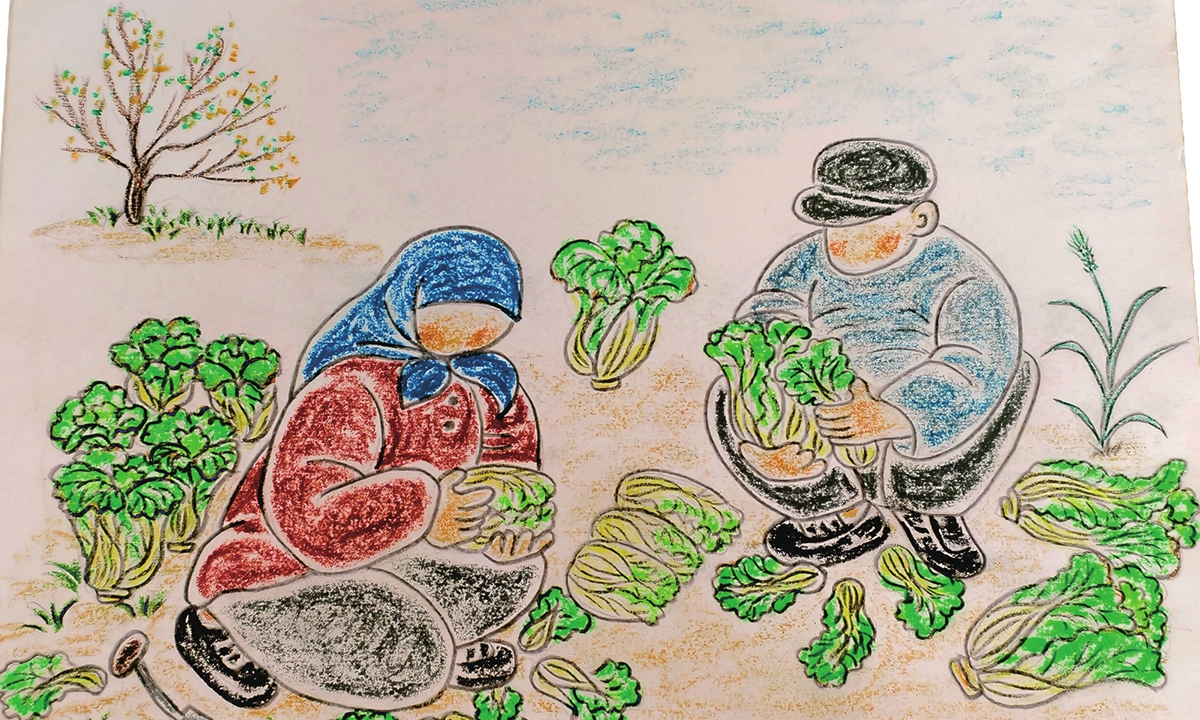
A painting about rural life Pei Aimin created . Photo: Courtesy of Pei Aimin
Poetic harvestTo others, rural life seems like endless, tiring work from dawn to dusk. But Pei always carries a book with her, feeling bright inside even if she only manages to read a few pages while sitting on the edge of a field during a break. Yet, at first, her passion for books was not understood by those around her. People would gossip and ask, "Can reading bring you a bigger harvest?" So, Pei read and wrote quietly, jotting her thoughts on scraps of paper which she tucked into her pocket.
For Pei, writing has always been tightly linked with her farm work. In the early days before cell phones, she kept small pieces of paper and a pencil in her pocket. Whenever there was a short break, she would kneel by a ridge and quickly write down her thoughts - maybe a line about "lambs smelling the fresh grass, more eager than children seeing candy," or a sketch of "haystacks in the evening sun." "If I did not make a note, I'd forget everything after feeding the sheep and cooking dinner," she said.
In 2011, with the help of college student volunteers, she opened a Sina Weibo account. Her creative "studio" moved from scraps of paper to her mobile phone, and typing a few lines during a field break became her favorite moment of the day.
Pei's writing was noticed by a publishing house. In 2022, her first book, with the collection of a decade of her diary entries, was finally published, drawing considerable attention. Pei said that it was only after this book was published that she could finally tell her neighbors with confidence: "When you plant crops well, poetry will also grow from your heart."
Recording farmers' lives
Pei told the Global Times that her first book acted like a key, unlocking a new understanding of reading for the villagers. People who once thought "writing books is for big authors" opened her diary and found scenes familiar to their own lives. Some older villagers, who could not read, would gently caress the book's cover and say with feelings, "Who knew the lives of us as farmers could be so meaningful?"
To share her work with the elder generation who could not read, Pei decided to turn her drawings into a book, too. In her new book, Pei has collected 120 illustrations, capturing all four seasons of the village: sowing in spring, irrigating in summer, harvesting grain in autumn, and spinning thread in winter.
When the book arrived in the village, the elders gathered together. Even if they could not read a word, they could recognize the people and scenes in the pictures. Seeing their smiles, Pei felt even happier than when her first book arrived. "Letting them see their own lives was more precious than any amount of praise," she said.
To this day, Pei keeps writing wherever she goes. "Planting corn means every row must be straight. Now, whether I write or draw, I have to be just as diligent, working with the same care." She plans to write more stories to record the changes in her village. Pei wants more people to know that rural life is more than just hard work - there is endless beauty, like fields of sunflowers in full bloom and the cheery songs of sparrows.
RELATED ARTICLES