‘A wave of China visits’ or ‘the building of high fences’ – which better represents Europe?: Global Times editorial
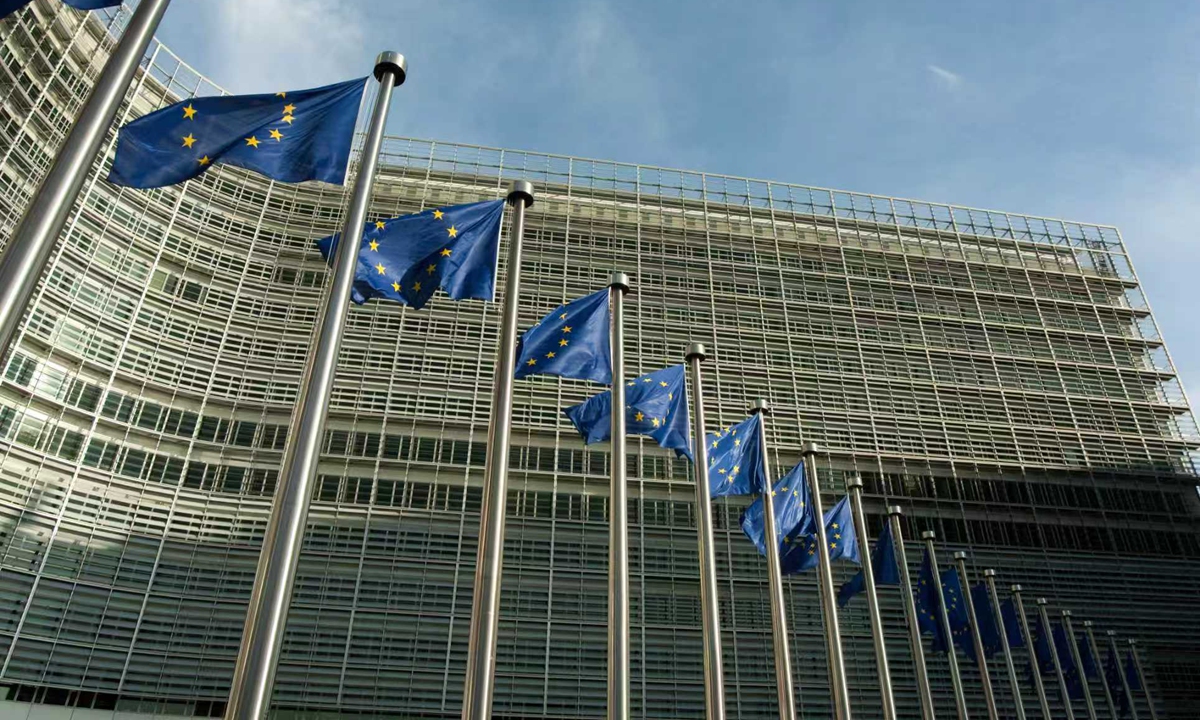
The European Union flags in front of EU headquarters in Brussels, Belgium. Photo: VCG
Recently, Europe has shown a growing divergence in its approach toward China. Belgium's Deputy Prime Minister and Minister of Foreign Affairs Maxime Prevot is currently on a five-day visit to China, his first since taking office. German Economy Minister Katherina Reiche also recently announced that she will visit China in late May. Since December last year, leaders from France, Ireland, Finland, the UK, Germany, Spain, and other countries have visited China in succession, underscoring a notable trend among European leaders to "look East." At the same time, a different picture is emerging in Brussels. On April 27, the EU's Industrial Accelerator Act (IAA), which has been criticized by China's Ministry of Commerce, introduced "made in EU" requirements and mandatory technology transfer provisions targeting four new emerging strategic sectors - batteries, electric vehicles, photovoltaics, and critical raw materials - posing serious investment barriers and institutional discrimination against Chinese companies. The EU has also recently unveiled its largest package of sanctions against Russia in two years, indiscriminately placing several Chinese firms on the sanctions list. While there is a continuous wave of visits to China by European heavyweights, Brussels appears to be repeatedly "building high fences." What's the reason for this "temperature difference"?
The "temperature difference" between "a wave of China visits" and the "building of high fences" essentially reflects a strategic disorder within the EU amid rising industrial anxieties. Brussels' perception of China and its related policies are increasingly shaped by geopolitical considerations and ideological bias, framing China as a so-called "systemic rival." It tends to impose its own outdated political experience onto China's development path, distorting China's comparative industrial advantages into alleged "systemic risks," and thereby falling into the trap of self-imposed constraints. In contrast, many EU member states, through practical engagement with China, have come to recognize that China is not only an opportunity that cannot be missed but also a partner in addressing shared challenges. Their perceptions have been recalibrated in practice, leading to more pragmatic and proactive China policies.
Brussels' so-called "de-risking" policy toward China has in fact deviated sharply from member states' actual economic interests and their demand for cooperation with China. According to foreign media reports, the drafting of the IAA faced opposition from multiple departments within the EU. Nine countries - the Czech Republic, Estonia, Finland, Ireland, Latvia, Malta, Portugal, Slovakia, and Sweden - jointly sent a letter expressing concerns, explicitly warning that the exclusionary provisions in protectionist policies would do more harm than good. German Chancellor Friedrich Merz publicly criticized the minimum "Made in EU" threshold, while Peter Kofler, chair of Danish Entrepreneurs, stated bluntly that Europe won't secure its future by turning inward. Yet despite such widespread opposition, the bill was still pushed through, suggesting that Brussels does not genuinely listen to its member states and highlighting structural flaws in the EU's decision-making mechanism.
The introduction of the IAA marks a reversal and regression in the logic of EU industrial policy. For more than two decades, the EU has styled itself as a "defender of free trade," frequently smearing China with terms including "forced technology transfer" and "investment barriers." However, this legislation precisely replicates the various protectionist practices it once criticized. The EU has long taken pride in the "Brussels Effect," through which its rules and standards exert normative influence on global governance. But once it turns toward protectionism, that same effect risks becoming an accelerator of self-isolation, harming others while being detrimental to oneself.
As the two major economies in the world, China and the EU have far greater industrial complementarity than competition. Interdependence is not a risk, and the intertwining of interests is certainly not a threat. Statistics show that there are over 10 million yuan in trade exchanges between China and EU every minute on average. China's direct investment in the EU has created over 260,000 local jobs, which translates into the livelihoods of 260,000 European families. In the first quarter of this year, the China-Europe Railway Express handled a total of 5,460 train trips, with the goods transported reaching 546,000 twenty-foot equivalent units, up 29 percent and 22 percent year on year, respectively. These figures are sufficient to illustrate the absurdity of "decoupling and severing supply chains" from China; the EU's policy toward China, divorced from realities, is continuously eroding the mutual trust between China and the EU. China is firmly committed to expanding high-level opening-up and consistently advocates resolving differences through dialogue and consultation. European businesses also generally look forward to riding the wave of China's high-quality development. Brussels has no reason to become a "policy shortcoming" in the broader context of China-Europe cooperation and win-win outcomes.
How should China and the EU interact? The answer has long been written in the practices of China-EU relations. When leaders from various European countries set foot on Chinese soil, they demonstrated through their actions that dialogue rather than confrontation, and cooperation rather than "decoupling," is the right way to manage China-EU relations.
As an important pole in a multipolar world, Europe should not belittle itself or fall into the fallacy of zero-sum thinking. Instead, it should actively assume responsibility, maintain strategic autonomy, and contribute to the maintenance of free trade and the establishment of genuine multilateralism. We look forward to Brussels redefining its position and value in the global landscape as it clarifies its strategic approach toward China.
RELATED ARTICLES