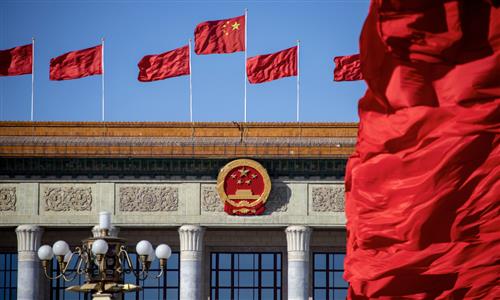
Xi chairs CPC leadership meeting on economic situation and work
Chinese economy’s robust start this year underscores resilience and dynamism

top news
The Political Bureau of the Communist Party of China (CPC) Central Committee held a meeting on Tuesday to analyze and study the current economic situation and economic work. Xi Jinping, general secretary of the CPC Central Committee, presided over the meeting, the Xinhua News Agency reported on Tuesday.
It was noted at the meeting that the Chinese economy has been off to a robust start this year, with key indicators beating expectations, underscoring its resilience and dynamism, according to Xinhua.
However, the economy still faces difficulties and challenges, and the foundation for the country's sustained economic recovery needs to be further consolidated, the meeting said. It called for greater efforts and more concrete measures to bolster economic work, per the report.
Greater, concrete efforts
As the first economy-focused meeting of Political Bureau of the CPC Central Committee, the key meeting in April plays an important role in China's economic operation, as it summarizes the country's economic performance in the first quarter and chart the course for the rest of the year, Hu Qimu, a professor at the Maritime Silk Road Institute of Huaqiao University, told the Global Times on Tuesday.
Efforts should be made to achieve self-reliance and strength in science and technology, and build self-supporting and risk-controllable industrial chains, according to the meeting.
China should implement a more proactive fiscal policy and apply an appropriately accommodative monetary policy in a targeted and effective way, continuously expand domestic demand and optimize supply, the meeting said.
The meeting called for efforts to strengthen the domestic economy and improve domestic and international economic flows so as to get the 15th Five-Year Plan period (2026-30) off to a good start.
Among the concrete measures outlined at the meeting, Dong Shaopeng, a senior research fellow at the Chongyang Institute for Financial Studies, Renmin University of China, highlighted two aspects: the in-depth implementation of the action to expand capacity and upgrade quality in the service sector and the full implementation of the "AI plus" action.
"The service sector is a vital component of modern industrial system. As projected by the National Development and Reform Commission, the sector's total scale is projected to surpass 100 trillion yuan ($14.66 trillion) during the 15th Five-Year Plan period. With a series of policy support, this sector will gain fresh momentum and reinforce its role as a strengthening force for the resilience and vitality of the broader economy," Dong told the Global Times on Tuesday.
In addition, the move to fully implement the "AI plus" initiative, develop new forms of intelligent economy, and improve AI governance is a necessary strategic deployment amid the rapid development of China's AI field, Dong said, noting that this will contribute to the cultivation of new quality productive forces and boost high-quality development.
The meeting also urged efforts to systematically address external shocks and challenges, enhance energy and resource security, and respond to uncertainties with the certainty of high-quality development.
The key meeting aroused attention from some foreign media as growing geopolitical uncertainties continue to take their toll on global economic growth projections.
"China's top leaders pledged to counter external shocks and enhance energy security, while highlighting better-than-expected growth so far this year after the Iran war triggered a global oil shock," Bloomberg reported on Tuesday.
Reuters also highlighted China's better-than-expected economic performance in the first quarter this year, noting that it shows "higher resilience than most other economies to the energy and commodity shocks caused by the Iran war."
China's GDP grew 5 percent year-on-year in the first quarter of 2026, 0.5 percentage points faster than that of the fourth quarter of 2025, data from the National Bureau of Statistics (NBS) showed on April 16.
Positive impact
"Against the backdrop of external turbulence in the first quarter of this year, China's robust start is hard-won and further underscores its role as a stabilizer in the global economy and geopolitical landscape," Tian Yun, a Beijing-based economist, told the Global Times on Tuesday.
The key meeting on Tuesday also stressed the need for firm commitment to reform and opening-up and improve domestic and international economic flows.
Hu said this sends a clear message that China's commitment to opening-up is unwavering, which will continue to position the country as a key driver of global economic growth. Thus the country's attractiveness for foreign capital will continue to grow, he added.
According to data released by the Ministry of Commerce on April 24, 13,987 new foreign-invested enterprises were established in the Chinese mainland in the first quarter, representing a year-on-year growth of 11 percent. The actual use of foreign direct investment in high-tech industries went up 30.7 percent year-on-year to 102.73 billion yuan, accounting for 41.2 percent of the total, the data showed.
Notable growth in foreign investment in China's high-tech sector is closely linked to China's economic pursuit of innovation-driven growth and the accelerated development of new quality productive forces, Hu said, noting that China is not only the "world's factory," but has evolved into a high ground for top multinational enterprises to plan innovation, localize research and development, and deepen their presence in the market.
This assessment is corroborated by recent moves from the international financial community. On Monday, international credit ratings agency Moody's revised China's outlook to "stable" from "negative," citing resilient economic and fiscal strength despite ongoing domestic pressures and challenges in trade and geopolitics, Reuters reported.
An official with China's Ministry of Finance said on Monday that this rating reflects Moody's recognition of the strong resilience of China's macroeconomic and fiscal strength amid external shocks, as well as new drivers and progress in the country's high-quality economic development.
"As the global economic landscape undergoes profound adjustments due to technology-induced structural changes, China's commitment to high-level opening-up and shared development will continue to create vast opportunities for the world through its stable economic growth," Raquel Isamara León de la Rosa, an expert on China at the Meritorious Autonomous University of Puebla, Mexico, told the Global Times in a recent interview.
RELATED ARTICLES