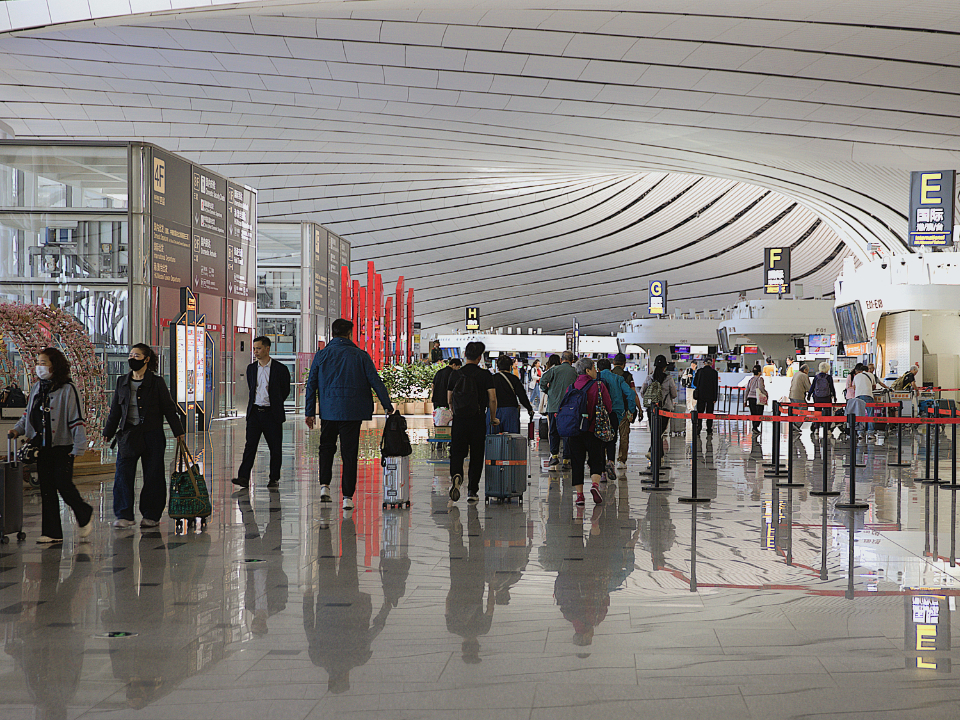
Passengers walk through Beijing Daxing International Airport on April 29, 2026. Photo: Courtesy of Beijing Daxing International Airport
With the traditional May Day long holiday approaching, China's transport sector is now buzzing with activity. The national railway system launched its eight-day travel rush service on Wednesday, planning to handle 158 million passenger trips nationwide, while major airlines are ramping up flight capacity to cope with surging travelers.
China’s national railway system kicks off its May Day holiday travel rush on Wednesday. Spanning eight days from April 29 to May 6, the heated travel season is projected to witness 158 million rail passenger trips nationwide, the Global Times learned from China Railway Group.
Rail authorities will operate roughly 12,000 passenger trains daily on average to meet surging travel demand. May 1 is set to be the busiest day of the rush, with passenger volume expected to hit 24 million, according to China Railway Group.
Travel demands for tourism, family visits and leisure trips remain robust during this year's May Day holiday. As of 8 am Wednesday, China Railway 12306 platform has sold a total of 83.02 million holiday train tickets. Top travel destinations include Beijing, Shanghai, Hangzhou and Guangzhou.
Travel demand for air travel is also rising steadily. Data from industry information provider Umetrip sent to the Global Times on Wednesday showed that as of Tuesday, domestic flight bookings for the May Day holiday had exceeded 6.01 million, while cross-border flight bookings had surpassed 1.12 million, registering a slight year-on-year increase.
When it comes to top travel destinations, Beijing ranks first on the domestic list for the May Day break, according to Umetrip.
Beijing Capital International Airport is projected to handle 1.023 million passengers trip during the five-day holiday from May 1 to 5, averaging 204,500 trips per day, with 6,160 flights scheduled, an average of 1,232 flights per day, the Global Times learned from the airport.
Meanwhile, the Beijing Daxing International Airport is expected to operate 5,249 flights and administer 857,600 passenger trips during the same period. The daily average will reach 1,050 flights and 171,500 passenger trips, representing year-on-year increases of 8.67 percent and 12.16 percent, the Global Times learned from the airport.
Umetrip data showed that, as of Tuesday, flight bookings from China to Southeast Asia destinations for the long holiday increased by 24 percent year-on-year. The European market has also shown strong performance, with flight bookings from China to Europe rising about 13 percent year-on-year.
Major Chinese airlines have announced plans to increase flight capacity. China Eastern Airlines will operate 14,600 flights and has launched several new international routes, including Xi'an–Vientiane and Wuhan–Vientiane lines, to meet booming travel demand, the Global Times learned.
China Southern Airlines plans to run 33,000 flights from April 28 to May 8, with daily flight numbers rising 7 percent year-on-year. Its Southeast Asia routes will increase by 11 percent to 2,100 flights, the Global Times learned from the carrier.
For road travel, national highway traffic volume is projected to rise 3.4 percent year-on-year, with a peak of 70 million vehicles per day — hitting a new record for the May Day holiday, officials from the Ministry of Transport stated at a Tuesday press conference.
Riding hailing platform Didi Chuxing told the Global Times on Wednesday that ride-hailing demand on the platform is expected to rise by 23 percent compared with the pre-holiday period.
Ministry of Transport forecasts that China’s overall cross-regional travel volume will hit a record high for the May Day holiday period. The volume is expected to reach 1.52 billion trips, averaging 304 million trips per day, a year-on-year increase of 4 percent. On May 1, the first day of the holiday, cross-regional travel volume is projected to reach 344 million trips, up 3.3 percent from a year earlier.
The travel boom comes as a number of provinces and cities have recently unveiled arrangements for student spring breaks, most of which fall in April or early May.
People’s Daily reported that this year, multiple regions including Zhejiang, Shandong, Hunan, Hainan and Yunnan provinces have arranged school spring breaks to align seamlessly with the May Day holidays. The extended holidays have further fueled public enthusiasm for travel and consumption.
Qunar’s data shows that bookings for domestic hotels, air tickets and scenic spot admissions have doubled year-on-year over the two-week period spanning before and after the May Day holiday break.
Spring Tour told the Global Times that its domestic travel reservations have soared by nearly 20 percent compared with the same period last year. Meanwhile, long-distance travel destinations have emerged as top favorites among travelers, according to Fliggy’s latest figures.
This elongated travel season is expected to drive both passenger trips and tourist volumes beyond last year’s levels, underscoring the enduring resilience and vitality of China’s tourism and consumption sector, Wang Peng, an associate research fellow at the Beijing Academy of Social Sciences, told the Global Times on Wednesday.
Notably, the ripple effects are transcending the tourism industry itself, catalyzing a synchronized upswing across catering, accommodation, transportation, and retail, Wang said.
RELATED ARTICLES