ARTS / CULTURE & LEISURE
Soil temperature changes influenced ancient millet farming in East Asia: new study
By Published: May 05, 2026 11:04 PM

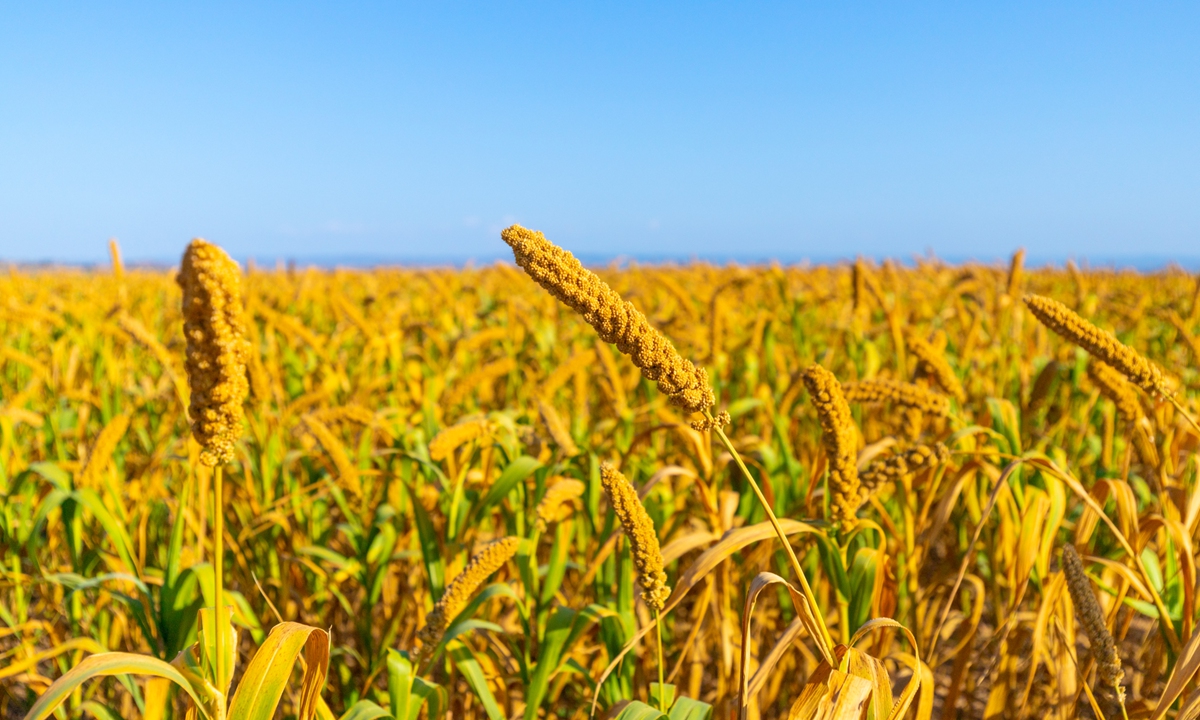
Photo: VCG
A recent study, jointly conducted by the Institute of Earth Environment at the Chinese Academy of Sciences and several Chinese and international research institutions, has found that soil temperature changes during the Neolithic period deeply shaped the development of millet-based agriculture on the Loess Plateau. According to a China News Service report on Tuesday, experts say these findings offer new scientific evidence to help understand the environmental factors that influenced the origins and evolution of Chinese civilization.The report said that the research reconstructed high-resolution soil temperature changes on the Loess Plateau from about 12,300 to 2,800 years ago. By combining this data with models of millet and broomcorn millet crop distribution, the researchers propose that soil temperature was a key factor that affected when and where Neolithic millet agriculture developed in East Asia.
Millet-based agriculture - mainly growing millet and broomcorn millet - was an important economic foundation for the origins and early development of Chinese civilization. Around 8,000 years ago, it was already an important way of life in the Yan-Liao region, one of the cultural regions in northern China represented by the Hongshan Culture. However, a period of rapid growth and expansion did not start until about 6,000 years ago, when the development center moved to the Loess Plateau. This slow early progress, followed by a sudden shift, matches a period in Chinese history known for slow growth in its early civilization, according to the China News Service.
This period between 8,000 and 6,000 years ago saw the warmest temperatures and highest rainfall in northern China's Holocene period. Yet, the millet agriculture and civilization developed slowly, a mismatch that has long puzzled researchers. The environmental forces behind these trends have not been fully understood until now.
To investigate, the research team collected a thick (about four meters) section of loess (fine silt deposits) in the middle of the Loess Plateau, the core area for Neolithic millet farming. They established a detailed timeline from the soil, and used biomarker analysis to reconstruct the history of soil temperature from 12,300 to 2,800 years ago. Comparing this with data from archaeology and paleoclimate records, and using crop distribution models, they explored how changes in soil temperature influenced the timing and spread of millet farming across East Asia, according to CCTV News.
The results showed that between 8,000 and 7,500 years ago, warmer soil temperatures created good conditions for millet and broomcorn millet cultivation. In the Yan-Liao area, where life was difficult, ancient humans were among the first to adopt millet as a major food source. However, at the same time, people on the Loess Plateau were still mainly hunters.
From 7,500 to 6,000 years ago, higher vegetation coverage and soil moisture led to much lower soil temperatures, which negatively affected millet farming. Model results showed that much of the Yan-Liao region was no longer suitable for growing millet, so the center of millet agriculture shifted southward to the warmer and more suitable Loess Plateau.
From 6,000 to 4,000 years ago, soil temperatures became warmer and more stable, and vegetation coverage decreased, creating ideal conditions for the rapid expansion and development of millet farming. This provided for an important economic base for the prosperity of the late Neolithic cultures in northern China.
The Neolithic cultures in northern China such as the Hongshan Culture were important components of the origins of Chinese civilization, Liu Zheng, a member of the Chinese Society of Cultural Relics, told the Global Times.
These findings help explain the environmental mechanisms behind the spread and evolution of the early millet agriculture, offering new scientific evidence to understand the environmental factors behind the origins and evolution of Chinese civilization. The results are expected to support further research into tracing the roots of ancient Chinese civilization, as reported by CCTV News.
RELATED ARTICLES