ARTS / CULTURE & LEISURE
Chinese printmaking artist Sha Yonghui finds creative inspiration in deep reading
Art path in pages
By Published: May 07, 2026 10:07 PM
Editor's Note:
In an age of information overload, reading remains a necessary channel to invigorate the mind, provide inspiration and cultivate virtue. Whether it is childhood enlightenment or the pursuits of adulthood, everyone's reading journey carries unique emotions and life experiences.
The Global Times has specially launched the "100 Avid Readers" series, inviting guests from various fields to share their connections with books, stories of growth and sparks of thoughts.
In this installment, Sha Yonghui, printmaking artist and director of the printmaking institute at China National Academy of Painting, shares the reading journey, which inspired and directed her career.
When Chinese printmaking artist Sha Yonghui picks up her carving knife, the characters and scenes from the books she has read rise vividly in her mind. Words gradually transform into visual images, giving greater confidence to every movement of the knife, the artist told the Global Times.
In Sha's work, Jinqiu Shidai (lit: The Golden Autumn Era), the artist leveraged the stark contrast between deep blue and gold to depict a bountiful harvest. Her work, Fenghuang Zhanchi (lit: Phoenix Spreads Its Wings - Beijing Daxing International Airport), consists in a dramatic composition to reflect the awe-inspiring spirit of a national project.
Meanwhile, her series about the Red Army's four crossings of the Chishui River recreates the gravity of revolutionary history through black, white, and gray tones. Behind all these artistic creations runs one consistent thread: reading.
Sha shared that her journey began with illustrated storybooks or lianhuanhua in childhood, which sparked her love for images. Entering the field of printmaking later on, she kept learning through professional books, historical documents, and classical literature.
Reading is not only the wellspring of inspiration for Sha's art; it is also the core way she overcomes creative bottlenecks, determines the direction of her work, and expresses her cultural reflections.
Essence of creativity
"My first taste of art came from the illustrated storybooks of my childhood," Sha recalled. In an era without AI or short videos, lianhuanhua, what today is called picture books, were her most precious "spiritual food." "I could read the same book over and over, and some scenes are still etched clearly in my mind. The emotions created by those black-and-white lines first stirred my imagination," she said.
Sha later discovered that many of her favorite lianhuanhua artists had backgrounds in printmaking. The powerful lines of woodcut art had already planted the seeds of printmaking in her heart. This experience of reading images, rather than just words, let Sha break out of the single dimension of "text reading." She developed a way of thinking where images and words coexist and feed each other.
If illustrated storybooks set her on the printmaking path, then the book - Peiyang Haizi Conghuahua Kaishi (lit: Cultivating children starts with drawing) on children's art education eventually changed her creative trajectory, helping her find a much clearer sense of direction.
By then, Sha was teaching at a university and, out of an interest in children's education, read this book. Its main idea - "Let go of the obsession with realistic drawing and rediscover the essence of true creativity" - suddenly opened her mind.
"Before this, my work focused too much on materials and technique. I was always trying to make my prints 'beautiful' and 'realistic.' But this book made me realize that the heart of creation isn't to please others, but to express our inner world and explore the deeper meaning in things," Sha told the Global Times. This realization marked a major turning point: she shifted from a focus on expressive technique to a concern for describing social meaning and depth.
From then on, Sha began weaving more thoughtful reflection into her works. Her prints broke free from merely displaying craft and skill. Instead, she began to observe and express life and society through her art. This shift helped her develop a personal style. For example, in her representative work The Golden Autumn Era, Sha used a deep blue background and golden figures, not just to showcase her mastery of color woodcut, but also to communicate her reflections on the times.
Art of 'slowness'
Today, Sha continues her disciplined reading routine. Her reading lists extend from printmaking to history, literature, and more, forming a diverse web of knowledge. As a printmaker, she sees professional books as her essential tools. She often rereads printmaking techniques and art theory, filling the margins with notes and creative thoughts. History books, meanwhile, provide her with inspiration for themed creations. While making works about the Red Army crossing the Chishui River four times in the fight, for instance, Sha not only pored over extensive records about the Long March and local histories, but also visited Southwest China's Guizhou Province in person, mapping out every detail of the Red Army's journey. To her, history forms the "skeleton" of artistic work. Without historical context, a piece lacks substance.
In Sha's view, reading and printmaking are closely connected; they are both forms of "slow art." Both require patience and deep focus. "Only by fully immersing yourself in a book can you truly feel its meaning. Only by slowing down in your printmaking can you find inspiration in each encounter between blade and wood," Sha explained to the Global Times.
Much of her artistic work is done at night. "My days are full of teaching and work. Only from 8 pm to midnight can I fully settle down to carve and print," she revealed. Every step of the printmaking process, from sketching to transferring the design, carving, and inking , demands patience and care.
This spirit of "slowness" has also helped Sha cling to the value of handmade art in the age of AI. "AI can process data and generate images, but it does not have emotions. It cannot perform the subtle, second-by-second adjustments that happen when an artist carves each line by hand. Every groove I carve contains my warmth as the creator. That is irreplaceable."
At a time when quick, fragmented reading is common, Sha prefers deep reading. She feels that scanning fragments may give readers breadth, but only truly absorbing a whole book gives lasting nourishment. She always marks key points, writes down insights, and even rereads books many times.
From the image-driven enlightenment of childhood comics to the deep nourishment of books across many fields, reading has always colored Sha's artistic journey. When asked for advice for young artists, she asserted that only by "chewing on the tough books and truly reading the classics" can the youth build their own creative understanding, and create art with real substance.
In an age of information overload, reading remains a necessary channel to invigorate the mind, provide inspiration and cultivate virtue. Whether it is childhood enlightenment or the pursuits of adulthood, everyone's reading journey carries unique emotions and life experiences.
The Global Times has specially launched the "100 Avid Readers" series, inviting guests from various fields to share their connections with books, stories of growth and sparks of thoughts.
In this installment, Sha Yonghui, printmaking artist and director of the printmaking institute at China National Academy of Painting, shares the reading journey, which inspired and directed her career.
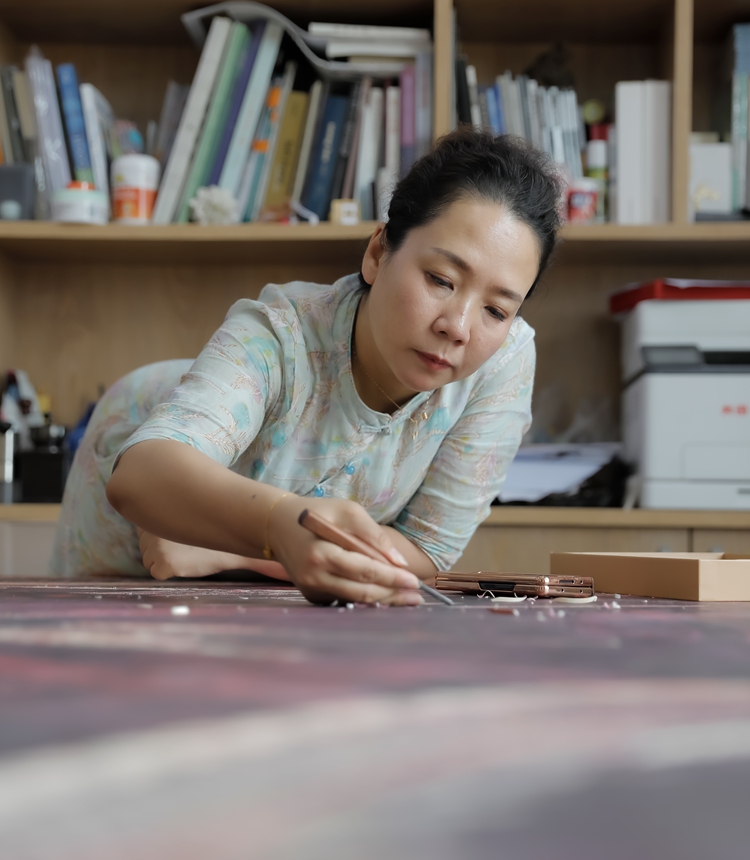
Sha Yonghui is engaged in the creation of printmaking. Photo: Courtesy of Sha
When Chinese printmaking artist Sha Yonghui picks up her carving knife, the characters and scenes from the books she has read rise vividly in her mind. Words gradually transform into visual images, giving greater confidence to every movement of the knife, the artist told the Global Times.
In Sha's work, Jinqiu Shidai (lit: The Golden Autumn Era), the artist leveraged the stark contrast between deep blue and gold to depict a bountiful harvest. Her work, Fenghuang Zhanchi (lit: Phoenix Spreads Its Wings - Beijing Daxing International Airport), consists in a dramatic composition to reflect the awe-inspiring spirit of a national project.
Meanwhile, her series about the Red Army's four crossings of the Chishui River recreates the gravity of revolutionary history through black, white, and gray tones. Behind all these artistic creations runs one consistent thread: reading.
Sha shared that her journey began with illustrated storybooks or lianhuanhua in childhood, which sparked her love for images. Entering the field of printmaking later on, she kept learning through professional books, historical documents, and classical literature.
Reading is not only the wellspring of inspiration for Sha's art; it is also the core way she overcomes creative bottlenecks, determines the direction of her work, and expresses her cultural reflections.
Essence of creativity
"My first taste of art came from the illustrated storybooks of my childhood," Sha recalled. In an era without AI or short videos, lianhuanhua, what today is called picture books, were her most precious "spiritual food." "I could read the same book over and over, and some scenes are still etched clearly in my mind. The emotions created by those black-and-white lines first stirred my imagination," she said.
Sha later discovered that many of her favorite lianhuanhua artists had backgrounds in printmaking. The powerful lines of woodcut art had already planted the seeds of printmaking in her heart. This experience of reading images, rather than just words, let Sha break out of the single dimension of "text reading." She developed a way of thinking where images and words coexist and feed each other.
If illustrated storybooks set her on the printmaking path, then the book - Peiyang Haizi Conghuahua Kaishi (lit: Cultivating children starts with drawing) on children's art education eventually changed her creative trajectory, helping her find a much clearer sense of direction.
By then, Sha was teaching at a university and, out of an interest in children's education, read this book. Its main idea - "Let go of the obsession with realistic drawing and rediscover the essence of true creativity" - suddenly opened her mind.
"Before this, my work focused too much on materials and technique. I was always trying to make my prints 'beautiful' and 'realistic.' But this book made me realize that the heart of creation isn't to please others, but to express our inner world and explore the deeper meaning in things," Sha told the Global Times. This realization marked a major turning point: she shifted from a focus on expressive technique to a concern for describing social meaning and depth.
From then on, Sha began weaving more thoughtful reflection into her works. Her prints broke free from merely displaying craft and skill. Instead, she began to observe and express life and society through her art. This shift helped her develop a personal style. For example, in her representative work The Golden Autumn Era, Sha used a deep blue background and golden figures, not just to showcase her mastery of color woodcut, but also to communicate her reflections on the times.
Art of 'slowness'
Today, Sha continues her disciplined reading routine. Her reading lists extend from printmaking to history, literature, and more, forming a diverse web of knowledge. As a printmaker, she sees professional books as her essential tools. She often rereads printmaking techniques and art theory, filling the margins with notes and creative thoughts. History books, meanwhile, provide her with inspiration for themed creations. While making works about the Red Army crossing the Chishui River four times in the fight, for instance, Sha not only pored over extensive records about the Long March and local histories, but also visited Southwest China's Guizhou Province in person, mapping out every detail of the Red Army's journey. To her, history forms the "skeleton" of artistic work. Without historical context, a piece lacks substance.
In Sha's view, reading and printmaking are closely connected; they are both forms of "slow art." Both require patience and deep focus. "Only by fully immersing yourself in a book can you truly feel its meaning. Only by slowing down in your printmaking can you find inspiration in each encounter between blade and wood," Sha explained to the Global Times.
Much of her artistic work is done at night. "My days are full of teaching and work. Only from 8 pm to midnight can I fully settle down to carve and print," she revealed. Every step of the printmaking process, from sketching to transferring the design, carving, and inking , demands patience and care.
This spirit of "slowness" has also helped Sha cling to the value of handmade art in the age of AI. "AI can process data and generate images, but it does not have emotions. It cannot perform the subtle, second-by-second adjustments that happen when an artist carves each line by hand. Every groove I carve contains my warmth as the creator. That is irreplaceable."
At a time when quick, fragmented reading is common, Sha prefers deep reading. She feels that scanning fragments may give readers breadth, but only truly absorbing a whole book gives lasting nourishment. She always marks key points, writes down insights, and even rereads books many times.
From the image-driven enlightenment of childhood comics to the deep nourishment of books across many fields, reading has always colored Sha's artistic journey. When asked for advice for young artists, she asserted that only by "chewing on the tough books and truly reading the classics" can the youth build their own creative understanding, and create art with real substance.
RELATED ARTICLES