ARTS / CULTURE & LEISURE
From seaside to street markets, Dalian’s seafood draws people to coast
A spoonful of the sea
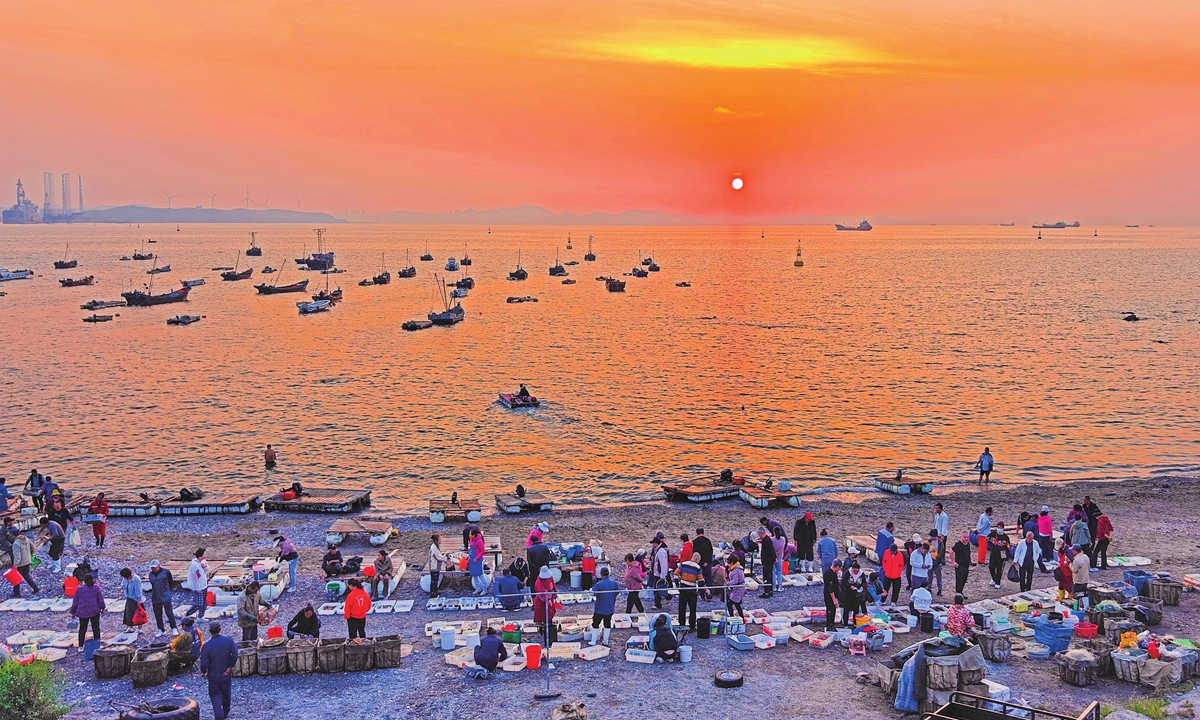
People arrive at the seaside before dawn to buy fresh seafood in Dalian, Liaoning Province. Photo: VCG
In the Donggang sea area of Dalian, Northeast China's Liaoning Province, the afternoon sea breeze now carries a hint of early summer humidity. The seaside musical fountain has not yet started, but people have already gathered along the shore. Some lean on the railings waiting for nightfall, some raise their phones toward the sea to test out shots of the coming lights, while others stroll slowly along the coastline.
"I originally just wanted to see the sea," Lin Ya, a visitor from Beijing, told the Global Times off the shore. "But as I walked along, I kept running into all these different interesting places; it's surprisingly easy to just keep wandering."
Lin said that she and her friend first spent time in Donggang before following the flow of people into the Nanshan district. There, instead of a closed exhibition space, a poetry installation is scattered across the streets: beside old staircases, on café windows, even next to convenience store doors, short lines of poetry appear unexpectedly that attracted her and her friend.
"It feels like the city is continuously generating content outward," Lin said. "You are not going to a single attraction. Things just keep appearing as you walk."
This kind of "moving forward into the next stop as you go" experience is increasingly becoming a common way for visitors to explore Dalian. The route does not end at a single landmark, but often extends naturally into streets, the beach, or a seaside market.
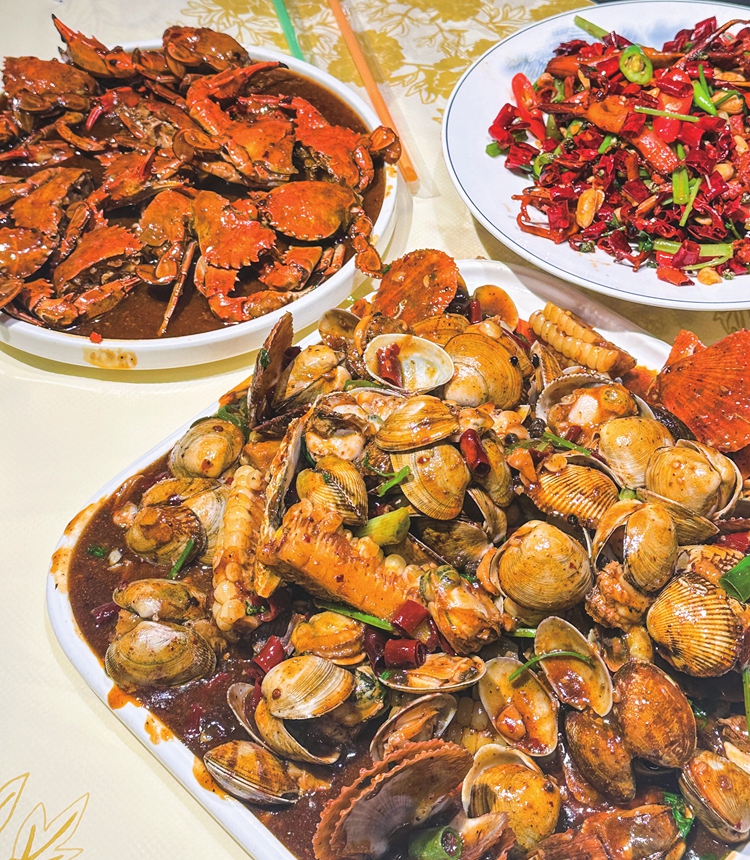
Seafood delicacies in Dalian, Northeast China's Liaoning Province Photo: Jiang Li/GT
Taste of the instant
By evening, many coastal crowds gradually drift toward the seaside market. Freshly caught seafood stalls sit alongside makeshift cooking stands, the air filled with a raw mix of sea brine and charcoal heat. On metal trays, sea urchins have just been cracked open, their bright orange roe filling the shells as people crowd in around them. Lines stretch far beyond the narrow walkway.
Over the recent years, the "freshly opened sea urchin" trend has spread quickly on the Chinese social media platform RedNote, inspiring many to visit.
Compared with carefully plated dishes, what many are after is the immediacy of the scene - the sea urchin just opened, still glistening with seawater, the stallholder working right beside it, the background constantly moving with passing crowds that also become part of the frame.
One stall owner, surname Zhou, opens sea urchins with practiced ease while chatting with those waiting in line. The metal spoon taps against the shell in a steady rhythm as a small pile of empty shells quickly builds up beside him.
"In the past, people came to the seaside mainly to take photos," he told the Global Times. "Now many come specifically looking for something like 'freshly opened sea urchin' - something they can eat and film at the same time."
At his stall, Zhou adds that price is also part of the appeal. "A large horseshoe-shaped sea urchin is around 50 yuan ($7.34). The smaller ones are about 20 to 30 yuan," he said. "It's not expensive, so people are willing to try it on the spot."
Young visitors, he noted, rarely start eating right away. They lift their phones first, recording everything in sequence. "Some film the opening process, some the first bite, others wait until a full tray is ready before posting."
On weekend evenings, Zhou said, many visitors in the market are also livestreaming. "Sometimes someone posts a video, and the next person in line is already here because they saw it online."
What visitors are seeking, he believes, goes beyond seafood itself - it is the sense of being inside something as it unfolds.
"Visitors used to ask how many attractions are left to visit," Zhou said. "Now they ask what else they can do nearby. Many start at the seaside in the afternoon, go to the market at night, and then find a place to grab a drink or watch a game."
By evening, many coastal crowds gradually drift toward the seaside market. Freshly caught seafood stalls sit alongside makeshift cooking stands, the air filled with a raw mix of sea brine and charcoal heat. On metal trays, sea urchins have just been cracked open, their bright orange roe filling the shells as people crowd in around them. Lines stretch far beyond the narrow walkway.
Over the recent years, the "freshly opened sea urchin" trend has spread quickly on the Chinese social media platform RedNote, inspiring many to visit.
Compared with carefully plated dishes, what many are after is the immediacy of the scene - the sea urchin just opened, still glistening with seawater, the stallholder working right beside it, the background constantly moving with passing crowds that also become part of the frame.
One stall owner, surname Zhou, opens sea urchins with practiced ease while chatting with those waiting in line. The metal spoon taps against the shell in a steady rhythm as a small pile of empty shells quickly builds up beside him.
"In the past, people came to the seaside mainly to take photos," he told the Global Times. "Now many come specifically looking for something like 'freshly opened sea urchin' - something they can eat and film at the same time."
At his stall, Zhou adds that price is also part of the appeal. "A large horseshoe-shaped sea urchin is around 50 yuan ($7.34). The smaller ones are about 20 to 30 yuan," he said. "It's not expensive, so people are willing to try it on the spot."
Young visitors, he noted, rarely start eating right away. They lift their phones first, recording everything in sequence. "Some film the opening process, some the first bite, others wait until a full tray is ready before posting."
On weekend evenings, Zhou said, many visitors in the market are also livestreaming. "Sometimes someone posts a video, and the next person in line is already here because they saw it online."
What visitors are seeking, he believes, goes beyond seafood itself - it is the sense of being inside something as it unfolds.
"Visitors used to ask how many attractions are left to visit," Zhou said. "Now they ask what else they can do nearby. Many start at the seaside in the afternoon, go to the market at night, and then find a place to grab a drink or watch a game."
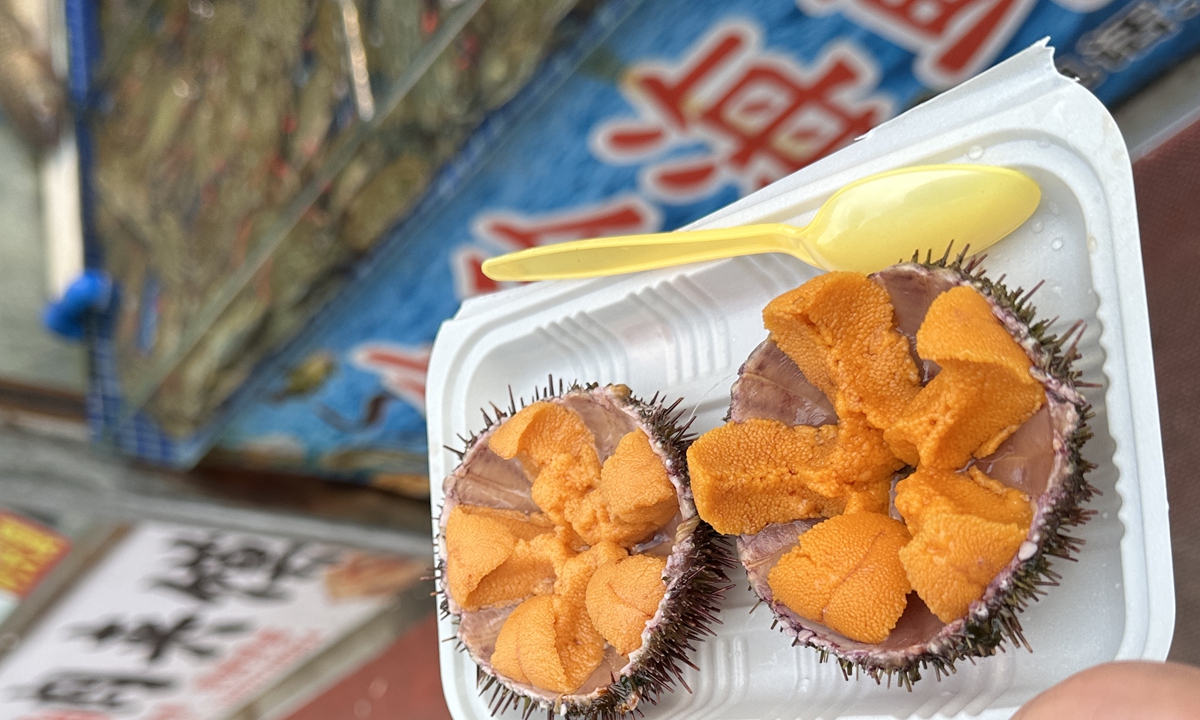
Seafood delicacies in Dalian, Northeast China's Liaoning Province Photo: Jiang Li/GT
A city that connectsThis "coastal-to-street, market-to-night" chain-like way of exploring is no longer limited to local tourists. It is increasingly becoming part of inbound travelers' itineraries as well.
According to data released by the Dalian Municipal Bureau of Culture and Tourism, inbound tourist arrivals during the 2026 May Day holiday rose 56.21 percent year-on-year. Among them, visitors from South Korea increased 55.92 percent, while Russian arrivals surged 179.18 percent.
With the resumption of the Dalian-Vladivostok route and the reopening of the Dalian-Singapore flight, cross-border accessibility has further strengthened inbound tourism momentum. Short-distance independent travel and small family groups have become the dominant pattern, with activities such as coastal hiking, flower viewing, parent-child trips and slow urban exploration gaining popularity, according to the bureau.
Yang Yimeng, a Shanghai-based coastal tourism operator, told the Global Times that what sets Dalian apart from other coastal destinations is the "just-right distance between spaces."
"In some cities, attractions are too concentrated - you walk a few steps and it's over. In others, everything is too scattered, so you need a car just to move around," she said. "Dalian is walkable. The seaside and the streets are connected. You can simply walk and switch scenes. That matters a lot."
This spatial structure is directly reflected in visitor flow. According to Yang, even during weekend peaks, movement between the coastline and street districts remains continuous rather than concentrated in isolated hotspots.
"The sea is not an endpoint, and neither is the street," she said. "It's the path between them - the one you can walk slowly through - that may be why people choose to stay."
Today, the city is not experienced as separate attractions, but as a continuous, walkable everyday landscape where movement and eating naturally blend into the same rhythm, according to Yang.
RELATED ARTICLES