ARTS / CULTURE & LEISURE
Yueju Opera reinvigorates classics, connects youth of mainland and Taiwan
Bridging the Straits
By Published: May 07, 2026 11:38 PM

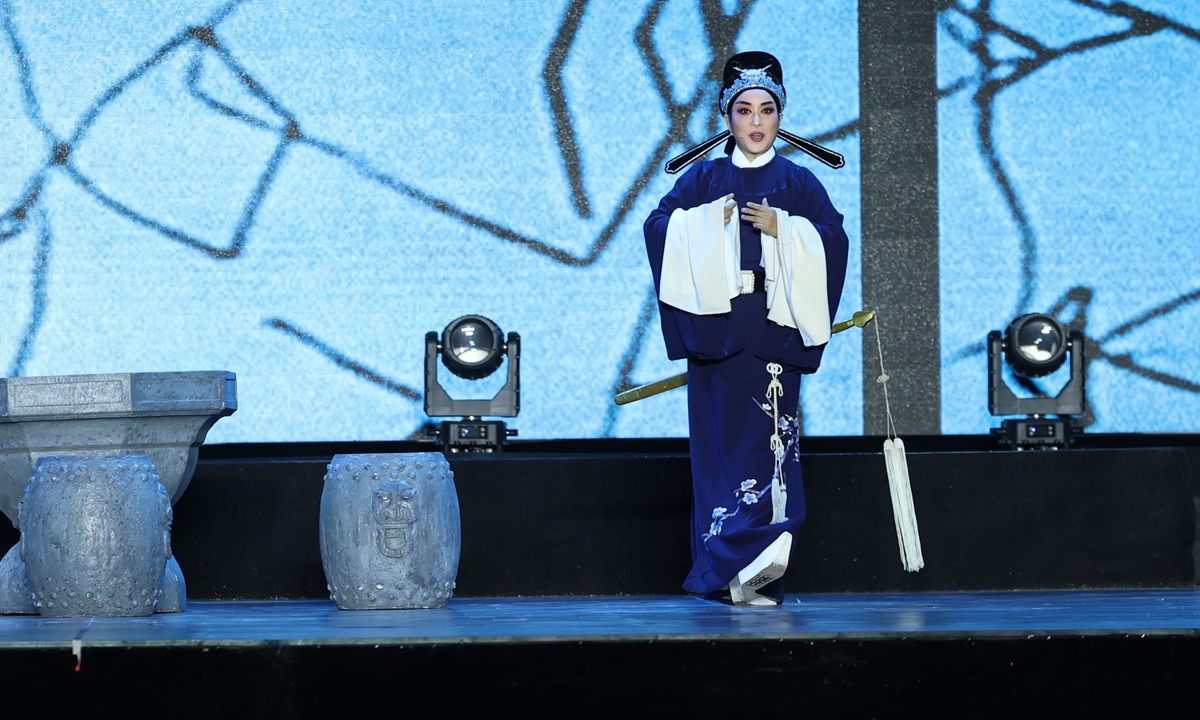
Yueju Opera artist Cai Zhefei performs on the stage. Photo: Courtesy of the Zhejiang Xiaobaihua Yueju Opera Troupe
The audience held its breath, eyes fixed on the stage in eager anticipation as centuries-old tales of scholars and beauties - stories that have moved generations of Chinese - were about to unfold once more. In the ancient town of Xitang in Jiaxing, East China's Zhejiang Province, the Zhejiang Xiaobaihua Yueju Opera Troupe is presenting its acclaimed excerpt program Garden of Love. Huge crowds of people, many of them young people, have been drawn to the performances.With innovation and inheritance from tradition, the 120-year-old Yueju Opera has developed from a regional opera school into one of the most popular types of traditional operas, not only gaining a large number of followers, especially young people, but also connecting followers across the Taiwan Straits.
As Cai Zhefei, deputy director of one of China's most beloved Yueju Opera troupes, gazed out at the sea of expectant faces in the Jiaxing audience, a strong sense of déjà vu washed over her. Only weeks earlier, the same repertoire, the same heartfelt enthusiasm had captivated audiences on the island of Taiwan during the troupe's tour.
"We performed five shows on the island of Taiwan; all sold out," Cai recalled. "What surprised us most was that over 60 percent of the audience was young people. Many young people on the island discovered Yueju Opera through short video clips on social media platforms - fragments from My Grand View Garden or other productions - and fell in love with it."

A view of the ancient town of Xitang in Jiaxing, Zhejiang Province Photo: VCG
Resonating across the StraitsFamilies attended together and dedicated fans traveled specifically for the performances. The emotional connection was palpable.
"On stage we perform; in the audience, they cry," Cai said. "These stories - the Twelve Beauties of Jinling from Dream of the Red Chamber, or the tragic romance of Lu You and Tang Wan - are deeply rooted in Chinese cultural DNA. They resonate instantly across the Straits without needing explanation. This is the power of shared heritage."
Yueju Opera, originating in Zhejiang Province's Shengzhou and renowned for its lyrical melodies, elegant aesthetics, and focus on romantic tales, has long served as a bridge. Cai emphasized that traditional Chinese opera functions as a "common language" that transcends geographic distance. The 15-year gap since the troupe's last major visit to Taiwan had not distanced them; if anything, digital platforms had nurtured new interest.
Dream of the Red Chamber stands as a shared cultural memory for people on both sides of the Straits. The youth and disillusionment, passionate attachment and impermanence experienced in the Grand View Garden - the place where main characters in Dream of the Red Chamber live - evoke emotions that transcend geography and are instantly understood by all. While the Palace Museum in Taipei was hosting the special exhibition The Splendor of Dream of the Red Chamber, audiences on the island of Taiwan were resonating with the heartfelt performance of My Grand View Garden, a Yueju Opera production adapted from Dream of the Red Chamber.
This resonance drew official attention. At a regular press briefing, Zhang Han, the spokesperson for the Taiwan Affairs Office of the State Council, praised performances by groups like Zhejiang Xiaobaihua, noting their warm reception, especially among young audiences in Taiwan. Zhang highlighted how such exchanges demonstrate the unique charm and infectious power of China's fine traditional culture, reaffirming that compatriots on both sides of the Straits share the same roots, language, and ancestry.
"Fine traditional Chinese culture remains the spiritual roots and a home for all Chinese people. No force can sever it," Cai stated. She expressed hopes for more frequent exchanges to bring additional productions to the island of Taiwan while welcoming Taiwan fans to experience the art form in its Zhejiang heartland.
Yueju Opera's appeal to youth is not accidental. The troupe has actively cultivated a new generation of stars who connect naturally with younger viewers. A prime example is Chen Lijun, a 1990s-born performer who has gained massive popularity through roles in New Dragon Gate Inn and My Grand View Garden.
At the core of Yueju Opera's current appeal, Cai believes, is something deeper than simply a young cast or trendy new subjects. "The core has never been merely about a youthful lineup or fashionable themes," she explained. "It is about endowing traditional opera with youthful vitality, youthful expression, and youthful audiences."
"Traditional subjects can also be very youthful," Cai continued. "Even if the main creators are not young, as long as the expression of the work aligns with today's aesthetics and what young people enjoy watching - that is what we call youthful opera."
Balancing tradition, innovation
This philosophy has guided Yueju Opera troupes' artistic direction in recent years. By breathing new life into time-honored stories without severing their roots, the troupe has successfully turned classic tales into living dialogues between tradition and modernity.
Productions like New Dragon Gate Inn and My Grand View Garden demonstrate that traditional stories can be packaged with modern appeal to captivate new generations.
"Two legs must walk together," Cai said. "Stagnation prevents progress; losing the foundation means it's no longer Yueju Opera. Exploration may involve risks and occasional failures, but without trying, there is no path forward."
Through in-depth explanations, behind-the-scenes documentaries, and educational content, young audiences are guided from initial curiosity sparked by traffic and popularity to a deeper appreciation of the art form's unique aesthetic charm and profound cultural heritage, she said.
RELATED ARTICLES