Overlooked prosecutorial evidence-gathering details revealed in Sutton's diaries acquired by Chinese collector
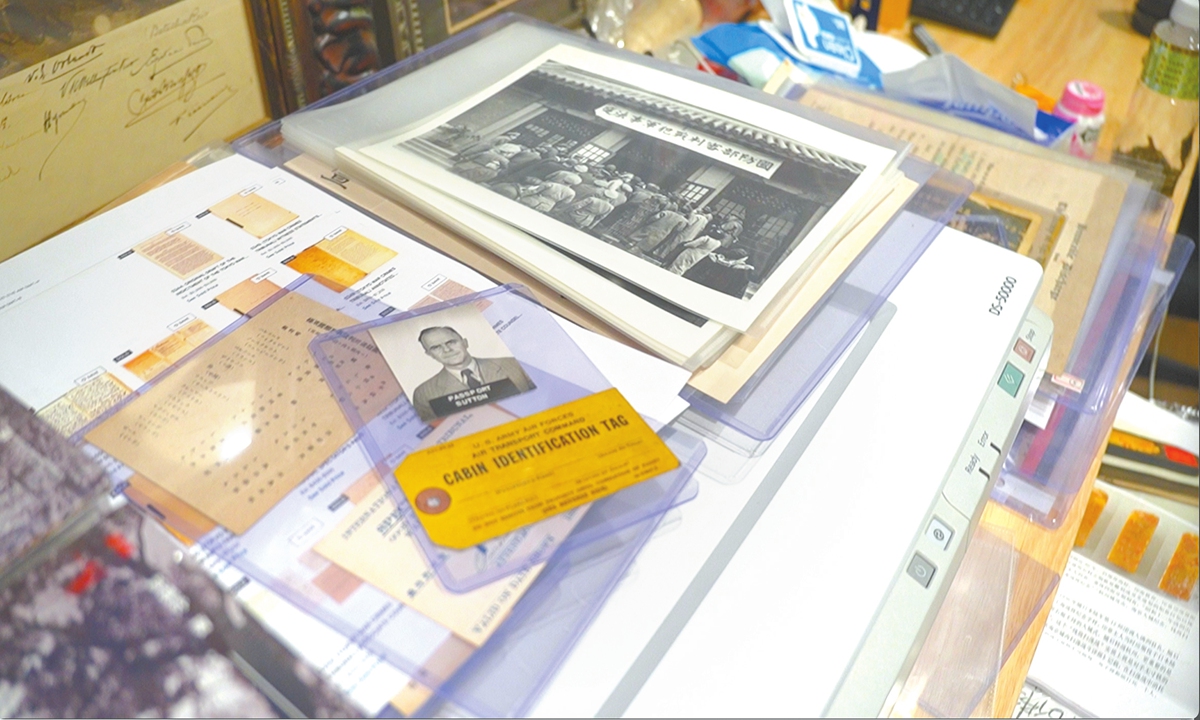
Materials related to David Nelson Sutton, shown by Chinese collector Zou Dehuai to Global Times reporters. Photo: Zou Zhidong/GT
Editor's Note: This year marks the 80th anniversary of the beginning of the International Military Tribunal for the Far East, also known as the Tokyo Trial. More than a legal proceeding, it was shaped by "decisive moments in history": prosecutors pursuing evidence, witnesses testifying, and judges upholding justice amid geopolitical strain. Eight decades on, Chinese collectors and scholars continue to unearthing archives, filling gaps in history, and advance unfinished justice—reinforcing historical conclusions with primary sources and drawing lessons for the present.
A steady April drizzle lingered over Nanjing, deepening the solemnity inside the Memorial Hall of the Victims in Nanjing Massacre by Japanese Invaders. It was here that a Global Times reporter met collector Zou Dehuai, who had traveled from afar to donate the archives of a US assistant prosecutor who took part in the Tokyo Trial, which he had acquired later.
Zou showed Global Times reporters pages from Sutton's diaries, which describe the opening session of the Tokyo Trial as "big lights glaring, intense" and "very impressive." In his diaries, Sutton also remarked that the "defendants look like insignificant beaten men."
David Nelson Sutton was invited after World War II to serve as an assistant prosecutor at the International Military Tribunal for the Far East and was one of the key figures responsible for investigating and gathering evidence on Japanese war crimes in China.
Zou shared with the Global Times what he found in Sutton's archives and diaries. While the evidence Sutton presented in court and his questioning of witnesses were rigorous, restrained and clinically objective, his private writings reveal a man driven by a deep personal commitment to justice. To ensure four key Chinese witnesses could travel to Tokyo to testify, Sutton personally advanced their travel and accommodation expenses - from Nanjing to Shanghai and onward to Tokyo - on behalf of the International Prosecution Section.
In Nanjing, Sutton went to the banks of the Yangtze River to verify on site the mass killing of 6,000 civilians by Japanese troops.
From March to April 1946, Sutton traveled to China with the International Prosecution Section and was tasked with investigating Japanese war crimes, focusing on evidence related to the Nanjing Massacre. During his stay, he conducted fieldwork in Shanghai, Beiping (Beijing today), Chongqing and Nanjing, among others, gathering eyewitness testimonies, statistical data and photographs of mass burial sites, and meeting with Chinese officials, missionaries, doctors and survivors, according to a statement the Memorial Hall of the Victims in Nanjing Massacre by Japanese Invaders shared with the Global Times.
Accompanied by Chinese prosecutor Xiang Zhejun and his assistant Qiu Shaoheng, Sutton conducted extensive fieldwork, interviewing Chinese officials, foreign missionaries, medical personnel and survivors of the Nanjing Massacre. He collected a large body of firsthand testimonies, statistical data and archival materials, later transforming them into admissible evidence for the tribunal. In June 1946, Sutton led more than 10 Chinese and foreign witnesses to testify in Tokyo, providing crucial testimonial and material evidence to support the prosecution of Japanese wartime atrocities in China, Memorial Hall of the Victims in Nanjing Massacre by Japanese Invaders research fellow Zhang Guosong, also a researcher at the National Memory and International Peace Studies Institute, told the Global Times.
Featuring Sutton's handwritten diaries and investigative reports, the collection fills critical gaps in the historical record - bringing greater depth and credibility to the narrative of the trial and reinforcing the overwhelming evidence of atrocities such as the Nanjing Massacre, Zhang said.
That evidentiary weight is also reflected in Sutton's own words. According to a Global Times review, Sutton ended one report submitted to the tribunal with a blunt assessment of wartime culpability: "It was a war begun in violation of solemn treaty obligations and repeated official assurances. It was a war waged in violation of every rule of organised warfare and in a manner which shocked the conscience of humanity. The acts of the defendants violated the inexorable rules of human conduct. Their acts were sins against humanity."
RELATED ARTICLES