ARTS / CULTURE & LEISURE
Beijing launches first research-led project on early sections of Great Wall

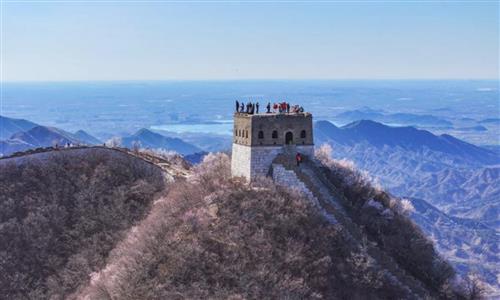
Photo: VCG
Applying non-destructive technological means to research the Great Wall, an archaeological project was recently launched at a Northern Qi (550-577) Great Wall site in Beijing, marking the city's first research-led archaeological project focused on the early sections of the Great Wall.Different from reactive or rescue archaeology, a "research-led" project means that archaeologists "proactively choose sites, define research objectives, and carry out planned surveys and excavations according to their research needs," Wang Peng, an archaeological expert, told the Global Times.
Located in Beijing's Changping district, the Northern Qi Great Wall remains were chosen because the site was once a shubao, a type of military garrison fortification used in ancient times. Such forts were often built at "strategic thoroughfares" along the Great Wall. They provide physical evidence for studying the "ancient military defense system of the Great Wall," Shang Heng, the lead of the project and an associate research fellow at the Beijing Institute of Archaeology, told the Global Times.
The Great Wall garrison covers an area of approximately 800 square meters. Its location is highly concealed, tucked away in steep mountains covered by dense layers of forest. Shang said that this section of the Great Wall was built along the southwest-facing mountain terrain, while the garrison adjoins the southeastern side of the wall.
"This commanding height and open visibility reflects how ancient people selected locations for the Great Wall," Shang said.
Although the archaeological project is still in its preliminary survey phase, researchers have conducted a rough dating of this section based on material assessments and analysis. The wall was built using piled natural stone, a construction material mainly used for pre-Ming Dynasty (1368-1644) or the early sections of the Great Wall.
Meanwhile, the team discovered a large number of distinctive "finger-impressed" tile fragments at the site. This tile technique features unique finger impressions, which were deliberately left by craftsmen before firing. "This craftsmanship was particularly esteemed and prevalent during the Northern Qi period," Shang remarked.
Combining the investigation of these tile fragments with carbon-14 dating of charred materials found in the soil, archaeologists have preliminarily determined that this section of the Great Wall was built during the Northern Qi period.
To facilitate more in-depth investigation, the research team has also introduced non-destructive technological means. Equipment such as terrestrial laser scanners and ground-penetrating radar (GPR) have been deployed to collect data on the surface, subsurface, and surrounding environment.
These devices can help detect topographical features, subsurface structures, and other information without damaging the archaeological site. The GPR for example can detect changes in stratigraphic structure within a depth of 8 meters. The electromagnetic wave reflections from subsurface mediums may point to archaeological clues such as rammed earth, piled stones, or tile fragments.
"This is an archaeological approach that neither disturbs the site nor damages the cultural relics. By understanding the subsurface conditions in advance, we can make subsequent excavations more precise and more focused," Liu Rui, director of the Urban Heritage Protection and Landscape Planning Institute of Beijing City University, told the Global Times.
She also added that many sections of the Great Wall are not suitable for traditional archaeological excavations, which makes it necessary to explore the introduction of these new techniques.
"Similar technological methods will continue to be applied in the current project, such as the identification of tiles, the study of plant seeds, and the analysis of animal bones," Shang noted. He also added that through this archaeological project, he hopes to fill the gaps in traditional historical research regarding the Northern Qi Great Wall, including details such as its "architectural form, functional layout, military defense system, and subsistence systems."
RELATED ARTICLES