ARTS / CULTURE & LEISURE
Sanxingdui pit No.7 yields rare ancient meteoritic iron artifact
Bronze Age extraterrestrial object identified
By Published: May 11, 2026 04:59 PM

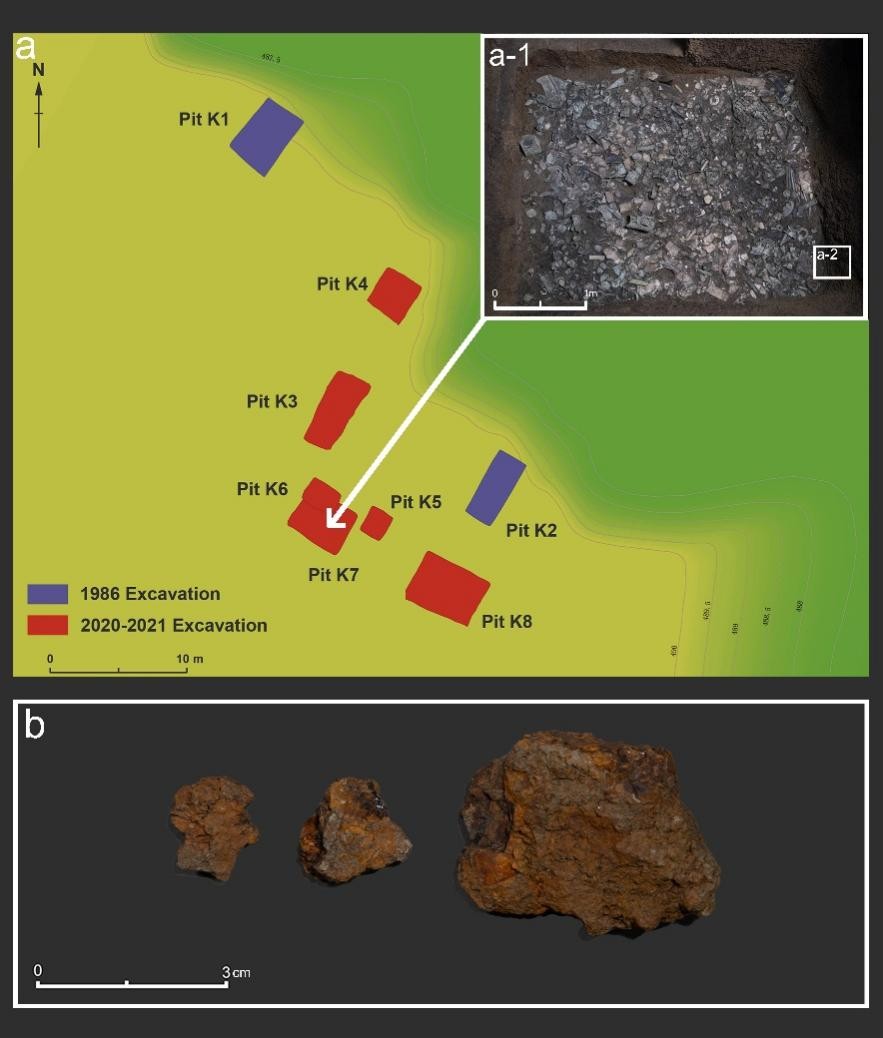
The image above shows the location map of the sacrificial pits, while the three cultural relics in the image below are newly discovered meteoric iron objects. Photo: Courtesy of Li Haichao
Chinese archaeologists have identified a heavily corroded iron object unearthed from the Sanxingdui Ruins in Southwest China as the earliest known meteoritic iron artifact from the region's Bronze Age, filling a longstanding gap in the study of ancient Chinese metallurgy, according to a press release that the research team sent to the Global Times on Monday.
Meteoritic iron, distinct from stony meteorites, is a type of meteorite composed mainly of iron, originating from extraterrestrial bodies that fell to Earth. It was a rare and prized material in antiquity, long before human smelting of terrestrial iron ore became widespread.
The long strip-shaped object, believed to have been used as a tool or weapon, was recovered in 2021 from sacrificial pit No. 7 at the site in Sichuan Province and was later confirmed as meteoritic iron after a suite of scientific tests, according to a study published in the journal Archaeological Research in Asia.
Li Haichao, a professor at Sichuan University who led the excavation, told the Global Times that the object was found near the eastern wall at the bottom of the pit, buried among ivory, bronze sacred trees and other elite ritual goods. Measuring about 20 centimeters long and up to 7.9 centimeters wide, the heavily rusted piece was too fragile to identify in the field, so the team lifted it with surrounding soil and transferred it to a laboratory.
A small fragment that detached from the artifact was analyzed using a series of scientific archaeological methods, including portable X-ray fluorescence, metallographic microscopy and scanning electron microscopy with energy-dispersive spectroscopy.
The tests revealed a uniform microstructure of equiaxed ferrite grains with no sign of cold working, and a composition of roughly 77.8 percent iron and 19.8 percent nickel, evenly distributed at the microscopic level, a feature beyond the capabilities of late Shang Dynasty (c.1600BC-1046BC) melting technology.
"Such high nickel content and its micro-scale homogeneity are the definitive evidence of a meteoritic origin," Li said. "The metallurgical technology of the late Shang dynasty, more than 3,000 years ago, could not produce a uniformly high-nickel iron alloy. Our analysis clearly rules out artificial smelting, confirming the artifact is made of meteoritic iron."
To date, only 13 meteoritic iron artifacts have been found across China, most of them in northern regions such as Beijing, Henan and Hebei. Apart from one piece from the Yejiashan cemetery in Central China's Hubei Province, southern China had previously yielded no such finds.
"The Sanxingdui object is now the earliest meteoritic iron artifact documented in southwestern China and the largest known specimen of its kind in the country," Li said.
Unlike the bronze-iron composite items typical of China's Central Plains, the Sanxingdui artifact is made entirely of meteoritic iron, pointing to a distinct metallurgical tradition, the researchers said.
"This discovery proves that the ancient Shu people already possessed the advanced ability to identify and work with meteoritic iron 3,000 years ago," Li added. "It offers new insight into the technological sophistication of the Shu civilization and the patterns of cross-regional exchange during the Bronze Age."
The exact function of the elongated, axe-shaped object remains unclear because of its poor condition. It may have been a tool, a weapon, or an item with ceremonial significance, the study noted.
According to Li, the research was conducted by the School of Archaeology and Museology at Sichuan University together with the Sichuan Provincial Cultural Relics and Archaeology Research Institute.
The Sanxingdui Ruins drew worldwide attention after six new sacrificial pits were uncovered in 2020, yielding an extraordinary trove of bronze, gold, jade and ivory artifacts. Pit No. 7, where the iron object was found, also produced the famous turtle-shell-shaped grid artifact and large quantities of ivory and bronze vessels, the press release noted.
RELATED ARTICLES