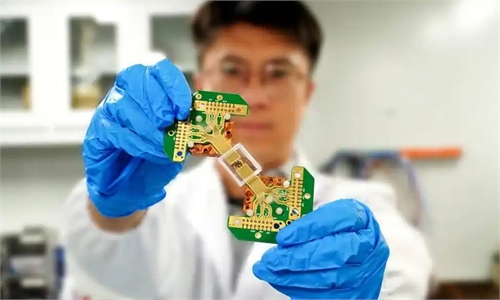
Chinese researchers achieve breakthroughs in photoresist development for semiconductors
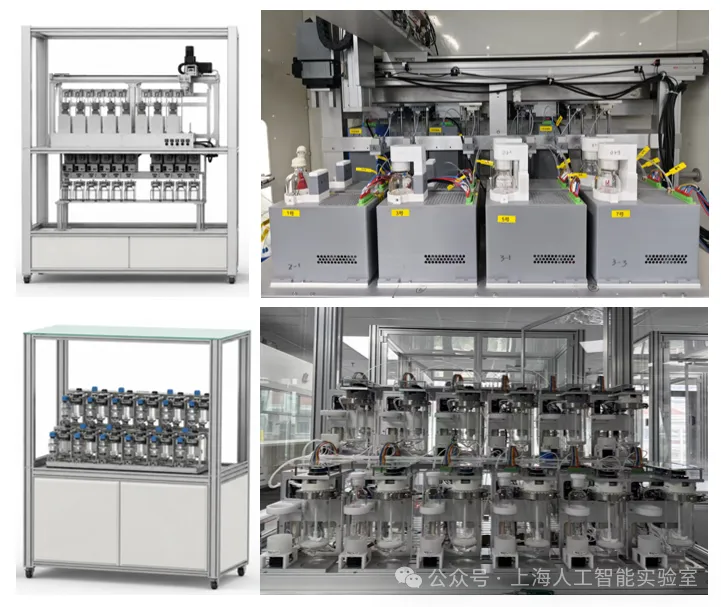
Automated photoresist resin manufacturing equipment Photo: Courtesy of Shanghai AI Lab
Chinese researchers have developed a new platform powered by artificial intelligence (AI) that enables the stable production of high-purity, highly consistent and efficient krypton fluoride (KrF) photoresist resin, the Shanghai Artificial Intelligence Laboratory (Shanghai AI Lab) said on Tuesday.
Industry analysts said that as China's chip manufacturing technology continues to achieve breakthroughs, the country's progress toward greater self-reliance in the semiconductor industry is steadily advancing.
Built on the laboratory's Intern AI model, the system integrates "AI decision-making + automated synthesis" into a closed-loop research and development framework. Researchers said that the platform enables the production of KrF photoresist resin with high purity, high consistency and improved efficiency, according to the Shanghai AI Lab.
The achievement was made by a team led by the Shanghai AI Laboratory in collaboration with Xiamen University, Suzhou National Laboratory and other partners.
According to the Shanghai AI Lab, the new method could help reduce the semiconductor material industry's dependence on a small number of overseas suppliers whose proprietary technologies have long been regarded as a "black box."
The team said that the breakthrough offers a new standardized and rapidly iterative pathway for the development of advanced chip materials.
Photoresist is one of the core materials used in semiconductor manufacturing, and its quality directly affects chip performance and yield. KrF photoresist resin is a key base material that determines the overall performance of the photoresist.
Breakthroughs in the sector have not been limited to this case. A Chinese joint research team recently reported a major breakthrough in the development of new high-performance two-dimensional semiconductor materials.
The team has achieved important progress in wafer-scale growth and controllable doping of new high-performance two-dimensional semiconductor materials, which is expected to provide key material and device support for independently controllable chip technologies in the post-Moore era, according to a report by Science and Technology Daily on April 9.
The recent advancement in chip technology reflects the continued advance in China's innovation capabilities, Ma Jihua, a veteran Chinese technology industry analyst, told the Global Times on Tuesday.
Ma said that in addressing the problems in chip production, China is achieving systematic and synchronized capability improvements in both key equipment such as lithography machines and core materials such as photoresists, gradually pushing chip manufacturing toward self-reliance and controllability.
US restrictions against China have objectively forced China to accelerate independent innovation and the building of a complete industrial chain, Ma said, adding that as China's chip technology continues to make breakthroughs, related capabilities are rapidly improving from "point to area," forming a multi-layered development pattern.
According to Ma, China's chip industry has been accelerating comprehensive progress from design and manufacturing to packaging integration. With more breakthroughs in key links, China's chip industry is expected to make leapfrog progress in certain areas and gradually enhance its global competitiveness, Ma added.
As companies race to ramp up production, data from global chip industry group SEMI showed that from 2020 to 2030, China's annual wafer capacity is estimated to increase from 4.9 million to 14.1 million, nearly tripling, and its share of the global market will rise from 20 percent to 32 percent. Meanwhile, China's manufacturing capacity for chips made on mature 22- to 40-nanometer process nodes is projected to reach 42 percent of global output by 2028, the Securities Times reported.
RELATED ARTICLES