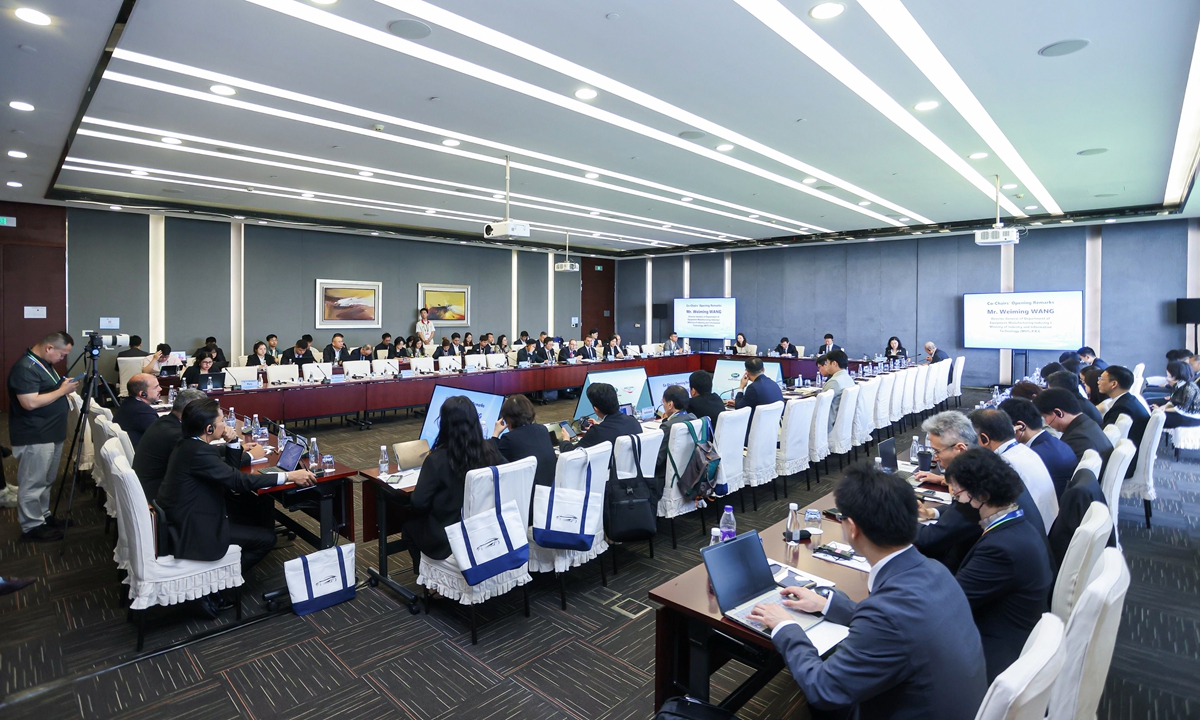
The 43rd APEC Automotive Dialogue opens in Shanghai on May 12, 2025. Photo: Courtesy of China Association of Automobile Manufacturers
At the 43rd APEC Automotive Dialogue currently underway in Shanghai, participants said that China's rapid new-energy vehicle (NEV) development and growing investments across the Asia-Pacific region are reshaping the regional automotive landscape, with economies from Mexico to Thailand seeking deeper cooperation with Chinese carmakers on supply chains, electrification, and intelligent connected vehicle (ICV) standards.
The dialogue, held on the sidelines of the ongoing Asia-Pacific Economic Cooperation (APEC) Senior Officials' Meeting in Shanghai, brought together government officials, industry association representatives, and business leaders to discuss regional automotive industry development, supply chain resilience, and the advancement of ICVs across technology, standards, regulations, applications, and artificial intelligence.
"We are seeing a significant expansion of Chinese companies' presence in Mexico, and it is important for the region to embrace the new technologies that China's automotive industry brings," Gabriel Padilla Maya, general director of the National Auto Parts Industry of Mexico, told the Global Times on the sidelines of the dialogue on Tuesday.
Padilla said that China's presence in the Mexican market has driven growth in sales of electric cars of more than 20 percent, which calls for a broader transformation of the regional supply chain, noting that cooperation on supply chain training programs would be a particularly valuable opportunity.
The dialogue comes after the China Association of Automobile Manufacturers (CAAM) released China's latest vehicle export data on Monday. In April, production of NEVs reached 1.32 million units, up 5.5 percent year-on-year, while sales totaled 1.344 million, up 9.7 percent. NEV sales accounted for 53.2 percent of total new car sales during the month, according to the CAAM.
On the export side, NEV shipments totaled 430,000 units in April, up 1.1 times year-on-year.
Wang Weiming, an official of the Ministry of Industry and Information Technology (MIIT) and a co-chair of the dialogue, said in his remarks that China's government attaches great importance to the development of the automotive industry, and the MIIT is actively contributing to the global automotive transition.
He cited a series of milestones, including the mass-market deployment of fast-charging technology capable of reaching 80 percent charge levels in 15 minutes, the cumulative opening of more than 57,000 kilometers of test roads for ICVs, and the deployment of more than 11,000 intelligent roadside units.
Against the backdrop of China's rapid advances in NEVs and ICVs, Padilla said that Mexico is planning for the next 20 years and developing a new investment attraction initiative to draw more investment from Asia, particularly China, and to accelerate technology adoption across the supply chain.
In Asia, Thailand has emerged as one of the most important investment destinations for Chinese automakers. As 2025 marked the 50th anniversary of the establishment of diplomatic ties between China and Thailand, many major Chinese companies, particularly in the automotive sector, have chosen to invest in the economy, Ausein Wirojtacha, a plan and policy analyst at the Office of Industrial Economics under Thailand's Ministry of Industry, told the Global Times one day earlier at an automotive workshop under the APEC meeting.
Wirojtacha said that Thailand will further develop its domestic supplier base, facilitate the transition from traditional combustion engine vehicles to electric vehicles, and strengthen the development of human resources, in order to build stronger foundations for deeper cooperation with Chinese companies.
China's wide NEV adoption has created vast room for ICV applications. MIIT data showed that in the first two months of 2026, the penetration rate of newly sold passenger vehicles equipped with L2-level combined driver assistance functions reached 69.15 percent, up 10 percentage points year-on-year, meaning that more than 69 out of every 100 new passenger cars sold are now equipped with L2-level driver assistance.
Chen Chunmei, another MIIT official, said at the workshop that as the Asia-Pacific region has become one of the world's most dynamic markets and innovation hubs for ICVs, China is willing to jointly advance technological innovation and cross-sector integration with APEC members. China is also accelerating the formulation of unified standards for driver assistance, autonomous driving, and cybersecurity, and will actively participate in the development and coordination of international regulations and standards, Chen added.
Padilla said that unified standards are necessary for ICVs, and the North American region needs to move toward international standards while also recognizing the different cooperation frameworks that exist across regions.
RELATED ARTICLES