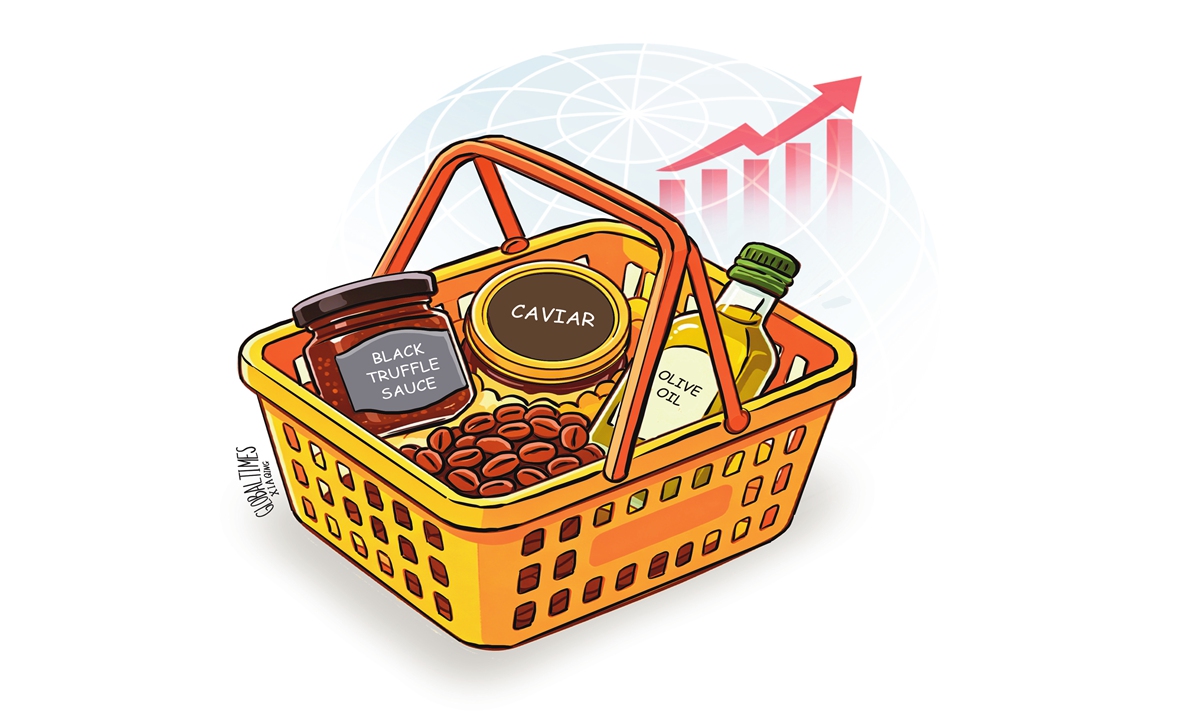
Illustrating: Xia Qing/GT
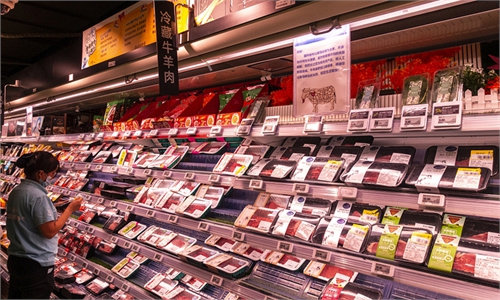
In a supermarket in Shenzhen's Bao'an district, neatly stacked boxes of South African apples, which went on sale roughly a week ago, have drawn the attention of local shoppers. These apples, reportedly the first shipment under China's zero-tariff policy for all 53 African countries with diplomatic ties to China, illustrate the expanding scope of China's food imports.According to a report by the People's Daily on Wednesday, data from the 2026 APEC Food Safety Cooperation Forum show that in the first four months of the year, China's food imports reached 409.2 billion yuan ($60.3 billion), up 8.8 percent year-on-year. The figures suggest that Chinese consumers are increasingly able to access a wider range of international products, supported by trade policy, improved logistics, and other factors.
The arrival of high-quality coffee beans, olive oil, and other imports suggests more than simple diversification on supermarket shelves. It reflects a broader trend of consumption upgrading, as rising incomes and changing lifestyles are contributing to a more receptive market for high-quality foreign products. For exporters, this development represents a steady, tangible opportunity.
China's food consumption is gradually evolving, underpinned by a range of emerging trends. Consumers are showing rising interest in functional, high-quality, and innovative products, reflecting increasingly diverse and personalized preferences. Yet considerable untapped potential remains across the market, indicating that domestic and international suppliers are engaging with a more discerning consumer base.
Amid rising food imports, three aspects of China's consumption trends warrant attention. First, the country's consumption upgrade is driving greater diversity in imported products. Opportunities arise from responding to evolving market preferences, particularly the growing consumer emphasis on health and product variety.
According to a food industry report by iiMedia Research, as health awareness among Chinese consumers rises, the market for health-oriented products such as meal replacements and light meals is expanding and is expected to exceed 350 billion yuan by 2027. In addition to traditional expectations regarding nutritional composition - such as low fat and high protein - consumers are also placing greater emphasis on ingredient freshness, taste, and overall product diversity.
In addition, consumption is becoming increasingly cross-sectoral, intersecting with culture, entertainment, and travel. A report by Huajing Industry Research Institute highlights that younger consumers' pursuit of emotional value is driving growth in intellectual property-based food products linked to gaming, domestic cultural trends, and animation. The market reached 35.4 billion yuan in 2024, and is projected to grow at a compound annual growth rate of 18.5 percent until 2029. These trends are creating space for imported products, suggesting that foreign foods aligned with evolving lifestyle preferences can establish a foothold in the Chinese market.
Second, the impact of China's consumption upgrade extends beyond individual products to the broader downstream value chain. As imports increase, opportunities are emerging across the wider food ecosystem, including processing, branding, and related services. For example, as durian imports grow, Chinese consumers are showing rising interest in associated products, such as durian-based snacks, desserts, and beverages, creating scope for collaboration between domestic and international players. Consumption upgrading is reaching across the value chain, extending engagement beyond the trade of food products.
Third, evolving consumption indicates that Chinese consumers are willing to pay for the logistics and freshness requirements associated with imported products. They are increasingly prepared to absorb the costs associated with long-distance transportation and cold-chain storage. This finding points to commercial potential that extends beyond the food industry, encompassing trade, logistics, cold-chain services, and related sectors.
Amid sustained economic growth and rising household incomes, the expansion of imported food in China is set to continue. A genuine enthusiasm for fine food shapes consumer preferences in China, reflecting a broader appreciation of the country's culinary culture.
The rise of imports does not stand in opposition to the development of China's domestic food industry. On the contrary, the two are increasingly complementary, with international products and local production reinforcing each other, fostering innovation, diversifying offerings, and strengthening the broader food ecosystem.
The 8.8 percent increase in food imports is more than a simple expansion in volume. It offers a window into the ongoing upgrading of consumption and the gradual evolution of supply chains. Across a rapidly developing sector, there is scope for both domestic and international players to engage with new products, services, and business models, revealing a market that is simultaneously maturing and opening up.
The author is a reporter with the Global Times. bizopinion@globaltimes.com.cn
RELATED ARTICLES