ARTS / CULTURE & LEISURE
Discovery of Pu’er tea at Xinjiang site sheds light on ancient Silk Road exchanges
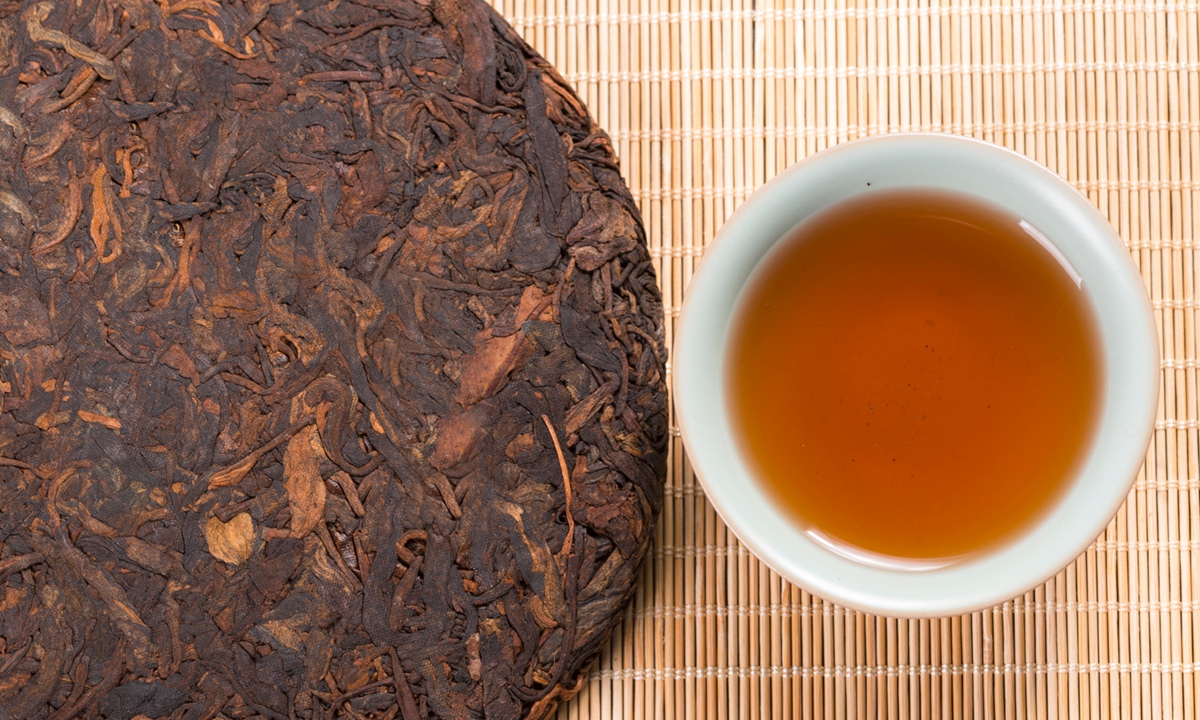
Pu'er tea Photo: VCG
Upon analyzing the residue found in an ancient pottery jar unearthed in Turpan, Northwest China's Xinjiang Uygur Autonomous Region, Chinese archaeologists discovered that it was actually Pu'er tea - a type of tea unique to faraway Yunnan Province in Southwest China.This pottery jar was unearthed from Turpan's Xipang Jingjiao Monastery site. In Chinese, "Jingjiao" refers to Nestorianism, a branch of the Christian faith that emerged in what is now Syria and prospered in China from the late Tang Dynasty (618-907) through the Yuan Dynasty (1279-1368). The Xipang Jingjiao Monastery site's archaeological dating also matches this timeline.
The pottery jar residue initially looked to only be "soil mixed with grass," Yang Yimin, the lead researcher on the project and a professor at the University of Chinese Academy of Sciences, told the Global Times.
Yang and his team used techniques such as pyrolysis-gas chromatography to test the residue and eight other soil samples of interest from the site. The tests revealed that the samples contained not only fatty acids such as hexadecanoic acid and phytosterols, but also caffeine and theacrine. "These two substances are key biomarkers of teas leaves," Yang remarked.
While caffeine serves as key marker in many ancient Chinese tea samples, "theacrine" is only particular to Pu'er tea and Camellia kucha.
"We conducted further researches, for example, on the ratio of caffeine to theacrine in the tea residue, and found out that the remains are Pu'er tea," Yang said.
The discovered tea residue is excellent evidence of how the ancient exchanges thrived along the Silk Road, with "tea" standing as one of the key witnesses of products moving from Yunnan to Xinjiang. The discovery pushes back the history of Pu'er tea, one of China's most time-honored and world-renowned teas, back to the Tang and Song (960-1279) dynasties. "This tea road also reflects the diverse trade and exchange routes along China's ancient Silk Road," Jin Liangyi, a Silk Road culture expert, told the Global Times.
Before the tea residue was unearthed at the Xinjiang site, another ancient tea discovery had been made in 2021 at a site in Zoucheng, East China's Shandong Province. There, archaeologists found residue left behind from boiled tea leaves. This residue was later confirmed to be the earliest known tea remains in the world, dating back approximately 2,400 years. The finding also traced the origin of China's tea culture to the Warring States Period (475-221BC), specifically between 453BC and 410BC.
"The tea trade was not just about the flow of goods, but an exchange of lifestyles, cultural customs, and practices," Jin said.
Including the tea discovery, the Xipang Jingjiao Monastery site has yielded many other discoveries that bear witness to diverse cultural exchanges. Ancient manuscripts in multiple languages have been unearthed here, such as Chinese Buddhist scriptures, Taoist texts, and Nestorian documents in Syriac. In addition, a rich collection of murals, jade artifacts, leather goods, and other artifacts were discovered, showcasing the development of ancient craftsmanship and the fusion of diverse beliefs.
Noting that the on-site investigation discovered that there are also some Buddhist monastery ruins preserved next to the Nestorian site, Liu Wensuo, lead archaeologist of the site's excavations, said this "reveals the inclusiveness and respect for other cultures that Chinese civilization has possessed since ancient times."
RELATED ARTICLES