China’s coastal provinces report strong growth of foreign trade in first 4 months, driven by export of high-tech products
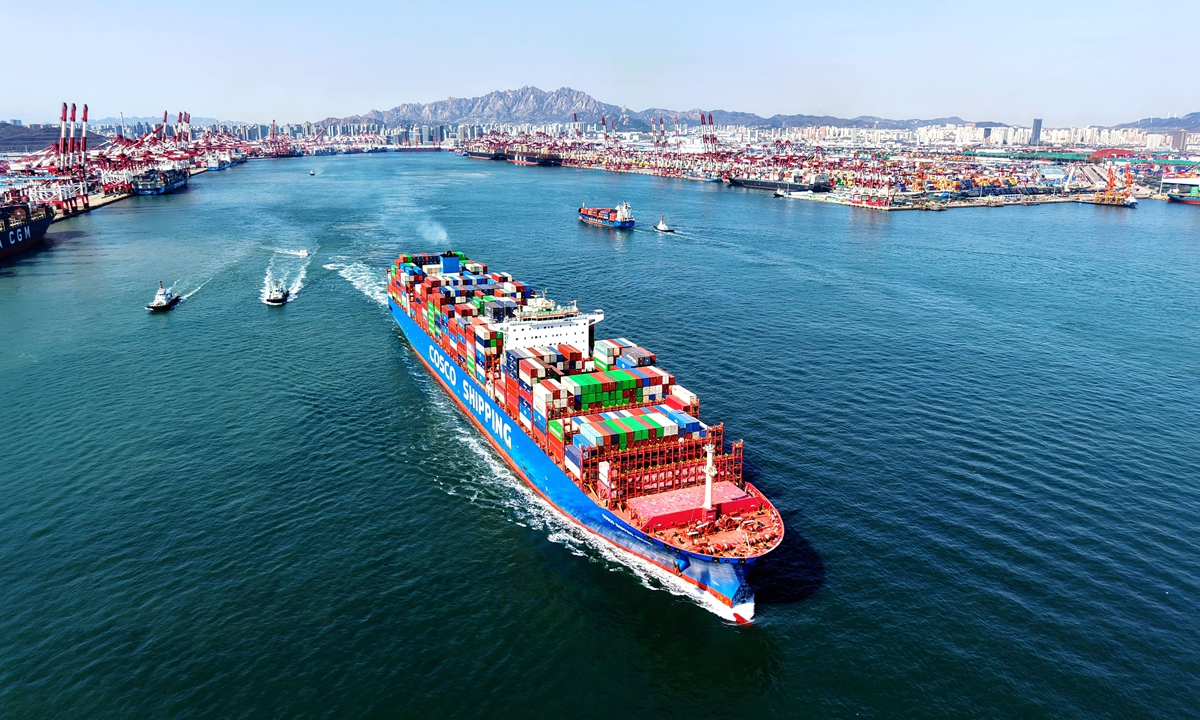
View of a container vessel near Qingdao port in East China's Shandong Province on April 7, 2026 Photo: VCG
China's major coastal trade provinces have reported strong foreign trade growth in the first four months of 2026, with analysts saying the performance highlights not only the resilience of China's export sector under external pressure, but also a deeper shift in growth drivers toward emerging markets and higher-end manufacturing.
The latest official data showed that Jiangsu and Guangdong outpaced the national average in total foreign trade growth from January to April. Zhejiang's total trade, exports and imports all hit record highs for the period, and Fujian posted its fastest January-April growth since 2023.
The strong provincial performance came amid solid momentum in China's overall foreign trade, with imports and exports rising 14.2 percent year-on-year in April despite a complex external environment.
The long-term positive fundamentals of China's foreign trade remain unchanged and its foundation remains solid, He Yongqian, a Ministry of Commerce (MOFCOM) spokesperson said on Thursday, adding that China's foreign trade is capable of maintaining steady improvement in both scale and quality this year and continuing to contribute to global economic and trade growth.
New markets, new momentum
Specifically, East China's Jiangsu Province saw foreign trade grow to 2.2 trillion yuan ($305 billion) in the January-April period, up 19 percent year-on-year, Xinhua Daily, citing Nanjing Customs, reported on Wednesday.
In April alone, Jiangsu's foreign trade exceeded 600 billion yuan for the first time, up 23.7 percent from a year earlier. Exports rose 20 percent, while imports jumped 31.1 percent.
Neighboring Zhejiang Province saw foreign trade reach 1.86 trillion yuan in the first four months, up 6.7 percent year-on-year. Exports increased 6.5 percent and imports rose 7.4 percent, with both exports and imports hitting record highs for the period, Zhejiang Daily reported on Thursday, citing Hangzhou Customs.
South China's Guangdong Province also showed strong growth. Its foreign trade totaled 3.49 trillion yuan in the January-April period, up 18.4 percent year-on-year. Exports rose 11.4 percent, while imports surged 30.1 percent, China News Service reported on Wednesday.
The same momentum was also seen in Fujian Province, where foreign trade rose 7.9 percent year-on-year in the first four months, the fastest pace for the same period since 2023, Fuzhou Daily reported, citing local customs authorities. Imports expanded by nearly 20 percent.
Coastal regions have long served as the backbone of China's foreign trade, and their solid performance this year reflects China's ability to keep foreign trade stable amid external uncertainties, while also demonstrating the resilience of key manufacturing provinces against external shocks, Li Changan, an economist at the University of International Business and Economics, told the Global Times on Wednesday.
Last year, seven provincial-level regions, including Guangdong, Jiangsu, Zhejiang and Fujian, contributed more than half of the country's total foreign trade growth, public data shows.
Li also pointed to the faster import growth seen in the coastal provinces. "It reflected firm domestic demand and the continued vitality of industrial activity, while also underscoring China's efforts to expand market openness and pursue more balanced trade," he said.
Lü Daliang, director of the Department of Statistics and Analysis of the General Administration of Customs (GAC), said on May 9 that thanks to proactive efforts and coordinated policy measures by various regions and departments, China's foreign trade had gotten off to a strong start this year, with its resilience and vitality fully demonstrated.
Growth drivers evolve
A notable feature of the latest data from these coastal provinces is the rapid expansion of trade with emerging markets.
In the first four months, Jiangsu's trade with Belt and Road partner countries rose 26.2 percent to 1.15 trillion yuan, contributing 12.9 percentage points to the province's overall trade growth. Zhejiang's trade with Belt and Road partner countries increased 6.7 percent year-on-year, while its trade with Africa rose 16 percent.
Guangdong maintained double-digit trade growth with the ASEAN, while its trade with the five Central Asian countries, Africa and India all expanded faster than the province's overall trade growth.
Fujian showed the same trend, with trade with Latin America rising 18 percent and trade with Africa up 28.6 percent in the January-April period.
The growth in trade with Africa is particularly notable, reflecting deepening bilateral economic and trade ties, analysts said.
From May 1, China expanded its zero-tariff treatment for two years to cover all 53 African countries with which it has established diplomatic ties, with experts saying the country's vast market is creating new development opportunities for Africa and opening broader space for future trade exchanges.
Meanwhile, trade with traditional partners also remained resilient. Jiangsu's trade with the EU rose 20.6 percent year-on-year in the first four months. Guangdong's trade with the EU posted double-digit growth this year, while its trade with Australia surged 51.4 percent.
Another highlight is the continued shift in these provinces' export mix toward higher-tech, higher value-added and greener products.
According to the latest statistics, Zhejiang's exports of the "new three" products - electric vehicles, lithium batteries and solar panels - jumped by more than 50 percent.
In Jiangsu, mechanical and electronic products accounted for three-quarters of total exports, while Guangdong saw rapid growth in high-tech exports including drones. Fujian's exports were supported by computers, ships and automobiles.
High-tech exports have also gained pace as part of a broader nationwide trend. Among the highlights, trade in mechanical and electrical products grew nearly 20 percent in the first four months, showing strong momentum.
MOFCOM spokesperson He Yongqian said on Thursday that "this reflects not only the combined effect of the global industrial cycle and market demand, but also the continued optimization of China's foreign trade structure and the steady improvement of its industrial innovation capacity."
International media and financial institutions have also linked China's export resilience to the competitiveness of its advanced industries.
The Financial Times reported that China's exports "rebounded strongly in April, beating analysts' expectations", with strength seen in high-end manufacturing sectors such as electronics and machinery.
A Bloomberg report said last week that China's export growth "rebounded more than expected" as trade volumes were boosted by "an investment boom in artificial intelligence."
Li said that while many countries' industrial sectors have come under heavy pressure in the current international environment, China has maintained stability and avoided major disruption, making its role in global supply chains even more prominent.
"The position of China as a major trading nation will continue to strengthen," he said. "This will serve as an anchor for global trade and contribute to global economic stability."
RELATED ARTICLES