Chinese-built world’s largest methanol dual-fuel container ship begins sea trials
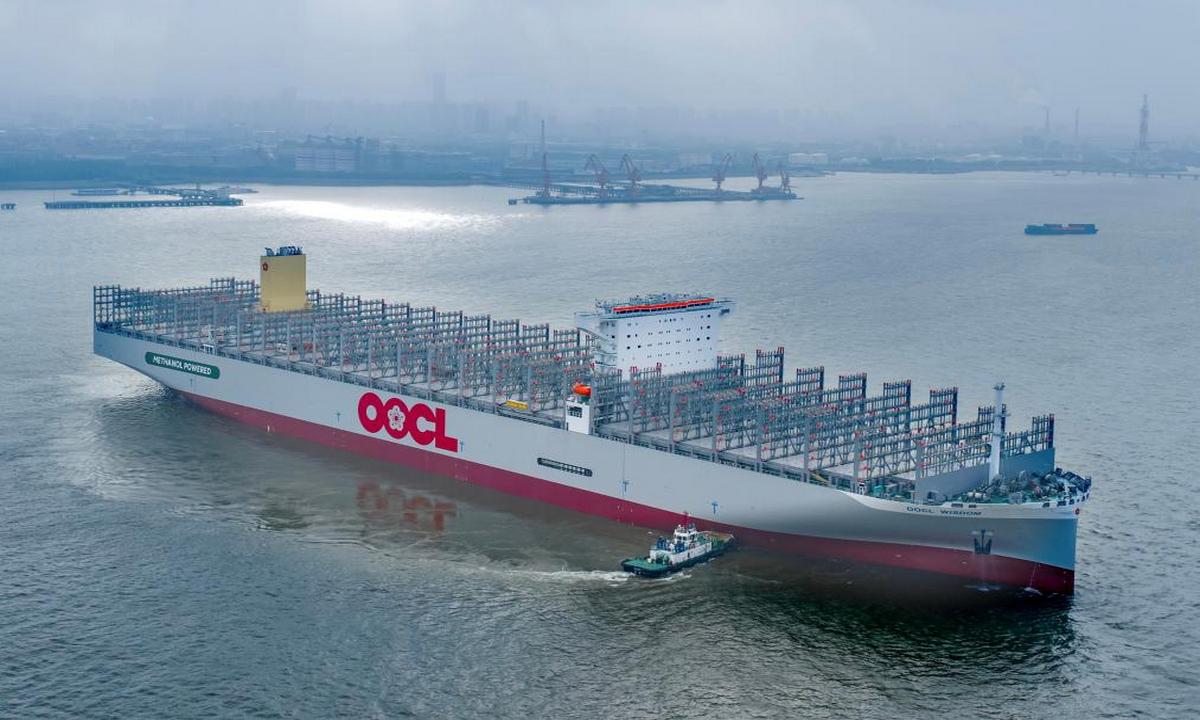
Photo: Courtesy of Nantong COSCO KHI Ship Engineering Co
A Chinese-built methanol dual-fuel container ship that can carry 24,000 standard containers, the world's first of its kind, departed from Nantong, East China's Jiangsu Province for sea trials on Thursday, the Xinhua News Agency reported.
The ship was built by Nantong COSCO KHI Ship Engineering Co, and is currently the world's largest methanol dual-fuel container ship.
Independently designed and built in China, the ship measures 399.99 meters in length, 61.3 meters in width and 33.2 meters in depth, with a deadweight tonnage of 225,000 tons and a maximum capacity of 24,168 standard containers, the largest among ships of its class, according to Xinhua.
Zhang Haidong, a representative of the company, said that the ship's core breakthrough lies in its integration of the world's largest methanol dual-fuel main engine, auxiliary engines and boiler system, enabling flexible switching between methanol and conventional fuel modes, according to the report.
When powered by green methanol, a single ship can reduce carbon dioxide emissions by about 150,000 tons annually, while nearly eliminating sulfur oxide emissions and significantly cutting nitrogen oxide emissions, in line with the global shipping industry's decarbonization goals, Zhang said, according to Xinhua.
Following the completion of sea trials, the ship will be put into operation on international shipping routes, injecting "Chinese momentum" into the global shipping industry's green and low-carbon transition.
Official data released recently showed that China led the world in the three major shipbuilding indicators in the first quarter, while Chinese shipbuilders are also accelerating their push into green and intelligent development.
Data available on May 9 from the Ministry of Industry and Information Technology (MIIT) showed that shipbuilding completion reached 15.68 million deadweight tons during the period, up 46 percent year-on-year, highlighting the country's continued strength in the global maritime manufacturing sector amid robust international demand for large vessels and high-end ship types.
Notably, green ships accounted for a significant share of China's new shipbuilding orders in the first quarter.
Green ship orders made up 80.2 percent of the international market share of China's newly secured orders during the period, with new contracts covering various types of dual-fuel and electric ships powered by liquefied natural gas (LNG), liquefied petroleum gas, methanol and ethane, according to the MIIT.
Green ships refer to ships that adopt advanced technologies or use new and clean energy sources to reduce pollution and greenhouse gas emissions.
Green ships are characterized by lower pollution emissions, effective pollutant treatment and higher energy efficiency, enabling more energy-saving and environmentally friendly operations, according to China Media Group (CMG).
Commenting on Chinese shipbuilders' accelerated push toward green and intelligent development, Wang Peng, an associate research fellow at the Beijing Academy of Social Sciences, said that the trend aligns with the global shipping industry's broader decarbonization drive.
The International Maritime Organization (IMO) has called for net-zero greenhouse gas emissions by about 2050, and the EU's shipping decarbonization regulations have been fully implemented this year, said Wang Zhe, a professor at Beijing Normal University, according to CMG.
By using fuel technologies such as methanol, LNG, pure electric and ammonia to power ships, Chinese shipbuilders are not only meeting global shipowners' compliance needs, but also seizing major opportunities arising from the green transition, Wang Zhe said.
Meanwhile, Wang Peng said that China's cost-effective and technologically advanced green ships have provided a "Chinese solution" for accelerating the IMO's decarbonization goals, offering key technological support for the global shipping industry to reduce pollution and greenhouse gas emissions.
He added that China's leadership in green and intelligent shipbuilding also reflects a phased achievement in the country's push toward high-end, intelligent and green manufacturing transformation.
"The rapid growth of green vessels has further driven coordinated development across the entire industrial chain, including clean-energy propulsion systems and advanced materials, strengthening the resilience and competitiveness of Chinese industry in the global value chain."
RELATED ARTICLES