ARTS / CULTURE & LEISURE
Chinese, Arab poets seek kindred spirits at international poetry festival
Poetry as a bridge
By Published: May 14, 2026 10:37 PM

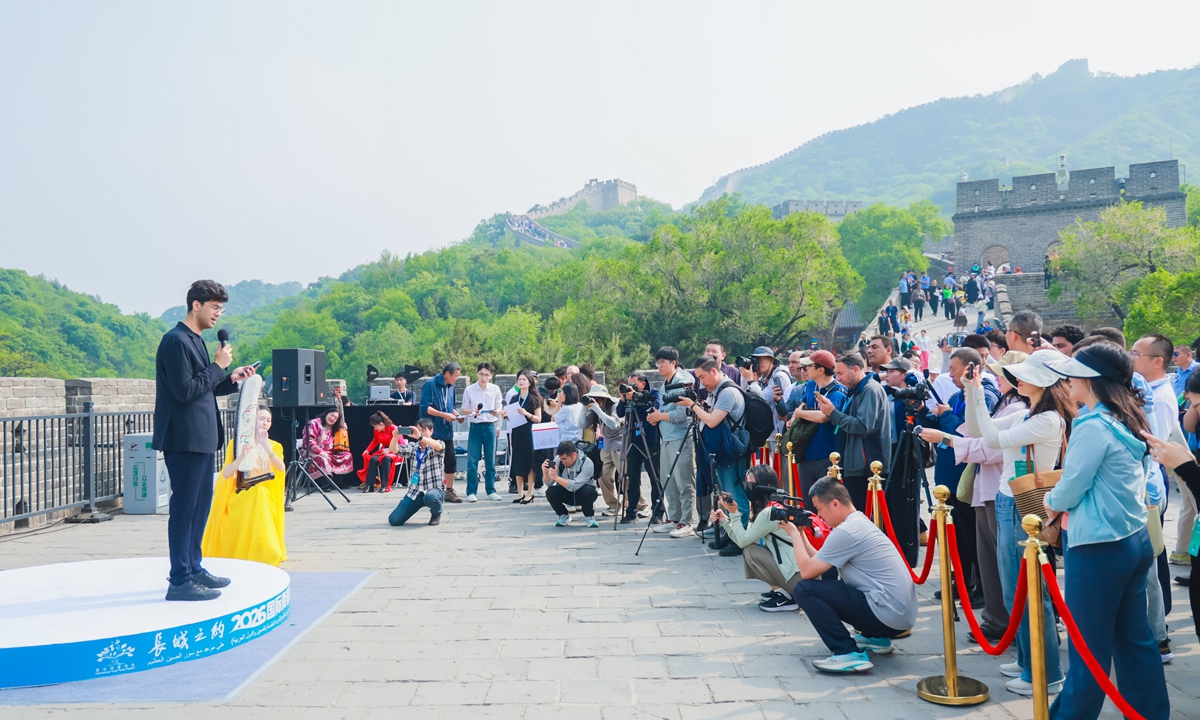
Kuwait poet Ali Ben Nekhy (left) reads a poem at a ceremony held during the 2026 International Youth Poetry Festival at the Badaling Great Wall in Beijing on May 14, 2026. Photo: Courtesy of the China Writers Association
Chinese poet Ai Kou has long been accustomed to gathering with fellow Chinese poets for creative exchanges.Yet at the ongoing 2026 International Youth Poetry Festival, she finds herself especially delighted by the opportunity to sit down for deep conversations with literary creators from the Arab world.
"At this festival, I've made friends with poets from various countries like Tunisia," Ai Kou told the Global Times.
Overcoming language barriers, she was once again reminded that no matter people's cultural backgrounds, poetry can always reach the softest place in the human heart.
From the riversides of Guangzhou in South China's Guangdong Province to the storied ramparts of Beijing's Great Wall, around 100 poets, writers and translators from China and 13 Arab countries have come together to seek kindred spirits through verse.
This year's International Youth Poetry Festival, being held from May 9 to 17 and themed as a China-Arab special session, welcomes voices from diverse countries including Jordan, Bahrain, Tunisia, Saudi Arabia, Sudan, Syria and China.
United by verse
On Thursday, an early summer day in Beijing, the ancient ramparts of the Badaling section of the Great Wall stood silent witness to a gathering that saw and heard voices from across continents weaving their verses together under the open sky.
Chinese and international guests at the poetry festival climbed the Great Wall to continue their dialogue around literature and civilizations.
The poetry event held on the Great Wall creatively blended a variety of art forms, including traditional folk music, poetry recitals, dance, tai chi, and a children's choir, creating an immersive scene for a dialogue of civilizations atop this historic landmark.
The performance began with a spirited and grand combination of music and dance, followed by heartfelt and profound classic recitations, dynamic cross-genre interpretations, and pure and touching songs sung by children.
Nabil Suleiman, a Syrian writer and literary critic, told the Global Times that he had been looking forward to this trip to the Great Wall in the hope of seeing young poets from China and Arab countries freely express themselves on this ancient structure, generating new inspirations and creating more works.
"The Great Wall is one of the most iconic and representative structures in China. For Arab poets who have traveled such a long way, it would surely be a pity to visit China without seeing the Great Wall," Ai Kou noted.
"In recent conversations, I learned that most of the Arab guests are visiting China for the first time. I can sense their excitement and anticipation for seeing the Great Wall," said Ai Kou.
During the festival, Ai Kou has often used translation apps to communicate with poets from countries such as Tunisia and Morocco. However, she found that these apps frequently introduced subtle inaccuracies, especially when translating recommended lines of poetry between poets.
Ai Kou observed that, compared to the original poems, the language structure and conveyed meanings would shift, yet these very differences often sparked new poetic inspiration, providing poets from different countries with a feeling of freshness and creative ideas.
"This is the charm of poetry," Ai Kou told the Global Times.
"Although we come from different cultural backgrounds, we all agree that sincerity is one of the most important qualities in poetry writing. These days, we can really feel that by sharing our works and creative ideas. We have overcome language barriers and grown closer," Ai Kou said.
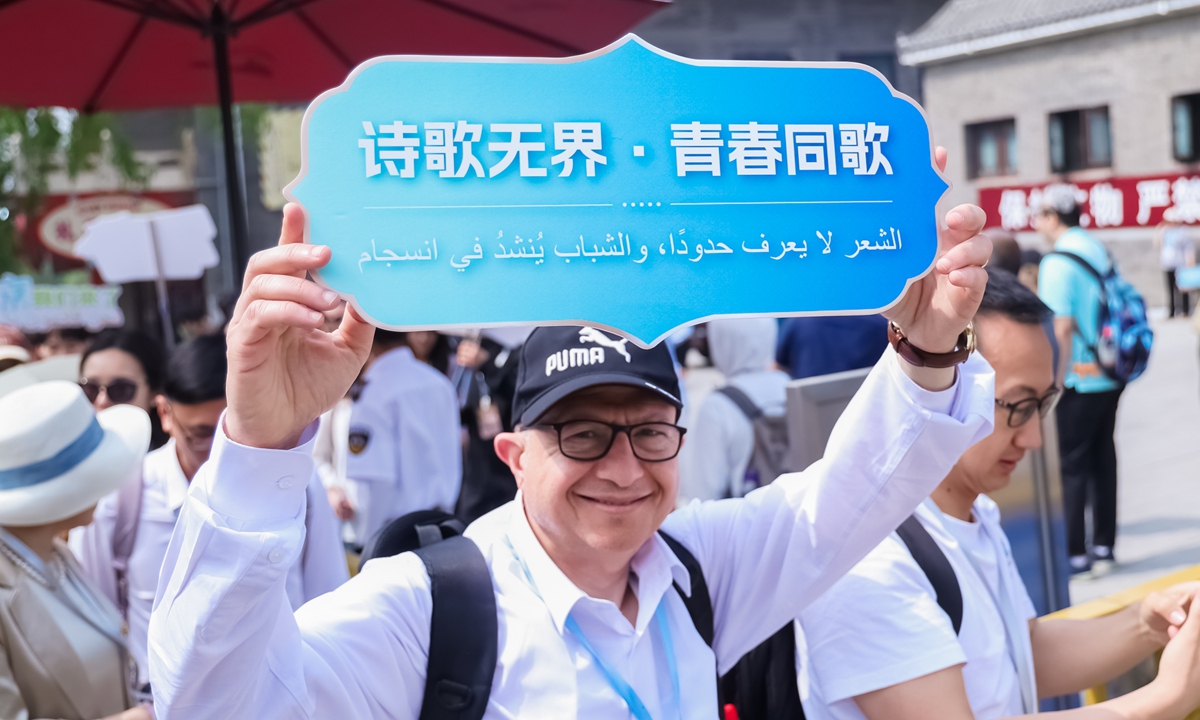
Egyptian poet Mouner Oteiba holds a banner that reads "Poetry knows no boundaries, and youth sings in harmony" in Chinese and Arabic as he participates in the poetry festival in Beijing on May 14, 2026. Photo: Courtesy of the China Writers Association
More literary exchangesPrior to arriving in Beijing, these poets and writers immersed themselves in the poetic spirit of Guangzhou, reading original works, holding roundtable discussions, and exploring Guangzhou's modern literary heritage.
Foreign guests such as Egyptian translator Mira Ahmed even penned a poem inspired by Guangzhou - a gift to the city that welcomed her.
These exchanges, rich in both form and feeling, offered a deeper resonance between Chinese and Arab cultural currents.
During the poetry festival, a China-Arab academic dialogue themed "the tradition and future of poetry" was held in Guangzhou.
Nearly 100 poets, scholars, and sinologists engaged in thought-provoking discussions around topics such as the universality and philosophical depth of poetry, innovations and challenges, as well as the future of poetry in the era of AI, according to the China Writers Association (CWA).
He Xiangyang, deputy head of the CWA, remarked that the progress of poetry has never been a simple repetition of tradition, but rather the result of innovation and creativity in times of change.
She encouraged young poets to defend and enhance the sacredness of poetry with their most genuine life experiences in this digital age.
Suleiman recalled the joy of reciting classic verses in his youth and expressed that poetry refines language, elevates understanding, and extends to the world an invitation of friendship and mutual understanding.
Suleiman told the Global Times that he visited Beijing in October and talked with professors as well as students at five universities about poetry and literary translation.
He noted that every time he comes to China, he acquires a great deal of experience. He said that as long as he is alive, he will continue to visit China again and again.
Suleiman has observed that nowadays many young people in Arab countries enjoy reading contemporary Chinese novels and other literary works. He also noticed that Chinese culture and ideas conveyed by these literary works have also spread accordingly.
Ai Kou also said that judging from this poetry festival, the extent to which Chinese poetry and literature have reached the world, as well as the quantity and quality of Chinese writers' works translated overseas, are all improving.
Meanwhile, more literary works by Arab writers have also been introduced to China, which can not only broaden the horizons of Chinese readers and writers, but also increase cultural exchange and mutual inspirations.
More events will unfold in Beijing over the following days. Poets will visit Beijing Normal University, where they are going to hold lively discussions on poetic form, translation and the craft of writing.
The National Museum of Modern Chinese Literature will become a focal point for cross-cultural comparison, with poets gifting their manuscripts and sharing the journeys of their nations' literature, according to the CWA.
RELATED ARTICLES