China will closely monitor developments, protect Chinese firms’ rights, interests: MOFCOM on UK’s reported plan to nationalize British Steel
Move should be properly justified, with clear grounds to protect foreign investors’ interests: expert
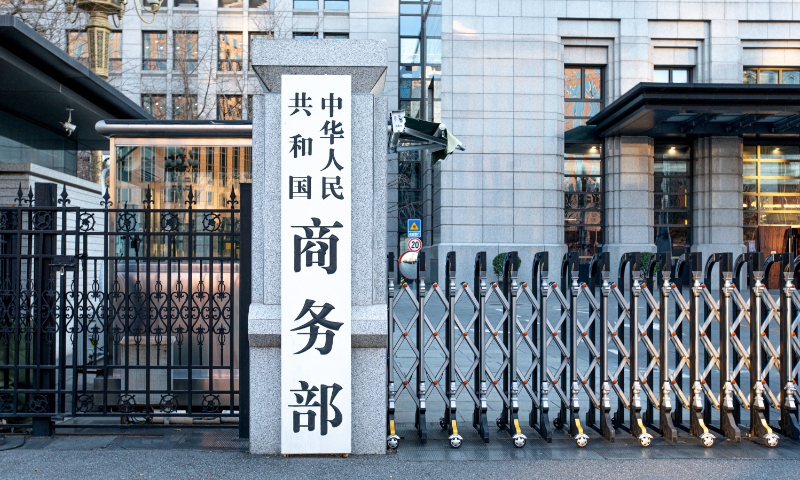
The Ministry of Commerce of China File photo: VCG
Chinese Ministry of Commerce (MOFCOM) said on Thursday China will take effective measures to protect the legitimate rights and interests of Chinese enterprises after reports regarding the UK government's potential nationalization of British Steel.
The response came after media reports that the UK government will introduce legislation to nationalize British Steel, which is a subsidiary of China's Jingye Group.
Whatever actions the UK government takes, it should fully consider the enormous investment that the Chinese firm has made in British Steel and its contributions to the UK economy and society, respect the wishes of the companies and market principles, refrain from abusing administrative coercive measures, and actively seek fair, just, and mutually acceptable solutions with Chinese companies, a spokesperson of the MOFCOM said.
The spokesperson urged the UK to adhere to the principles of fairness, impartiality, and non-discrimination, act prudently and after careful consideration to effectively protect the legitimate rights and interests of Chinese enterprises, and safeguard the hard-won positive atmosphere in China-UK economic and trade relations.
A Chinese expert urged the UK government to carefully assess whether nationalization is justified and to provide clear and sufficient grounds to safeguard the rights of foreign investors, while also ensuring a fair and transparent environment for Chinese businesses.
In March 2020, Chinese steelmaker Jingye Group said in a statement that it had completed the acquisition of British Steel's business and assets in Britain and the Netherlands, the Xinhua News Agency reported.
The completion secured the future of approximately 3,200 jobs, said Jingye, pledging to invest 1.2 billion pounds ($1.38 billion) to place the business on a more competitive and sustainable footing, said the report.
Hailing the acquisition as momentous, Ron Deelen, who was the British Steel CEO at that time, said "I'm confident we'll seize the incredible opportunity Jingye has given us to build on 150 years of heritage, and further cement British Steel's reputation as a manufacturer of world-class steel," Xinhua reported.
However, in April 2025, the British government seized operational control of British Steel from its Chinese owner, Jingye and, under plans announced by UK Prime Minister Keir Starmer on Monday, could fully nationalize it, Reuters reported.
Citing Starmer, the BBC reported that legislation would be brought forward this week to give the government powers to take "full ownership of British Steel," subject to a public interest test.
Jingye Group did not respond to a Global Times request for comment as of press time.
Commenting on the UK's move, Wang Yiwei, director of the Center for European Union Studies at Renmin University of China, told the Global Times on Thursday that in handling issues related to British Steel, the UK government should fully take into account the contributions and long-term operations of Chinese companies, and respect their legitimate rights and interests arising from lawful and compliant business activities.
"The UK should carefully assess whether nationalization is justified and provide clear, sufficient grounds to protect foreign investors' rights," Zhou Mi, a senior research fellow at the Chinese Academy of International Trade and Economic Cooperation, told the Global Times on Thursday.
Zhou noted that this issue is not only about a specific investment case involving a particular Chinese company, but will also have an important impact on the UK's ability to attract foreign investment and on its overall business environment.
The UK is China's third-largest trading partner, third-largest investment destination, and third-largest source of foreign investment in Europe, while China is the UK's largest trading partner in Asia.
Zhou said that it is important for the UK government to avoid politicizing the issue or relying on unilateral administrative measures at the expense of foreign businesses' interests. Instead, it should manage differences appropriately within the framework of rules and laws, so as to maintain the long-term, stable, and healthy development of China-UK economic and trade relations, the expert said.
RELATED ARTICLES