ARTS / CULTURE & LEISURE
China’s first canal wildlife corridor bridge takes shape in Guangxi
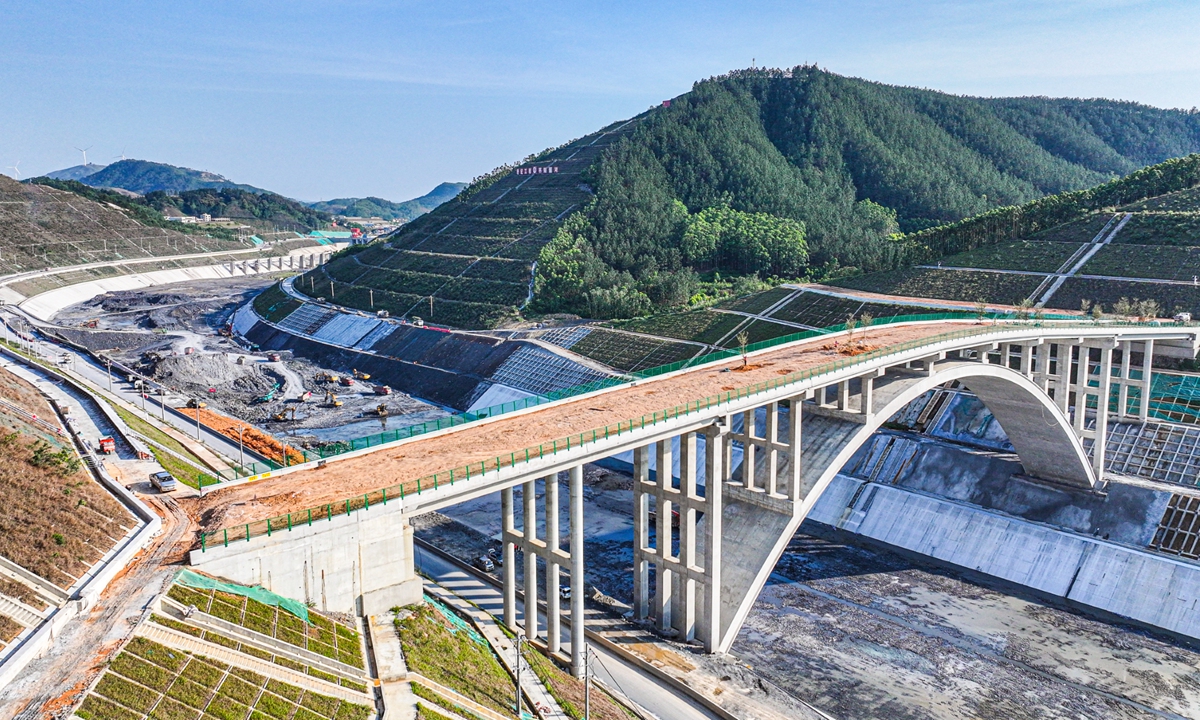
China's first dedicated wildlife corridor bridge spanning the Pinglu Canal in South China's Guangxi Zhuang Autonomous Region Photo: Courtesy of Li Xin
China's first dedicated wildlife corridor bridge, spanning a canal in South China's Guangxi Zhuang Autonomous Region, is currently undergoing greenification, with work on the bridge surface scheduled to be completed by the end of May, an official with the canal construction project told the Global Times on Thursday.While the wildlife corridor bridge does not have a specific opening date, the main structure has already been completed. The bridge surface is currently being fitted with a habitat suitable for wildlife activity, Zhang Shoulong, an engineer with the Pinglu Canal Group, told the Global Times.
The Pinglu Canal is a flagship project along the New International Land-Sea Trade Corridor, an important trade and logistics passage jointly built by provincial-level regions in western China and ASEAN members. The canal will facilitate the direct shipment of goods from Guangxi, Yunnan, and Guizhou through the Xijiang river system to ports in the Beibu Gulf of Guangxi.
During the construction of the Pinglu Canal, once-connected forests and grasslands were separated by the waterway, disrupting animals' migration routes and potentially hindering foraging, breeding, and population interactions.
Among the 27 bridges spanning the Pinglu Canal, two wildlife crossings have been built with an investment of about 100 million yuan ($14.7 million), with the aim of using green infrastructure to create migration and breeding corridors for animals along the route, according to the group.
Serving exclusively as passageways and habitats for wildlife, the dedicated wildlife crossing spans a total length of about 240 meters, while the bridge decks are 20 meters wide, said Zhang.
The shared crossing makes use of the Jintang village bridge, where a separate 3-meter-wide wildlife corridor has been installed on the right side of the deck. Sound barriers and isolation fencing ensure complete separation between vehicles, pedestrians, and animals, allowing them to move without disturbing one another.
The dedicated crossing has adopted a "localized" and multi-layered ecological design tailored to the habits of local species such as spotted linsang, leopard cats, and red-bellied squirrels, Zhang noted.
In selecting food-source plants, planners specifically chose species favored by wildlife but generally not harvested by humans, including Chinese banyan, Madagascar almond, Chinese bayberry and longan, providing a steady supply of berries and nuts for mammals and birds, the group reported.
The bridge deck incorporates subtle terrain variations to create water-collection areas planted with moisture-loving vegetation such as daylilies and purple loosestrife. Deadwood and rock piles have also been carefully arranged to provide amphibians and reptiles with sheltered hiding places and reliable water sources. Climbing vines attached to the corridor's railings form a noise-reducing "green wall," the group said.
Tree planting is scheduled to be completed in May, after which the project will enter the maintenance phase and monitoring of animal usage will begin, Zhang added.
Once the greening project is fully completed, the bridge will directly reconnect forests separated by the canal, ensuring normal migration, foraging, and genetic exchange among targeted species, while preserving the continuity and integrity of the regional ecosystem.
This dedicated "ecological corridor bridge" now quietly awaits the passage of wildlife, standing as a gentle touch within a major national infrastructure project, according to a report published by the China Small Animal Protection Association.
The Pinglu Canal project demonstrates through action that great national engineering carries not only the ambition to reshape landscapes, but also the sensitivity and respect to protect life, the report said.
May such care and wisdom continue to be reflected in more projects to come, so that every step of development is guided by respect for life and kindness toward all living beings, the CSAPA stated.
RELATED ARTICLES