GT Voice: German official’s pragmatic signal of co-op with China worth EU reflection
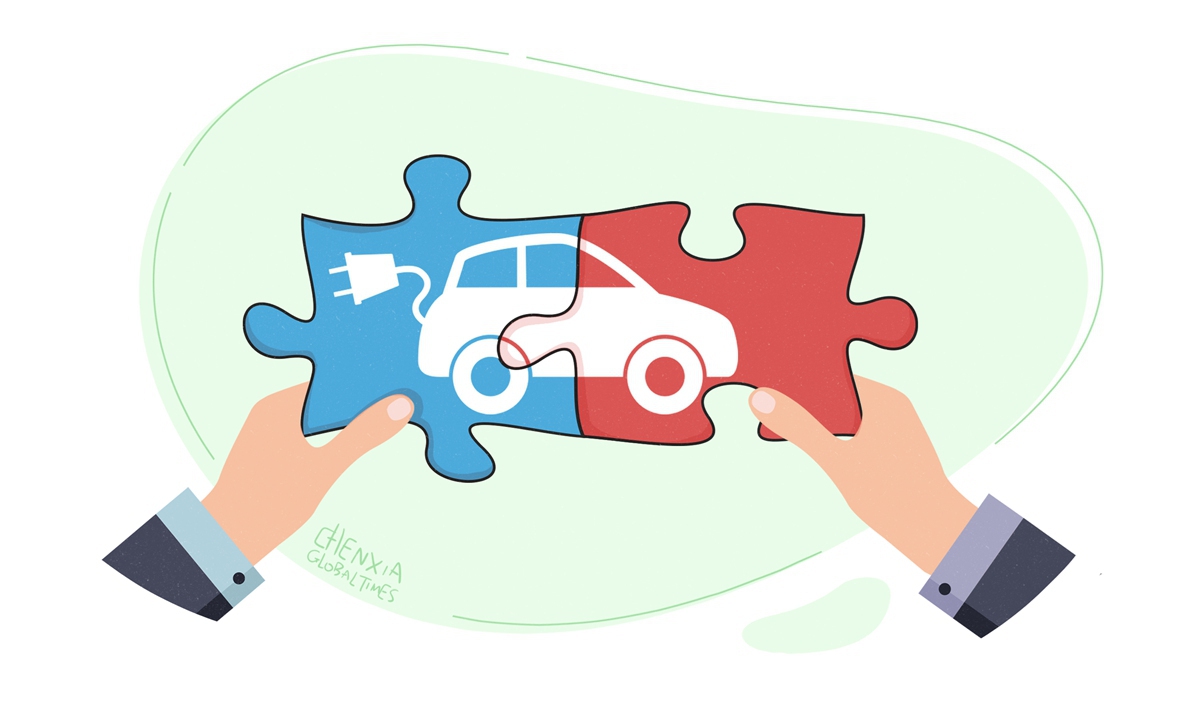
Illustration: Chen Xia/Global Times
As the global auto industry undergoes a profound transition toward electrification and intelligence, the pragmatic signal of industrial cooperation with China from an official of the German state of Saxony, and the market rationality and practical urgency behind it, deserve consideration by the EU.Dirk Panter, economy minister of the German state of Saxony, called for a more pragmatic approach to cooperation with Chinese carmakers at a time when Germany's automotive industry faces mounting pressure from a slowing electric vehicle (EV) transition, the Xinhua News Agency reported on Wednesday.
A joint venture between Volkswagen and Chinese automakers is one possible model, under which Chinese partners can produce vehicles using currently underutilized facilities in Saxony, he said, according to Xinhua.
His comment merits attention because the state has been one of the country's key vehicle manufacturing hubs, hosting production sites for giants such as Volkswagen, BMW and Porsche. Amid complex challenges in China-EU economic relations, the local official's economic rationality is an attitude that the EU would do well to ponder.
The European auto industry is facing headwinds. The German Association of the Automotive Industry (VDA) said on Wednesday that Germany's automotive industry could lose 125,000 jobs by 2035, with VDA President Hildegard Mueller citing high taxes, energy costs and labor costs as some key factors weakening the country's industrial competitiveness, according to Xinhua.
The German auto industry stands at a crossroads. On the one hand, the transition toward electrification and intelligence requires huge investment. On the other hand, problems such as high energy costs and a tightening regulatory environment continue to weaken the competitiveness of German manufacturing. In this context, the Saxony official's recognition of the industrial value of Chinese automakers not only makes economic sense, but is also a responsible attitude toward local employment and the future of the industry.
After years of sustained investment, Chinese automakers have built a complete industrial chain and gained significant market competitiveness in areas such as EV manufacturing, battery technology, and intelligent connectivity systems. This has created a complementary relationship with the EU. Europe possesses engineering expertise, high-end brand value, and mature manufacturing systems, while China has mastered full-chain capabilities ranging from battery technology to smart cockpits. This complementarity means that cooperation can generate incremental value rather than simply dividing up the existing market.
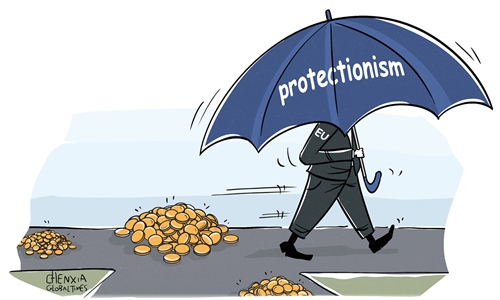
Regrettably, however, the rational voice from Saxony has not yet become the consensus at the EU level, with certain barriers and risks still facing Chinese businesses interested in investing in the bloc. For instance, a spokesperson of China's Ministry of Commerce said in April that the EU's Industrial Accelerator Act imposes multiple restrictive requirements on foreign investment in four strategic emerging industries - batteries, EVs, photovoltaics and critical raw materials - and includes exclusionary EU origin clauses in public procurement and public support policies. These provisions pose serious investment barriers and constitute institutional discrimination.
The global vehicle sector is in a critical stage of transition toward electrification and intelligence, and green and low-carbon development has become an irreversible trend. To fulfill its energy transformation goals and achieve large-scale electrification, the EU cannot do without efficient cooperation in the global industrial chain, which naturally includes technologies, products and investments from China.
If the EU attempts to protect the competitiveness of its local industry by closing its market and imposing discriminatory regulations, it will not only violate the basic laws of economic globalization, but also weaken its voice and influence in the global green transformation.
For the EU, recognizing China's industrial advantages, removing barriers, and deepening industrial cooperation with China with a pragmatic attitude represent the correct path to alleviate local employment pressure and accelerate green transformation. Policymakers need to realize that only by respecting market laws and returning to economic rationality can they truly safeguard the vital interests of European workers and ensure that the European auto industry maintains long-term competitiveness in the global EV transition.
RELATED ARTICLES