UN climate official’s praise of China’s clean-energy leadership shows China’s deep responsibility for domestic energy security, global climate governance: expert
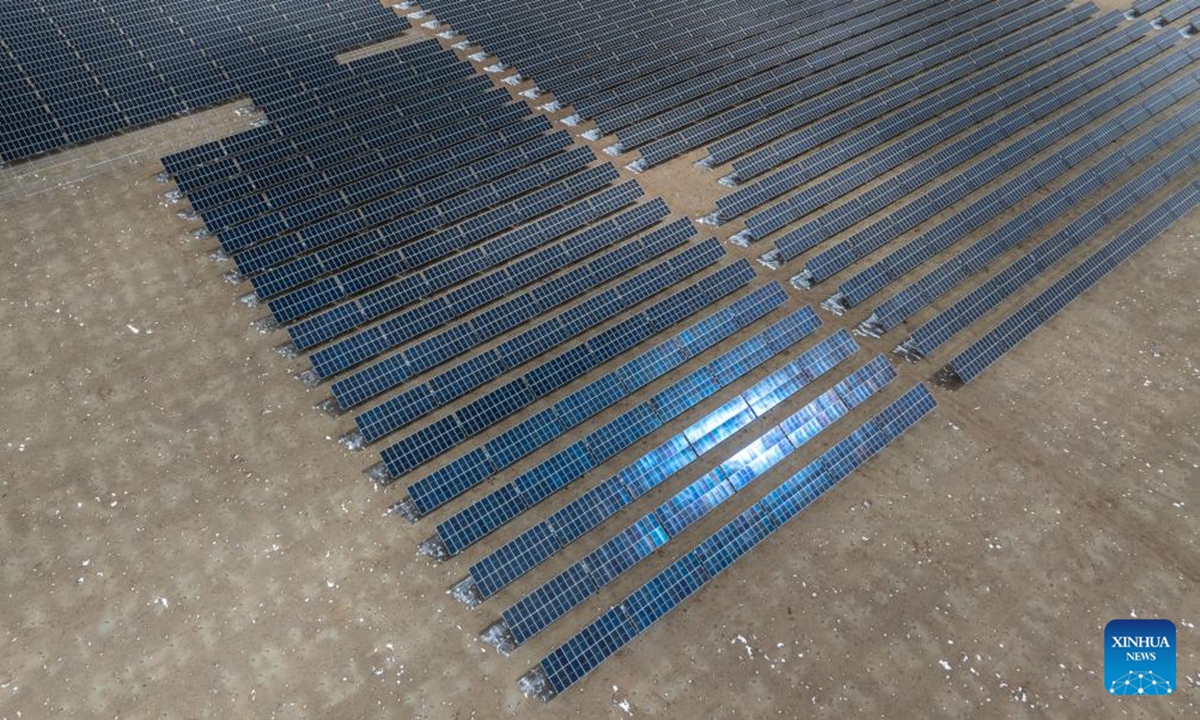
A drone photo taken on April 6, 2026 shows a view of a solar thermal and photovoltaic (PV) integrated project by China General Nuclear Power Group in Damxung County of Lhasa, southwest China's Xizang Autonomous Region. China General Nuclear Power Group announced on Monday that construction of a 50 MW trough-based concentrated solar power plant at an altitude of 4,550 meters started in southwest China's Xizang Autonomous Region. (Xinhua/Tenzin Nyida)
A top United Nations (UN) climate official has praised China’s role in the global clean-energy transition on Thursday, saying that the country is reaping benefits as a global leader on the green transition and other nations should follow as the Iran war shows the vulnerability of a fossil fuel-based economy, the Bloomberg reported on Thursday.
Speaking at an event held at Tsinghua University in Beijing on Thursday, Simon Stiell, UN Climate Change Executive Secretary said that “The further China goes, the faster the clean energy transition accelerates — the greater the benefit to your people and economy,” he said, “Where China leads, others follow. ”
“In this new era of geopolitics, and new era of climate multilateralism, China’s climate leadership is more important than ever,” he added.
Stiell’s remarks came as global energy markets remain under pressure from conflict in the Middle East, which has renewed concerns about the vulnerability of economies heavily reliant on fossil fuels. A Chinese energy expert said the comments reflected broader international anxieties over energy security and the need for stable, long-term climate cooperation.
“This precisely shows China’s deep responsibility for domestic energy security and social stability, while also making a pragmatic contribution to global climate governance,” Lin Boqiang, director of the China Center for Energy Economics Research at Xiamen University, told the Global Times on Friday.
Regrading some critics in the Bloomberg report claiming that “China has missed some recent goals and frustrated advocates of faster decarbonization with an agenda of steady, cautious activity rather than an acceleration of ambition to rein in emissions,” the expert said that a transition path grounded in industrial strength, linked by technological cooperation, and bounded by energy security is providing a more resilient model for global climate governance.
At a time when the Middle East conflict continues and the global energy landscape is undergoing profound restructuring, this kind of “steady yet resolute” leadership may be exactly the stability the world needs most, Lin noted.
China's newly installed solar and wind power capacity exceeded 430 million kilowatts in 2025, up 22 percent year-on-year, hitting a record high, the Xinhua News Agency reported in February, citing National Energy Administration data.
This surge propelled the cumulative grid-connected capacity of wind and solar power to 1.84 billion kilowatts, accounting for 47.3 percent of the country's total installed power capacity and surpassing thermal power for the first time, according to the Xinhua report.
China’s progress in clean energy is delivering benefits not only for the country itself, but also for the wider world, Lin said. Backed by the world's most comprehensive supply chains and a massive market, China has taken a leading position in solar power, wind power, EVs and energy storage, making it a key driver of global green transition, Lin said, adding that China supplies 70 percent of the world's wind power equipment and 80 percent of its photovoltaic modules, with strong competitiveness in both cost and quality.
Data from China's General Administration of Customs showed that the country saw an annual increase in clean tech exports in the first four months of the year. Within this category, shipments of electric vehicles, lithiumion batteries and wind turbine generators surged 68.1 percent, 43.2 percent and 40.7 percent, respectively.
“Demand for your (China's) technologies is booming,” Stiell told the audience.
China is also deepening cooperation with developing countries. During COP meetings, Chinese firms and institutions have signed multiple clean-energy agreements with Global South, providing support in solar, wind, storage and financing. One example is Ming Yang Smart Energy Group, which reportedly received a license for a $14.8 billion renewable-energy investment in Ethiopia.
According to Lin, China's exports of clean-energy technologies such as solar panels, batteries and electric vehicles (EVs) are increasingly helping to cut emissions in other countries.
According to the International Renewable Energy Agency, the sharp decrease in global average costs of electricity from solar and wind was largely attributed to China's contribution -- making clean energy more affordable and accessible worldwide, the Xinhua News Agency reported.
According to calculations by UK-based think tank Ember, a total of 50 countries had record solar imports from China in March, with Nigeria recording a 519 percent surge from February and notable spikes in Malaysia, Ethiopia, and Kenya.
As the world faces rising geopolitical uncertainty and renewed energy insecurity, China’s combination of industrial scale, technological capacity and international cooperation is increasingly being viewed as central to the global clean-energy transition, Lin said.
Global Times
