Apple, Huawei launch major discounts as premium smartphone race heats up ahead of 618 shopping festival
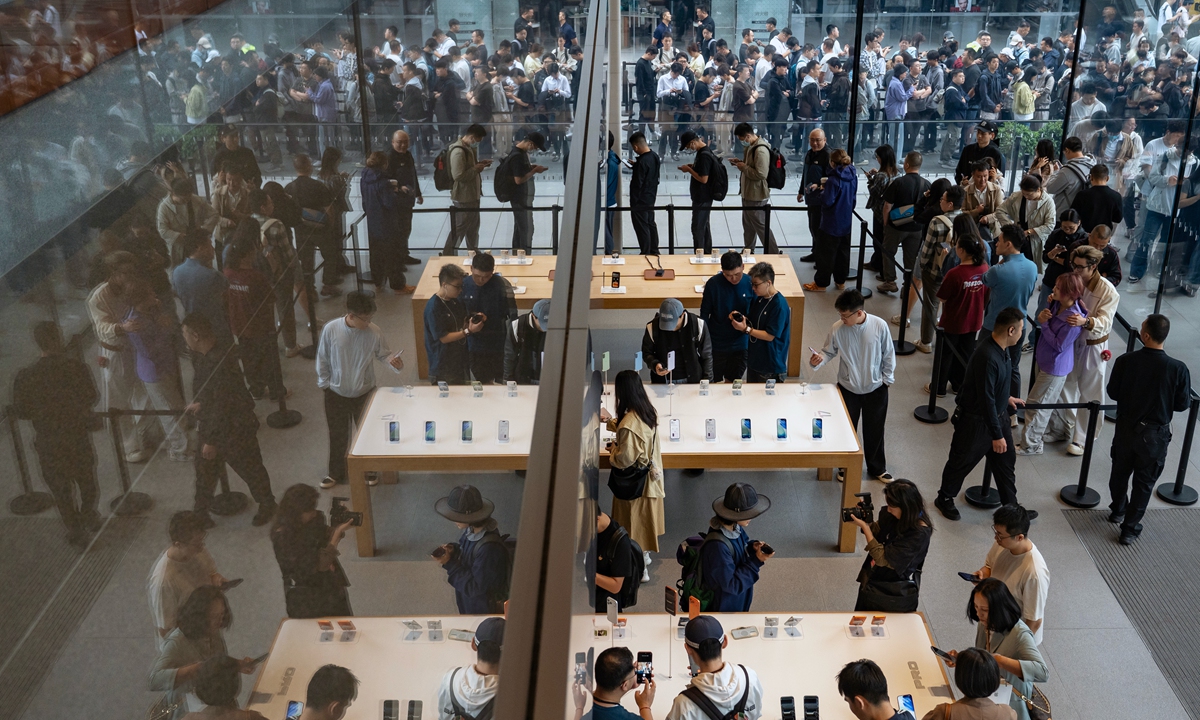
Consumers line up to pick up the latest iPhone 17 series ordered online at the Apple's store in Sanlitun, downtown Beijing, on September 19, 2025. Market observers say the iPhone 17 series could give a crucial boost to Apple's market share and shipments in China amid intensifying competition with its domestic rivals. Photo: VCG
Apple and Huawei have launched major discounts on flagship smartphones in China ahead of the annual 618 shopping festival, in a sign that competition in the country's premium handset market is heating up as leading domestic and overseas brands move to capture replacement demand.
Starting on Friday, Apple cut prices for its iPhone 17 Pro series by 1,000 yuan ($138), according to prices displayed on major Chinese e-commerce platforms.
JD.com, one of China's largest online retailers, showed on its Apple product self-operated flagship store that, after direct discounts and trade-in subsidies, some iPhone 17 Pro models could be purchased for as low as 6,999 yuan, the lowest level since the series was launched.
The standard iPhone 17, Apple's latest base-model flagship phone, also received its first notable price cut since release, with some versions priced at 4,499 yuan after multiple subsidies and trade-in offers.
Taobao, Alibaba's e-commerce platform, showed on its official Apple Store flagship shop that the iPhone 17 Pro series would be offered with a direct 1,000-yuan discount from the same day.
A store employee at an Apple outlet in Beijing confirmed to the Global Times on Friday that the latest discounts could be combined with trade-in subsidies and platform promotions, with some models reaching their lowest prices since launch.
"Some customers do wait for the May discount season, especially with 618 shopping festival approaching. For those planning to upgrade, this is a relatively good buying window," the employee said.
News of Apple's price cuts quickly shot to the top of Sina Weibo's trending list on Friday, carrying the platform's "explosive" tag. In one highly liked comment, a user said the discount stood out at a time when many consumer electronics products are becoming more expensive.
Huawei has also moved to lower prices for its high-end foldable models. According to Huawei Device, the Mate X7 series has been cut by 1,000 yuan across the board, starting from 11,999 yuan after the discount, while the Mate X6 series has seen reductions of up to 3,000 yuan. Both models are available with interest-free installment plans of up to 12 months.
The price cuts came as China's 618 shopping festival - originally launched by JD.com and now one of the country's largest mid-year online retail events - enters its warm-up period, with major platforms and consumer electronics brands ramping up subsidies, trade-in programs and limited-time offers.
Liu Dingding, a technology industry analyst, told the Global Times on Friday that the simultaneous discounts by Apple and Huawei point to a sharper contest at the top end of China's smartphone market.
"Apple and Huawei are the two companies most closely benchmarked against each other in the high-end segment," Liu said. "Other brands still hold market share, but in terms of premium-market influence, the rivalry is increasingly centered on these two players."
Liu said both companies are using this year's shopping festival window not merely for routine promotion, but to quickly lift orders and shipments while competing for a larger share of replacement demand.
Apple's latest discount campaign also comes as CEO Tim Cook is visiting China as part of the US business delegation accompanying President Donald Trump, a timing that the analyst said has brought additional attention to the brand.
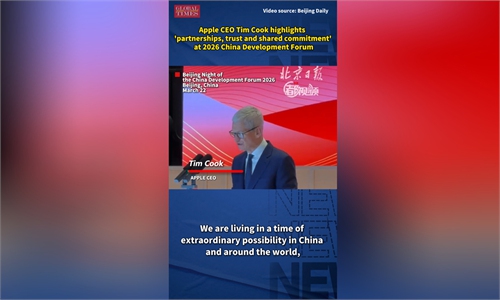
Cook has repeatedly highlighted Apple's long-standing ties with China. During the China Development Forum 2026 in Beijing in March, he underscored the importance of the Chinese market and local supply chains to the company.
Liu said the discounts should be seen as part of a broader contest among leading brands ahead of 618, especially as China remains one of the world's most important smartphone markets. "With platform subsidies added on top, consumers will see more direct benefits," he said.
Last year's JD.com 618 rankings also showed the impact of promotions on smartphone sales, with Apple, Xiaomi and Huawei leading the cumulative sales-value chart, while the iPhone 16 Pro series took the top two spots in the high-end smartphone category, according to media reports.
Liu said this year's 618 season also reflects several wider shifts in China's consumer market, including stronger recognition of domestic brands, the growing role of artificial intelligence in online shopping and supply-chain management, and younger consumers' rising demand for emotional value, cultural identity and personalized experiences.
Apple launched the iPhone 17 series globally in September 2025. In October, its sales and market share in China rose sharply, according to Reuter. But a CNBC report in September noted that Apple still faced pressure from Chinese rivals and questions over its artificial intelligence strategy.
"Apple continues to roll out products across different price bands because it still sees strong profitability and growth potential in China," Liu said, adding that China's market is large and open enough for both domestic and overseas brands to share the benefits of consumption growth.
Domestic brands are moving up the value chain, while global companies such as Apple still rely on China's manufacturing ecosystem, supply-chain efficiency and innovation capacity, Liu said.
RELATED ARTICLES