China’s SAMR unveils 34 priorities to back up private sector’s growth in 2026, curbing 'involution-style' competition
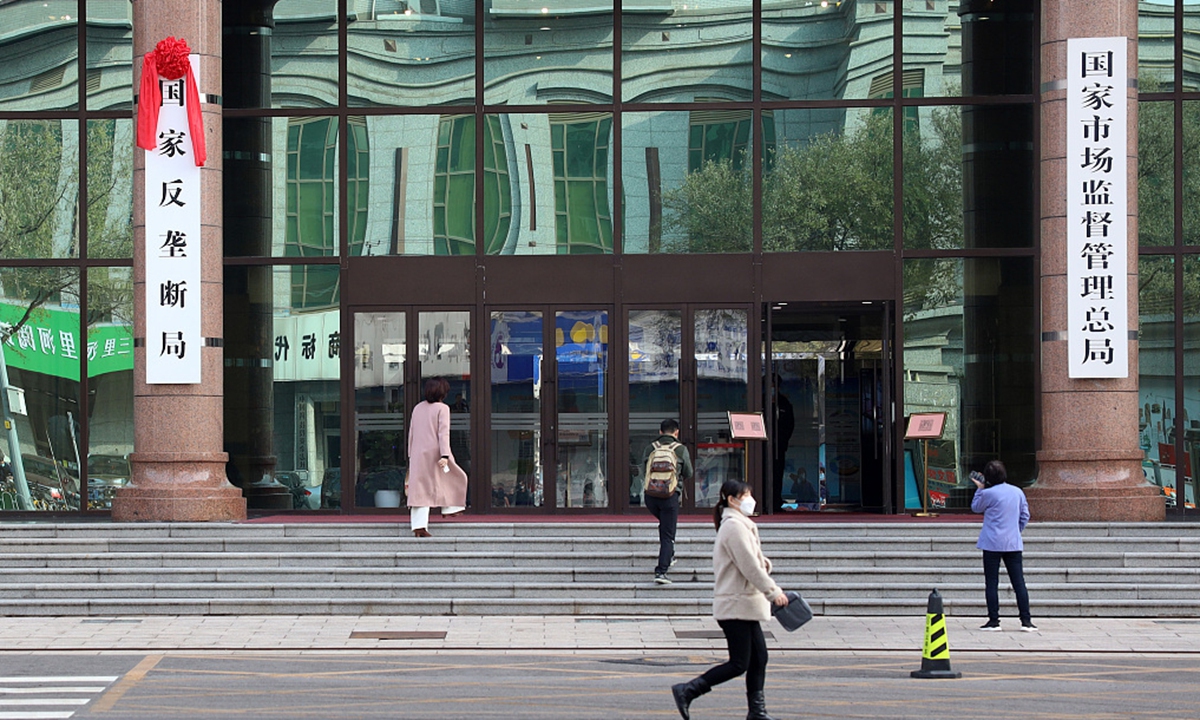
Photo shows the nameplate of National Anti-monopoly Bureau, which is in the same building of the State Administration for Market Regulation in Beijing. Photo: CFP
China's State Administration for Market Regulation (SAMR) has released its 2026 work plan for promoting the healthy growth of the private sector, a comprehensive set of 34 key initiatives that signals a strong regulatory push to optimize the business environment for the country's private enterprises, Chinese experts said.
The plan, published on the SAMR's official website on Sunday, prioritizes the removal of barriers that hinder the development of a unified national market. The regulator will strengthen antitrust compliance guidance and intensify efforts to combat "involution-style" cut-throat competition in an effort to ensure a fairer competitive environment for all businesses.
The release of this year's work guidelines aims to continuously optimize the business climate, safeguard the lawful rights and interests of private businesses, dismantle all types of market barriers, beef up anti-monopoly oversight and regulate market competition, so as to build a healthy and orderly competitive landscape, Cong Yi, a professor at the Tianjin University of Finance and Economics, told the Global Times on Sunday.
"It pinpoints core hurdles constraining the progress of the private sector. Excessive price competition may push some businesses to compromise quality; targeted regulatory moves are set to rectify such irregularities. These efforts will safeguard market order, protect consumer rights, and create a healthier ecosystem to fuel the steady and high-quality development of private businesses," Cong said.
Beyond the focus on fair competition, the 34-point plan also emphasizes smart governance and specific supportive measures to promote the high-quality development of private enterprises.
The SAMR will refine the legal framework for fair competition and oversight of enterprise-related fees, expand credit incentives and trade and technology-related supportive measures, and strengthen policy tools for individual businesses to ramp up the rule-of-law foundation for the private sector.
To improve regulatory efficiency, the SAMR will pilot non-site, contactless regulatory models and a "scan-code entry" system for enterprise inspections. These technology-enabled approaches aim to make law enforcement more impartial and transparent.
The plan also expands targeted assistance for individual businesses through more tailored, category-specific supportive measures, builds on its "credit + service" initiative, and strengthens quality infrastructure to support private-sector growth.
The move comes as China continues to double down on optimizing the business environment for private enterprises, a sector that has become a cornerstone of the country's economy.
Since the Private Sector Promotion Law came into effect in May 2025, relevant state departments have rolled out more than 150 supporting measures, and multiple provincial-level regions have introduced corresponding local rules, the Xinhua News Agency reported in March.
The SAMR's work plan sends a strong signal to stabilize market expectations, prioritize practical outcomes and strengthen the rule of law, marking a shift of policy focus from macro guidance to concrete implementation, Wang Peng, an associate research fellow at the Beijing Academy of Social Sciences, told the Global Times on Sunday.
"The clarified tasks will standardize supervision to boost business confidence," Wang said. "As a stabilizer and core growth engine of the economy, the private sector underpins fiscal revenue, economic output and job creation. Boasting outstanding flexibility and market insight, private businesses play an irreplaceable role in driving technological breakthroughs and boosting overall production efficiency during economic restructuring."
Data from the SAMR showed that China's private economy maintains solid growth momentum. A total of 1.979 million new private enterprises were set up across the country in the first quarter of 2026, rising 7.1 percent year-on-year and surpassing the average growth rate of the past three years.
China's private sector boasts strong momentum and great vitality. With a better business environment, targeted support and industrial guidance, plus favorable policies on equipment renewal, new infrastructure, digitalization and emerging areas, private firms will be well guided to advance the country's industrial upgrading, Cong added.
As of the end of March, registered private enterprises topped 57 million, accounting for 92.3 percent of all market entities. New quality productive forces stand out as a major growth driver. Enterprises engaged in new technologies, emerging industries and new business formats and models account for more than 40 percent of the newly founded private businesses, according to official data.
Private firms are also stepping up their development in high-end and innovative fields including artificial intelligence, advanced manufacturing, quantum information and humanoid robotics, according to the SAMR.
RELATED ARTICLES