China urges Australia to respect Chinese investors' legitimate rights following Northern Minerals divestment order
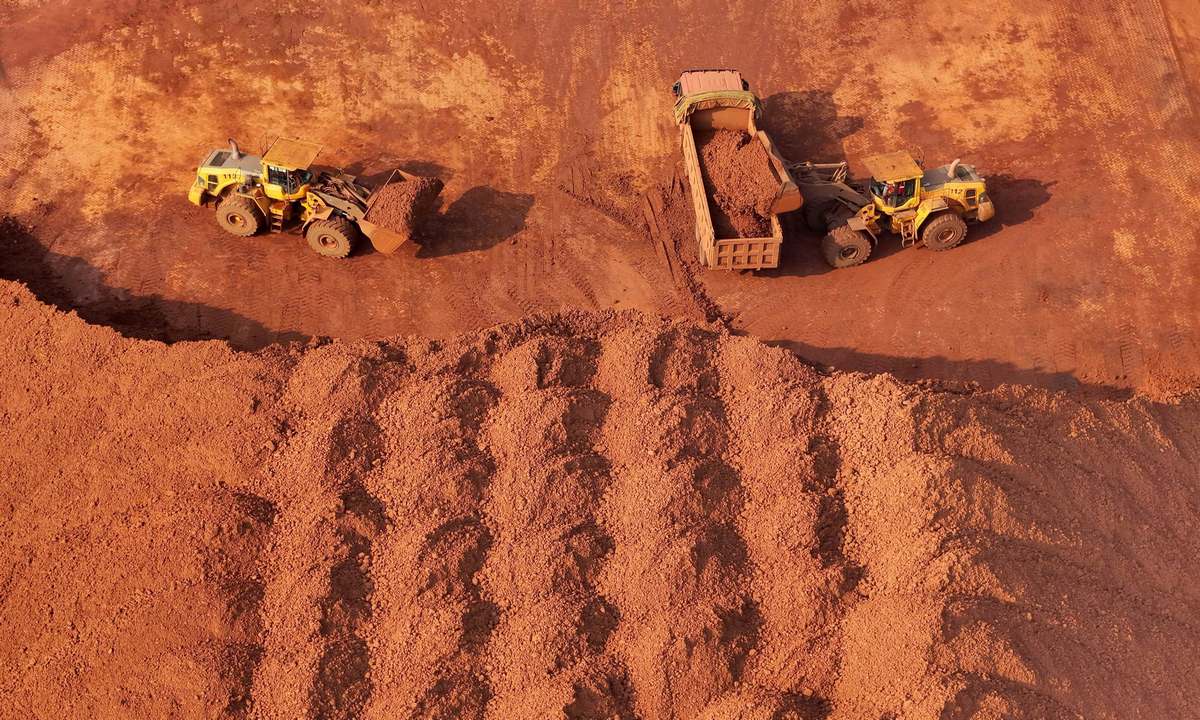
Rare earth resources Photo: VCG
China's Foreign Ministry said that China opposes the overgeneralization of national security and interference in normal investment, in response to questions related to Australia's order for China-linked investments to divest from a rare-earth miner in Australia.
Australia should earnestly respect the legitimate rights and interests of Chinese investors and provide a fair, transparent and non-discriminatory business environment for foreign investment, Chinese Foreign Ministry spokesperson Guo Jiakun said at a routine press conference on Monday.
The remarks came in response to a question about Australia's order for a group of China-linked shareholders to divest their holdings in Northern Minerals on the grounds of protecting its rare-earth industry.
Australian Treasurer Jim Chalmers has ordered China-linked shareholders to divest their holdings in Northern Minerals, citing so-called security concerns, the Australian Broadcasting Corp reported.
A spokesperson for Chalmers said that the decision was about protecting Australia's "national interest" and "ensuring compliance with its foreign investment framework," according to the report.
Northern Minerals said in a statement on its official website that it was aware of the Treasurer's orders and was considering its next steps. The company also announced that trading in its securities will be temporarily paused pending a further announcement.
The six investors -- Hong Kong Ying Tak Ltd, Real International Resources Ltd, Qogir Trading & Service Co Ltd, Chuanyou Cong, Vastness Investment Group Ltd and Zhongxiong Lin -- will have to sell their holdings within 14 days, according to the disposal orders attached to the statement.
Five of the shareholders are registered in Chinese mainland or the Hong Kong Special Administrative Region and one in the British Virgin Islands, according to the disposal orders.
Chinese experts denounced the move as a typical case of overreach of national security, which damages the investment environment of Australia and undermines global supply chain stability.
"This forced divestment represents a classic case of 'pan-securitization,' where strategically valuable business collaborations with Chinese links are being politicized, turning regulatory oversight into country-specific discrimination," Chen Hong, a professor and director of the Australian Studies Center at East China Normal University, told the Global Times on Monday.
The expert noted that the practice sends an extremely dangerous signal to international investors that Australia's investment rules are highly uncertain.
"A country that calls for foreign capital to participate in its commercial development yet arbitrarily forces investors to withdraw in the name of national interest is seriously damaging its own investment environment," Chen said.
Northern Minerals has been the subject of several Australian government interventions in recent years regarding its shareholder base, with the first in 2024 requiring five Chinese parties to dispose of their shares in the miner on "national interest" grounds, Reuters reported.
Some of those parties at the time sold to a related party, Hong Kong-based investor Ying Tak, Reuters reported. Treasurer Chalmers placed an interim order in April on Ying Tak, which restricted it from voting at Northern Minerals' annual meeting and selling its shares, according to the report.
From the industrial perspective, Australia's act of pushing critical mineral cooperation toward politics harms not only Chinese enterprises' legitimate interests but also its own industrial development opportunities, ultimately exacerbating the fragility of the global supply chain, Chen added.
"Western countries, including Australia, have tried to restrict Chinese investment in critical minerals for 'de-risking.' But rare-earth supply chains cannot be reshaped by political command. China's advantage comes from long-term industrial accumulation, not just resources. Excluding China raises costs, causes delays, and harms efficiency, undermining both Australian industry and global supply chain stability," Chen said.
Commenting on a question claiming that G7 finance ministers had reached an agreement in January calling for a reduction in dependence on China for rare earths, Mao Ning, spokesperson of China's Foreign Ministry, told a press conference at that time that China's position on maintaining the stability and security of global critical mineral supply chains remained unchanged. At the same time, we believe that all parties have a responsibility to do the same, Mao noted.
RELATED ARTICLES