What Jan-April economic data tells about ‘stability’ of China’s economy: Global Times editorial
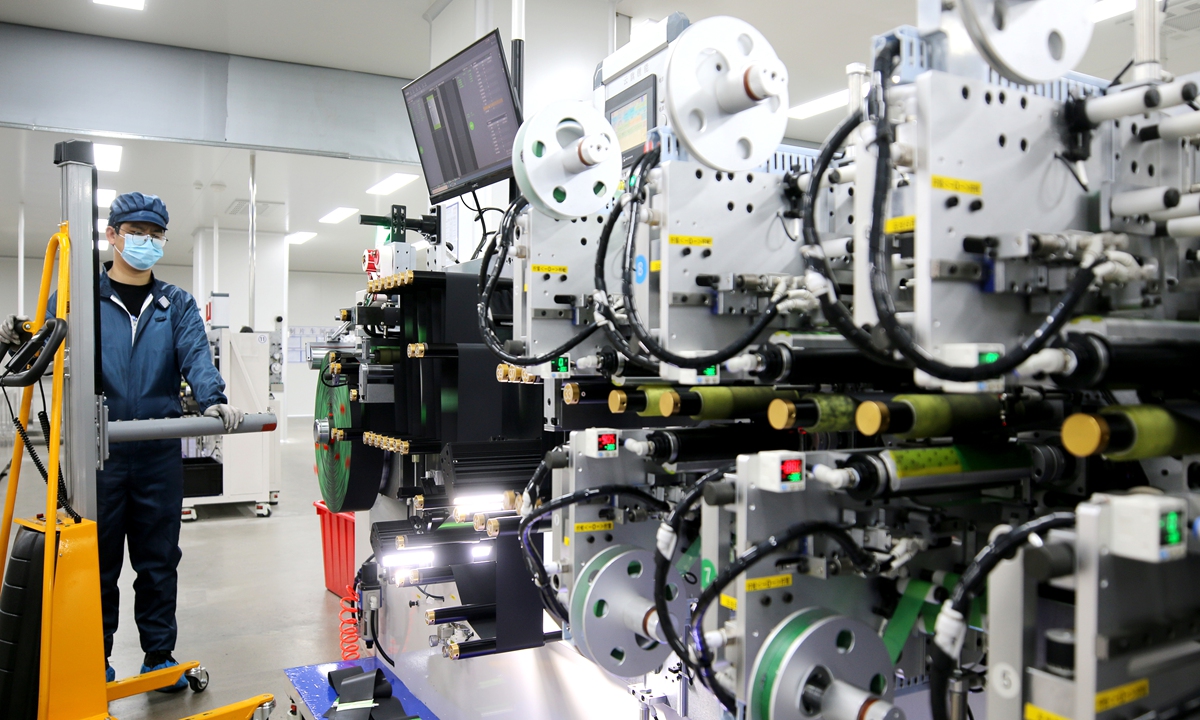
A worker conducts production and testing of lithium battery products at a lithium company in Ji'an, East China's Jiangxi Province, on March 1, 2026. The production lines are operating at full capacity to ensure supply, exemplifying the bustling manufacturing activity across the region. Photo: VCG
China's National Bureau of Statistics (NBS) released the economic data for the January-April period on Monday, showing that the Chinese economy has maintained development momentum of steady progress. Against the backdrop of sluggish global economic recovery, rising global trade protectionism and the spillover effects of geopolitical conflicts, the rebound in key indicators further demonstrates that the fundamentals of China's economy remain unchanged, the conditions supporting long-term growth remain intact and the underlying logic of high-quality development continues to hold firm.
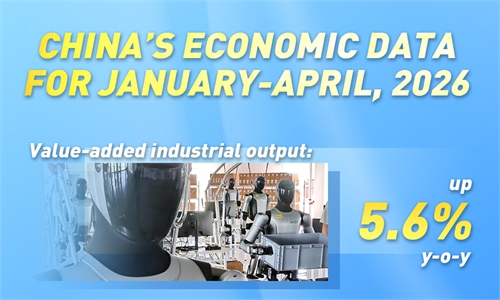
The more unstable and uncertain global supply chains become, the more they test a country's systemic manufacturing strengths. In the first four months, the total value added of industrial enterprises above the designated size grew by 5.6 percent year-on-year, while the value added of equipment manufacturing increased by 8.7 percent and that of high-tech manufacturing increased by 12.6 percent, 3.1 percentage points and 7.0 percentage points faster than that of the industrial enterprises above the designated size, respectively.
This shows that the strengths of Chinese manufacturing no longer lie merely in large scale, comprehensive industrial categories or low costs, but are increasingly reflected in higher technological sophistication, stronger positions within global industrial chains, and greater added value. An economy with a complete industrial system, strong supporting capabilities and sustained innovation vitality will not easily lose competitiveness because of changes in the external environment. Instead, the rougher the waters, the more China's manufacturing resilience, shock resistance and capacity for innovation stand out.
The stability of China's economy is also reflected in the growing resilience of its opening-up efforts. Many businesses and consumers around the world are currently facing rising costs and unstable supply chains, yet China's foreign trade has remained robust. From January to April, the total value of China's imports and exports of goods grew by 14.9 percent year-on-year, with exports up 11.3 percent and imports up 20.0 percent. In China's export structure, products with higher technological and industrial content, including electromechanical products, continue to account for a growing share. This indicates that China's foreign trade competitiveness is shifting from traditional cost advantages toward comprehensive strengths.
More importantly, China remains committed to expanding high-standard opening-up, continuously improving the business environment and advancing institutional opening-up, offering businesses worldwide a stable market, complete industrial support systems and sustained growth opportunities. On Monday, six Chinese government departments, including the Ministry of Commerce (MOFCOM), issued a notice to further optimize departure tax refund measures and expand inbound consumption, underscoring that China's door to the outside world is opening even wider.
Employment and prices are closely tied both to business operations and people's livelihoods, making them key indicators of whether a country's macroeconomy is functioning steadily. In the first four months, the urban surveyed unemployment rate averaged 5.3 percent. In April, the rate was 5.2 percent. The consumer price index (CPI) increased by 0.9 percent year-on-year during the same period, while April saw a 1.2 percent increase. China's super-large market is undergoing a transformation in consumption patterns - from quantitative expansion to qualitative upgrading, from goods consumption to service consumption and from traditional consumption to green, smart and digital consumption. As policies aimed at stabilizing employment, boosting consumption, and improving people's livelihoods continue to take effect, and as income expectations and market confidence gradually recover, the role of the Chinese market as an economic stabilizer will become even more prominent.
The confidence behind China's economic stability ultimately stems from the certainty of China's development path. Faced with a complex external environment, China has not pinned its hopes on short-term stimulus measures, nor has it been swayed by external noise. Instead, it has remained committed to high-quality development, coordinating the expansion of domestic demand and the deepening of supply-side structural reform, advancing the modernization of industrial systems through technological innovation, and promoting reform and development through opening-up. In recent years, whenever China's economy entered a stage of structural adjustment, pessimistic narratives inevitably emerged in international public discourse. Yet facts have repeatedly proven that China's economy possesses both the ability to solve problems and the resilience to press ahead under pressure.
Today, China's economy is still at a crucial stage of surmounting difficulties and obstacles and transforming toward higher-quality growth. At such a moment, it is all the more important to view the economic situation comprehensively, dialectically and from a long-term perspective. Pursuing progress while ensuring stability shows the overall trajectory has not changed, improving quality while making progress means the direction remains correct and pressing ahead under pressure shows resilience remains strong. The confidence underpinning China's economy comes from its complete industrial system, super-large market, sustained innovation capacity, high-level opening-up and the Chinese people's firm determination to pursue modernization. As long as China maintains strategic focus, strengthens development confidence and continues efforts to stabilize employment, enterprises, markets and expectations, the Chinese economy will continue to advance steadily along the path of high-quality development and provide much-needed stability and certainty for the global economy.
RELATED ARTICLES